Mon 18 Jun 2018, 08:41 GMT

Costa Cruises outlines fuel-related measures in Sustainability Report


Cruise operator describes the actions it has put in place to reduce fuel consumption and emissions.


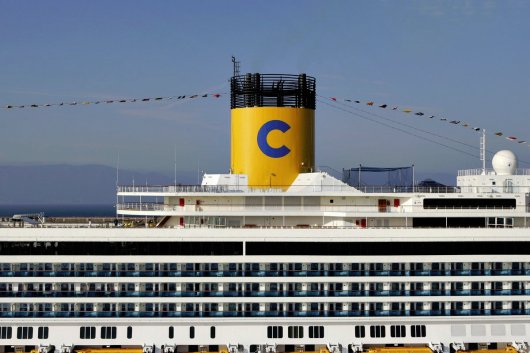
Image credit: Costa Cruises
Carnival Corporation brand Costa Cruises has outlined the measures it has put in place to reduce fuel consumption and emissions in the 2017 edition of its Sustainability Report.

As the world's biggest cruise ship operator, the group as a whole has set itself the target of reducing its carbon footprint by 25 percent by 2020.

And last year, Costa Cruises implemented several actions to improve the energy efficiency of its fleet.

There were 16 planned measures put in place to implement a number of projects designed to upgrade the existing fleet. The planned investments were mainly related to the upgrading of shipboard navigation systems and technological infrastructure directly linked to reduced fuel consumption and improved ship maintenance.

Each vessel in the fleet has a ship-specific Ship Energy Efficiency Management Plan (SEEMP). Efforts to reduce fuel consumption involve implementation of innovative technical solutions for ship efficiency performance management and concentrate mainly on the optimization of vessel speed and course adjustment.

Performance monitoring is carried out by means of a specific tool, Neptune Engine, enabling measurement and management of all critical ship data designed to ensure continuous improvement.

From next year, Neptune Engine will also be used to collect environmental data, with Costa Cruises expecting its shared database of critical parameters to help enhance collective skills and competencies across the board.

"Now, all of Costa's technical staff have knowledge - and are aware of the importance - of environmental issues; they share a joint vision and are able to take action more effectively thanks to this analytical IT tool, which helps them make more informed decisions," Costa Cruises says in the report.

The Costa Cruises vessel Costa Mediterranea was initially used as a test bed for Neptune Engine prior to being rolled out for the entire fleet.

Since 2012, the cruise vessel has been used to test a number of energy-saving measures ahead of their introduction fleetwide.

LNG

Construction of Costa Cruises's first LNG-powered vessel commenced in September at the Meyer shipyard in Turku, Finland.

The ship, which is to be named the Costa Smeralda, will have a gross tonnage (grt) in excess of 180,000 tonnes and is scheduled to enter into service in October 2019, operating in the Western Mediterranean.

LNG bunkering to the ship is to be provided by Shell Western LNG B.V. (Shell), as announced in 2016.

A second vessel, sister to Costa Smeralda, is slated for delivery in 2021.

The two new Costa Cruises ships will be powered by LNG both in port and on the open sea. LNG is to be stored in special tanks on board and used to generate 100 percent of the energy required for navigation and onboard services. Marine gas oil (MGO) tanks will also be installed.

The ships will run on dual-fuel Caterpillar power with enough LNG capacity for a trans-Atlantic crossing.

Scrubbers

Costa Cruises has also set aside investments to upgrade its existing fleet with exhaust gas cleaning systems, or scrubbers, in order to reduce engine exhaust emission levels and comply with existing Emission Control Area (ECA) and 2020 global sulphur cap regulations - whilst also enabling its ships to use cheaper heavy fuel oil (HFO).

The chosen scrubber technology has been developed by Ecospray - a company in which Costa has a controlling interest.

Costa Cruises notes that the retrofitting of existing vessels will result in a more than 90 percent reduction in emissions of nitrogen oxide (NOx), sulphur oxide (SOx) and particulate matters (PMs).


WinGD methanol and ethanol webinar invitation. WinGD to host webinar on methanol- and ethanol-flexible fuel engine technology  

Engine manufacturer will discuss market outlook, regulations and operational experience with alcohol-based marine fuels.

Peninsula graduate programme group photo. Peninsula opens applications for 2026 graduate programmes in marine fuels trading  

Two-year scheme offers positions across six global locations starting in September, combining hands-on experience with structured development.

Collin She, Oilmar DMCC. Oilmar DMCC promotes Collin She to key account manager role  

She will lead strategic customer relationships and drive growth opportunities in Singapore and the wider region.

Areion vessel. Dorian LPG takes delivery of dual-fuel VLGC capable of carrying ammonia  

The 93,000-cbm Areion can run on LPG or fuel oil and transport ammonia cargoes.

FSRU Toscana alongside Green Zeebrugge vessel. RINA awards ISCC EU certification to OLT Offshore LNG Toscana for bio-LNG supply  

Certification enables bio-LNG use in the EU as a renewable fuel under RED II and RED III directives.

World Shipping Council at IMO meeting. WSC calls for safe maritime corridor as 20,000 seafarers remain trapped in the Persian Gulf  

Industry body urges IMO member states to establish safe passage and supply access.

Graphic promoting Auramarine webinar titled 'Sustainable Fueling Part 3: Ammonia - next alternative fuel in marine'. Auramarine to host webinar on ammonia as marine fuel in April  

Finnish firm will explore ammonia’s role in maritime decarbonisation at its third spring webinar.

Front cover of study by WinGD and Envision Energy titled 'Renewable Fuel Economics: An OPEX illustration based on current costs'. Green ammonia could reach cost parity with VLSFO and LNG by 2050, study finds  

WinGD and Envision Energy study projects green ammonia operational costs competitive with conventional marine fuels.

Elenger Marine's LNG bunkering vessel Optimus alongside Brittany Ferries’ Saint-Malo. Bureau Veritas verifies methane emissions on Brittany Ferries’ LNG vessels  

Verification enables ferry operator to report measured methane slip instead of regulatory default values.

Map showing existing and planned Emission Control Areas (ECAs). Alliance calls for urgent black carbon action as new Arctic emission control areas take effect  

Canadian Arctic and Norwegian Sea ECAs now in force, with compliance deadline set for March 2027.