Last month marked one-year since
Waterfront Shipping (Waterfront) welcomed the first of seven ocean-going tankers capable of running on methanol into its fleet.
The first three vessels were delivered in April 2016 and the remaining four later that year.
Over the past year, the seven 50,000-deadweight-tonne (dwt) methanol tankers - powered by two-stroke, dual-fuel engines capable of running on methanol, fuel oil, marine diesel oil or gas oil - have been operating across the globe.
Last month,
Marinvest celebrated two of its vessels together attaining over 3,000 hours running on methanol, and the shipping company estimates that the use of methanol rather than conventional marine fuel has prevented more than 80,000 kilograms of sulphur oxide emissions.
"It has been exciting working with our shipping partners over the last few years to advance this new, clean technology," said
Jone Hognestad, former President of Waterfront Shipping, who retired in March 2017.
"Investing in methanol-based marine fuel is an important step in the right direction and reinforces our commitment to sustainable proven technology that provides environmental benefits and meets emission regulations."
"In 2012, we were looking to renew part of our fleet as time charter vessel contracts naturally expired and to add new vessels to the fleet to meet increased product transportation needs. As an innovative and leading global marine transportation company and a wholly owned subsidiary of Methanex Corporation, the world's largest producer and supplier of methanol, it was only natural that we investigated methanol as a future fuel for our vessels," added Hognestad.
Waterfront invited three shipping companies -
Marinvest/Skagerack Invest (Marinvest),
Mitsui O.S.K. Lines, Ltd. (MOL), and
Westfal-Larsen Management (WL) - to work on the project, and in December 2013 announced plans to commission these dual-fuel vessels. Shipping partners, engine manufacturer, MAN Diesel and Turbo SE, and the two shipyards building the vessels, Hyundai Mipo Dockyard in Korea and Minaminippon in Japan collaborated to bring the project to fruition.
"As we were evaluating our investment in this technology and having the Leikanger and Lindanger built with an engine that can run on a fuel such as methanol, it was important that we assessed its adaptability and use. Now with our vessels in operation and in the waters, we have found methanol to be one of the best alternative fuels due to its wide availability, the use of existing infrastructure, and the simplicity of the engine design and ship technology. Methanol shares similar characteristics with other marine fuels with respect to storage and handling and can even be bunkered by trucks if required. Using methanol as a marine fuel is a feasible and practical solution that supports the shipping industry and regulatory requirements. With the recent announcement by IMO for a global 0.5% sulfur cap for vessels worldwide effective 2020, methanol will soon be one of the very few fuel alternatives to MGO that can be utilized by existing modern vessels after relatively minor and cost effective retro-fit modifications compared to, for instance, LNG," said
Rolf Westfal-Larsen Jr., CEO Westfal-Larsen Management.
"We are proud to invest and have two of our JV vessels, Mari Jone and Mari Boyle, built with the first-of-its kind MAN B&W ME-LGI two-stroke dual-fuel engine. Our overall focus in the development of the dual-fuel system concept has been safety and engine reliability. We have found the technology for handling methanol is well developed and offers a safe dual-fuel solution for low-flashpoint liquid fuels. Safety measures include all methanol fuel equipment and distribution systems double-walled and ventilated with dry air, ensuring there is no direct contact with methanol and safe for operators and engineers. Any operational switch between methanol and other fuels is seamless and records a slightly better efficiency compared to conventional HFO-burning engines. Our vessels have regularly been running on methanol and we foresee this continuing going forward," commented
Patrik Mossberg, chairman, Marinvest/Skagerack Invest.
"Tests in blending water with methanol also show promising results in terms of meeting the International Maritime Organization's NOx Tier III requirements. Such a new Tier III solution could become a game changer. Further tests are scheduled in the near future to conclude if this could be a new way forward," commented
Rene Sejer Laursen, Sales & Promotion Manager, MAN Diesel & Turbo.
Timeline
April 2016:
Waterfront Shipping, Marinvest, MOL and WL announce the industry welcoming the world's first ocean-going vessels capable of running on methanol.
Delivery of the first three Korean and Japanese built methanol-fuelled ocean tankers, Lindanger, Mari Jone and Taranaki Sun.
June 2016: WFS and WL welcome shipping vessel, Leikanger.
August 2016: WFS and Marinvest welcome shipping vessel, Mari Boyle.
September 2016: WFS and MOL welcome shipping vessel, Manchac Sun.
November 2016: WFS and MOL welcome shipping vessel, Cajun Sun.
April 2017: Marinvest celebrates two of its vessels together attaining over 3,000 hours running on methanol.
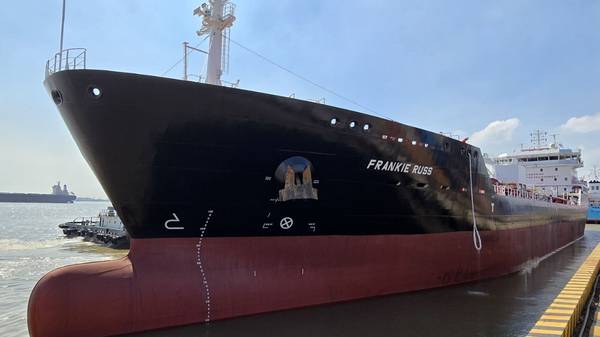
Image: The Mari Jone is one of seven methanol-powered ships chartered by Waterfront in 2016.