The
European Maritime Safety Agency (EMSA) has published a report which examines both methanol and ethanol as alternative fuels for bunkering.
Entitled "
Study on the use of ethyl and methyl alcohol as alternative fuels in shipping', the EMSA says it commissioned the 183-page study - carried out by authors Joanne Ellis (SSPA Sweden AB) and Kim Tanneberger (Lloyd's Register) - in order to gain more information about the benefits and challenges associated with both fuels and to evaluate their potential for the maritime industry.
Availability
On the issue of availability, the study points out that methanol is widely available as it is used extensively in the chemical industry. There are large bulk storage terminals in both Rotterdam and Antwerp, and it is transported both with short sea shipping and by inland waterways to customers. Ethanol is the most widely used biofuel in land-based transportation and can be found at most large chemical storage hubs in Europe.
Environment
Both fuels, are described as being 'good potential alternatives' for reducing both the emissions and carbon footprint of ship operations. As they are sulphur-free, the use of methanol and ethanol fuels would ensure compliance with the European Commission Sulphur Directive. They can also be produced from renewable feedstocks.
"Emissions of both methanol and ethanol from combustion in diesel engines are low compared to conventional fuel oils with no aftertreatment. Particulate emissions are very low, and nitrogen oxide emissions are also lower than with conventional fuels, although the amounts depend on the combustion concept and temperature. If a pilot fuel ignition concept is used with methanol and ethanol there will be a very small amount of sulphur oxide emissions which will depend on the amount and sulphur content of the pilot fuel," the study says.
Regarding the behaviour of methanol and ethanol fuels when spilled into the sea, both methanol and ethanol dissolve readily in water, are biodegradable, and do not bioaccumulate. They are not rated as toxic to aquatic organisms.
Economics
On the issue of pricing, the report says: "Methanol prices were below the price of low sulphur marine gas oil (MGO) on an energy basis for two years from 2011 to 2013, making it an attractive sulphur compliance option. With the low oil prices in 2014 and early 2015, methanol was comparatively more expensive but in late 2015 the price of methanol has started to move closer to the levels of MGO again. Cheap natural gas, a primary feedstock for producing methanol, contributes to lower production costs and thus methanol may be economically attractive again compared to conventional fuel alternatives. Ethanol prices have been higher than MGO traditionally, similar to other types of biofuels. Fuels from non-fossil feedstock, including bio-methanol, tend to have a higher price than fossil fuels."
Regarding investment and operating costs, the study states: "Investment costs for both methanol and ethanol retrofit and new build solutions are estimated to be in the same range as costs for installing exhaust gas after treatment (scrubber and SCR) for use with heavy fuel oil, and below the costs of investments for LNG solutions.
"Operating costs are primarily fuel costs. The payback time analysis carried out for this study indicate that methanol is competitive with other fuels and emissions compliance strategies, but this depends on the fuel price differentials. Based on historic price differentials, methanol will have shorter payback times than both LNG and ethanol solutions for meeting sulphur emission control area requirements. With the current low oil prices at the end of 2015, the conventional
fuel oil alternatives have shorter payback times."
Bunkering and storage
If ship-to-ship bunkering is carried out, the report says that it is likely existing small product tanker bunkering vessels would be suitable. Most bunkering vessels are classified as product tankers and could be used for carrying methanol and ethanol. The conversion cost of a bunker barge for methanol is estimated at EUR 1.5 million.
Land storage tank-to-ship bunkering is similar to loading of product tankers that transport methanol. This is done on a routine basis and there are procedures and guidelines for guidance.
According to the study, the cost of constructing a 20,000-cubic-metre methanol storage tank, including installations for loading the methanol from a product tanker vessel to the storage tank, and for transferring methanol from the storage tank to a bunker vessel, is estimated at approximately EUR 5 million. Construction of an LNG terminal was said to be 10 times more expensive than an equivalent methanol terminal.
Methanol deliveries so far
According to the report, the
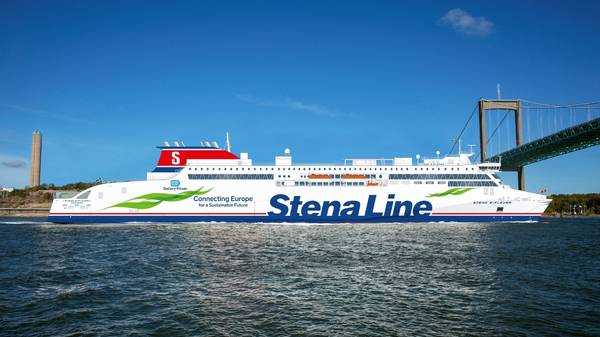
Stena Germanica [pictured] bunkering in Gothenburg is the only example of methanol bunkering to a ship being carried out presently, which is performed at quayside using a specially built pump station. The cost of this small unit was estimated to be EUR 400,000. No storage for methanol was constructed for this project.
Road tanker trucks provide methanol which is pumped on board using the pumps on the quay. A Manntek 'drip-free' coupling is used for the connection to the ship. A bunkering checklist was developed for the bunkering operation.
Previous research projects SPIRETH and METHAPU also used road tanker trucks for bunkering. These projects required smaller volumes of methanol and thus no land-side pumping installation was provided. For SPIRETH, the methanol tanker truck's own pump was used.
To read the full report, please click on the link below:
EMSA: Study on the use of ethyl and methyl alcohol as alternative fuels in shipping
Image: Stena Germanica