This is a legacy page. Please click here to view the latest version.
Tue 11 Jan 2022, 11:03 GMT

Australia's largest co-operative in biofuel trial


BP blend expected to reduce emissions by 15 percent.


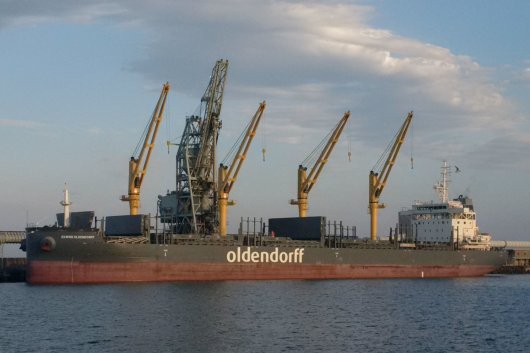
The 2016-built dry bulk carrier Edwine Oldendorff.
Image: Oldendorff Carriers
A trial voyage using biofuel for CBH Group, Australia's largest co-operative and one of the country's biggest agribusinesses, is being performed on the Edwine Oldendorff from Australia to Vietnam.

An advanced biofuel blend delivered by BP was used to refuel the cargo ship that is expected to result in a 15 percent reduction in emissions compared to conventional fossil fuels, according to the supplier.

The vessel last week loaded 30,000 tonnes of sustainably certified malting barley from the Albany Grain Terminal — one of CBH's four export terminals — for discharge in Vietnam.

The cereal grain is being delivered to Vietnam's leading malting company, Intermalt. The firm's malting plant in Cai Mep, Vietnam — opened in 2017 — is the biggest in South East Asia and services a number of brewing customers — the largest being Heineken, which has set itself the target of attaining a carbon-neutral value chain by 2040.

The aim of this trial of a second-generation biofuel is to test the supply chain and provide CBH and Oldendorff Carriers with greater experience regarding the practical issues involved in powering vessels with renewable energy blends.

Furthermore, the emission reduction potential of the fuel has been analyzed as part of Oldendorff Carriers' research agreement with MIT in Cambridge, Massachusetts.

Jason Craig, Chief Marketing and Trading Officer of CBH, commented: "Customers across the world are increasingly seeking to source sustainable products, including sustainable grain. It is our role, as Australia's leading grain exporter, to take the necessary steps to lower carbon emissions along our supply chain. Biofuel is one low-carbon option that could be part of the solution to reducing emissions in the shipping industry.

"We need to meet the growing market demand for sustainable or carbon-reduced grain by being proactive, practical and adapting. By doing this, we are making sure we can continue to keep our Western Australian growers competitive."

Ben Harper, Managing Director at Oldendorff Carriers, Melbourne, remarked: "We are very pleased to be collaborating with industry leaders CBH to trial biofuel in our vessel Edwine Oldendorff. Collaboration is crucial for us all to learn and share information about the best paths in our efforts to decarbonize the supply chain."

Last year, Oldendorff, together with BHP, GoodFuels and the Maritime and Port Authority of Singapore (MPA), conducted the first marine biofuel trial involving an ocean-going vessel bunkered in Singapore. The 2020-built, 81,290-deadweight-tonne (dwt) dry bulk carrier Kira Oldendorff was bunkered with 'drop-in' advanced biofuel blended with conventional fossil fuels.

Shipowner and operator Oldendorff, which usually has around 750 bulk carriers under operation at any one time, aims to become emissions-free by 2050. The company has been able to lower its carbon footprint by swapping 90 percent of its fleet capacity into a new generation of 'eco' ships, whilst its Greenship Project targets the reduction of CO2 emissions via the use of fuel-saving devices, performance monitoring, low-friction paint and trim optimization.

According to vessel-tracking data, the Edwine Oldendorff departed from Albany, Western Australia, on January 9 and is set to arrive in Cai Mep, Vietnam, on January 20.


VPS: From Regulation to Reality. From Regulation to Reality: Fuel Assessment Update of the Mediterranean Emission Control Area | Steve Bee  


<i>CMA CGM Krypton</i> naming ceremony. CMA CGM names 13,000-teu methanol-fuelled containership in South Korea  

Dual-fuel vessel will operate on Asia-Mediterranean-Middle East service connecting three regions.

Charlotte Nonnemann, ABB. Shipping industry pivots to fuel efficiency amid regulatory uncertainty on decarbonisation  

ABB says pragmatism prevails as shipowners focus on adaptable technologies following IMO net-zero framework delay.

<i>Laura Mærsk</i> vessel. Maersk to trial 50% ethanol blend on dual-fuel methanol vessel  

Shipping line plans higher-ethanol-content tests following initial 10% blend trial on Laura Maersk.

Solomon Islands National Action Plan launch. Solomon Islands unveils plan to reduce reliance on fossil fuels  

Maritime authority develops roadmap with IMO support to modernise vessels and port infrastructure.

<i>SG Lagoon</i> vessel. Japanese shipbuilder delivers LNG-fuelled Capesize bulk carrier  

Imabari Shipbuilding completes 209,000-dwt vessel with dual-fuel capability and enhanced environmental performance.

Aurelia NGX 40 launching graphic. Lubmarine launches dual-fuel engine oil for gas operations  

TotalEnergies unit claims product enables extended service life and reduced maintenance costs.

Side view of a cargo vessel. DNV clarifies FuelEU Maritime flexibility mechanisms ahead of first reporting deadline  

Classification society explains banking, borrowing, and pooling options for vessel compliance balances.

Kinetics and Amogy partnership agreement. Kinetics invests in Amogy to deploy ammonia power for floating infrastructure  

London-based Kinetics backs ammonia-to-power firm to develop zero-emission solutions for Powerships and data centres.

Maria Skipper Schwenn, Danish Chamber of Commerce. Maria Skipper Schwenn steps down from IBIA board  

Danish Chamber of Commerce role prompts departure after eight months on association's global board.


↑  Back to Top