This is a legacy page. Please click here to view the latest version.
Fri 17 Dec 2021, 16:43 GMT

BP and Maersk Tankers complete B30 biofuel trials


Ships sailing from Rotterdam to West Africa receive blend of VLSFO and 30% FAME.


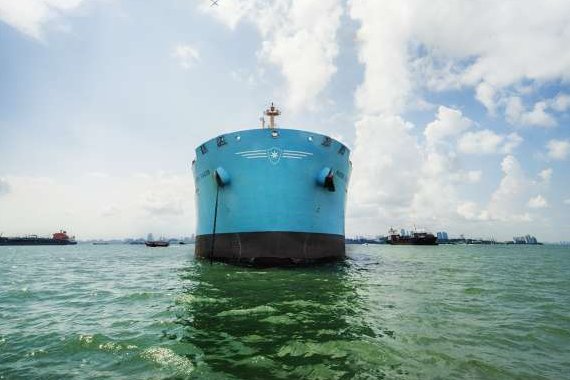
Image credit: Maersk Tankers
BP and Maersk Tankers, with support from the Danish Maritime Authority, report that they have successfully completed trials using biofuel-blended bunkers as a drop-in fuel for product tankers.

The trials were completed aboard the Maersk Cirrus and Maersk Navigator — product tankers on time-charter to BP from Maersk Tankers, with each vessel supplied with BP Marine B30 biofuel, consisting of 30 percent fatty acid methyl esters (FAME) blended with very-low-sulphur fuel oil (VLSFO).

FAME is a renewable alternative fuel largely produced from recycled cooking oils and renewable oil sources. It has physical properties similar to conventional diesel, and is also non-toxic and biodegradable. The origination and production of the feedstocks used to produce FAME is certified for its sustainability to internationally recognized standards.

The trials saw the vessels sail from Rotterdam to West Africa. Throughout the trials, tests were carried out to assess the reliability and performance of the B30 biofuel blend in each ship's main engine, auxiliary engine and boiler, and any impact on fuel tanks to determine the level of interchangeability with other fuel types.

No adverse effects to equipment or machinery were observed during or after the trials, the trial participants note. Also, no modifications to the engine or infrastructure are said to have been required, thus demonstrating the suitability of sustainable biofuels for use as a drop-in fuel.

Carol Howle, BP's executive vice president of trading and shipping, commented: "At any one time, BP has around 300 ships on the water moving our products around the world. With an ambition to be a net zero company by 2050 and help the world get there too, it's vital we help decarbonize this hard-to-abate sector. We're proud to be working with a partner like Maersk Tankers, to develop new alternative fuels and low-carbon solutions that will help accelerate the shipping industry's energy transition."

Christian M. Ingerslev, Maersk Tankers' Chief Executive Officer, said: "The need to cut emissions is one of the most important challenges facing shipping right now. We are only able to rise to this challenge if we do it in partnerships and explore a multitude of solutions. With BP, we are combining our expertise to play our part in testing and making alternative fuels available."

WinGD LNG dual-fuel engine with personnel wearing safety helmets. WinGD promotes variable compression ratio retrofits for existing LNG dual-fuel engines  

Engine designer claims technology can reduce emissions and methane slip ahead of 2030 targets.

IBIA Board Elections 2026 Nominees announcement. IBIA announces 11 nominees for four board vacancies in 2026 election  

Voting opens 5 January with results to be announced at AGM on 9 February.

Bureau Veritas and C-Torq Marine Services sign MoU. Bureau Veritas and C-Torq Marine Services sign MoU for hydrogen energy system development  

Partnership aims to secure approval in principle for W-VOLT120 hydrogen-based maritime power system.

Global Ethanol Association (GEA) and SQ Group logo side by side. Jinan Shengquan Group joins Global Ethanol Association as founding member  

Chinese bio-based materials group joins new industry body promoting ethanol for energy security and emissions reduction.

ONE Satisfaction vessel. Ocean Network Express names sixth methanol and ammonia-ready container ship  

ONE Satisfaction is a 13,800-teu vessel scheduled for delivery in February 2026.

MOL, Sinopec and Marubeni sign MoU. MOL, Sinopec and Marubeni sign MoU to establish marine biodiesel supply system in China  

Partnership aims to secure stable biodiesel supply for shipping decarbonisation in Chinese waters.

Castrol Logo. BP to sell 65% stake in Castrol to Stonepeak for $10bn enterprise value  

Deal brings BP's divestment programme to $11bn, with proceeds earmarked for debt reduction.

Clippership 24-metre class autonomous wind-powered vessel. RINA approves design for Clippership's 24-metre autonomous wind-powered cargo vessel  

Classification society to supervise construction of zero-emission ship featuring twin rigid wings for transatlantic operations.

CMA CGM Antigone vessel. Bureau Veritas classes first methanol dual-fuel boxship as CMA CGM takes delivery  

The 15,000-teu CMA CGM Antigone was built by CSSC Jiangnan Shipyard in China.

AiP award ceremony for floating nuclear plant design. Samsung Heavy Industries' floating nuclear plant design wins ABS approval  

Concept features twin KAERI small modular reactors and a compartmentalised layout to support offshore nuclear power generation.


↑  Back to Top