This is a legacy page. Please click here to view the latest version.
Fri 23 Mar 2018, 17:07 GMT

Fuel-saving ferry, LNG-powered ships were 'main milestones' of 2017: Balearia


Operator lauds bunker-related projects as EBITDA and turnover grow.


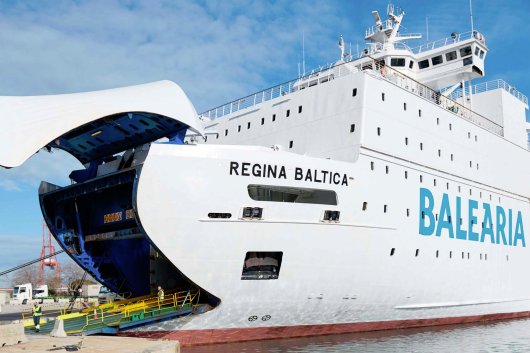
The Regina Baltica, operated by Balearia.
Image credit: Balearia
Spanish ferry operator Balearia says its commitment to LNG and the addition of the first of four bunker-saving 'eco fast ferries' to its fleet were two of the firm's "main milestones" of 2017.

Balearia noted that it invested EUR 125 million in acquisitions, new vessel construction and repowering last year as the company continued to focus on improving the fuel efficiency of its fleet and in the development of LNG-powered ferries.

In 2017, the first in a series of four eco fast ships, the Eco Aqua, started operating between the islands of Ibiza and Formentera. The other three vessels, Eco Terra, Eco Aire and Eco Lux are yet to be completed.

The fuel-saving ships are powered by state-of-the-art engines designed to minimize emissions and feature a wave-piercing bow and photovoltaic solar panels, supplying energy on board.

In terms of LNG developments last year, in February, Balearia ordered two new, dual-fuel, gas-powered ferries to be built at the Cantiere Navale Visentini shipyard in Italy. The vessels are expected to be operational by the end of 2018.

In January 2017, meanwhile, the company's 2010-built Abel Matutes was refuelled with LNG in Barcelona for the first time after being retrofitted with a 30-cubic-metre LNG storage tank and an auxiliary natural gas engine built by Rolls-Royce.

Balearia's fourth LNG-fuelled ferry, which was ordered in 2016 from Construcciones Navales del Norte SL (LaNaval) shipyard in Sestao, Spain, is scheduled to enter into regular service in 2019.

The ferry operator also noted in its analysis of 2017 that its commitment to expanding its geographical coverage and services resulted in its fleet sailing 15 percent more miles last year, but despite this, the eco-efficiency ratio for Balearia's next-generation ferries (which relates CO2 emissions with the passengers and cargo carried and the miles sailed) "only increased by 3.1 percent".

In its key financial figures for 2017, Balearia's earnings before interest, taxes, depreciation, and amortization (EBITDA) rose by 3 percent to EUR 81.5m, whilst turnover grew 10 percent to EUR 362.6m.


VPS: 2025 Marine Fuel Review. 2025 Marine Fuel Review | Steve Bee, VPS  

VPS Group Marketing & Strategic Projects Director analyses fuel quality data from the past year.

New Sea Generation (NSG) logo. New Sea Generation processing applicants for Greece bunker trader role  

Bunker firm offering a performance-based equity stake to experienced traders with active client portfolios.

Port of Barcelona. Spanish ports see fourfold increase in LNG bunkering volumes over two years  

Renewable bioLNG accounted for 12% of marine fuel supplied in 2025, Gasnam data shows.

ICS Deck Procedures Guide cover. ICS releases deck procedures guide covering alternative fuel bunkering  

Publication completes trilogy of operational guides alongside bridge and engine room resources.

Torbjörn Bäck, Echandia. Echandia to supply 3 MWh battery system for Singapore harbour tugboat  

Swedish firm wins contract as part of Singapore's plan to electrify harbour craft by 2030.

Golden Antares and Brave Pioneer methanol bunkering. Singapore completes first methanol bunkering operation following licence awards  

Golden Island delivers 300 tonnes of methanol to dual-fuel vessel in port’s inaugural operation.

MT SPA vessel. Union Maritime takes delivery of world’s first LNG- and wind-powered LR2 tanker  

MT SPA features dual-fuel capability and WindWings technology, with second sister vessel on order.

Petrobras and Transpetro signing ceremony. Petrobras and Transpetro order 41 vessels worth $470m for fleet renewal  

Brazilian state oil companies contract gas carriers, barges and pushboats from domestic shipyards.

European Commission headquarters. EU proposes phase-out of high-risk biofuels from renewable energy targets by 2030  

Draft regulation sets linear reduction trajectory starting in 2024, with contribution reaching zero by end of decade.

Vessel with H2SITE ammonia cracking system. H2SITE launches Norwegian subsidiary to advance ammonia-to-power technology for maritime sector  

Spanish technology firm establishes Bergen hub to accelerate deployment of ammonia cracking systems for shipping.


↑  Back to Top