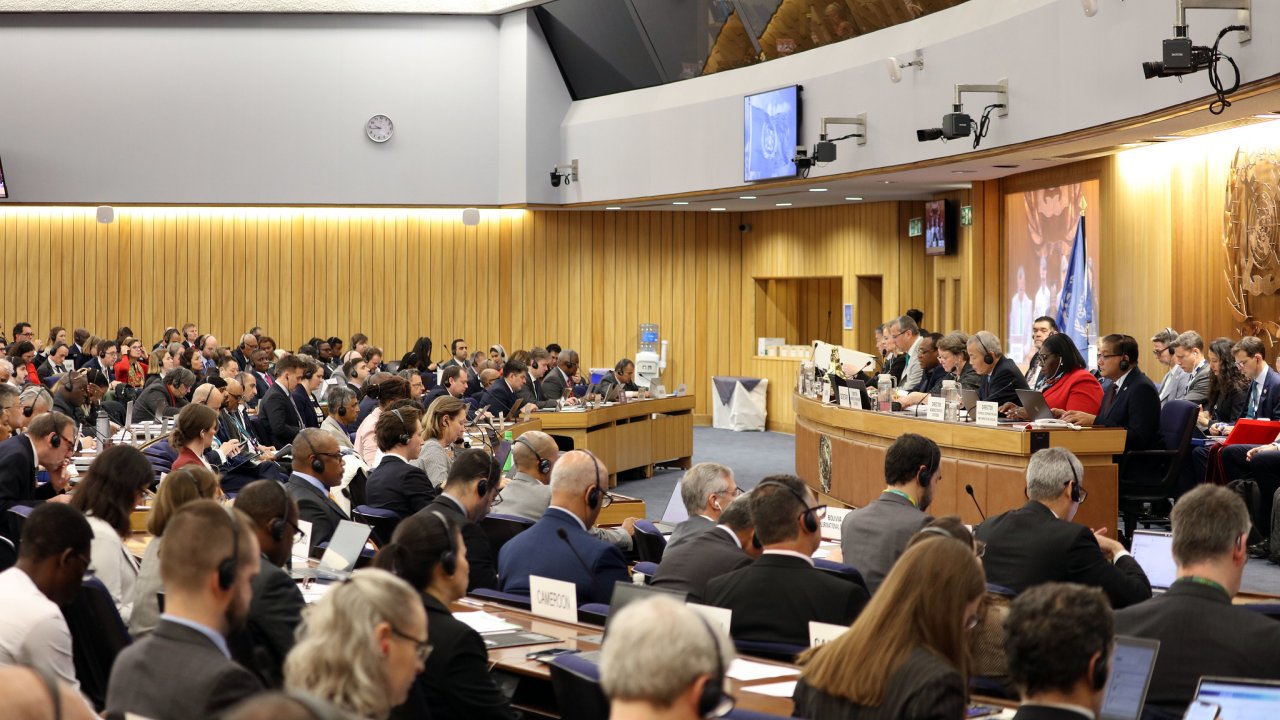
The International Maritime Organization (IMO) formally approved a proposal for a new global pricing mechanism for ships based on greenhouse gas fuel intensity (GFI) thresholds at the 83rd session of the Marine Environment Protection Committee (MEPC), held on April 7-11.
Named the IMO Net-zero Framework, it is the first in the world to combine mandatory emissions limits and greenhouse gas (GHG) pricing across an entire industry sector.
If formally adopted at an extraordinary MEPC session in October 2025, the measures could enter into force in 2027, 16 months after adoption (in line with MARPOL articles).
Requirement to reduce greenhouse gas fuel intensity (GFI)
Under the draft regulations, ships over 5,000 gt will be required to reduce, over time, their annual greenhouse gas fuel intensity (GFI), measured as the amount of well-to-wake GHG emissions produced per unit of energy consumed, expressed in grams of CO₂ equivalent per megajoule (gCO₂e/MJ) of fuel energy.
| GHG Fuel Intensity (gCO₂e/MJ) = |
|
This metric, which also includes wind propulsion, solar power and electricity delivered to the ship, reflects how efficiently a vessel uses its energy relative to the emissions it produces.
Two tiers of GFI reduction requirements
There will be two tiers of GFI reduction requirements that ships will be required to meet each year: a minimum 'Base Target' and a stricter 'Direct Compliance Target'. These yearly reduction targets are against the 93.3 gCO₂e/MJ baseline GFI figure established by the IMO, which represents the global fleet-average GFI in the baseline year, 2008.
| IMO GFI reduction targets (%) | ||
|---|---|---|
| Year | Base (%) | Direct Compliance (%) |
| 2028 | 4 | 17 |
| 2029 | 6 | 19 |
| 2030 | 8 | 21 |
| 2031 | 12.4 | 25.4 |
| 2032 | 16.8 | 29.8 |
| 2033 | 21.2 | 34.2 |
| 2034 | 25.6 | 38.6 |
| 2035 | 30 | 43 |
| 2040 | 65 | |
| IMO GFI targets (gCO₂e/MJ) — from 93.3 gCO₂e/MJ baseline | ||
|---|---|---|
| Year | Base | Direct Compliance |
| 2028 | 89.57 | 77.44 |
| 2029 | 87.70 | 75.57 |
| 2030 | 85.84 | 73.71 |
| 2031 | 81.73 | 69.60 |
| 2032 | 77.63 | 65.50 |
| 2033 | 73.52 | 61.39 |
| 2034 | 69.42 | 57.29 |
| 2035 | 65.31 | 53.18 |
| 2040 | 32.66 | |
If the Base or Direct Compliance targets are not met in a given year, then ships will be required to pay Remedial Unit (RU) charges, expressed in US$ per tonne of CO₂ equivalent emissions (CO₂e).
The SUs received by a ship, which are valid for two years, can be transferred to other vessels with a compliance deficit or used for subsequent reporting periods.
It seems likely, as with other carbon pricing systems with tiered penalties, that Tier 1 SUs will be able to be used to cover both Tier 1 and Tier 2 compliance deficits, whilst Tier 2 SUs will be restricted to Tier 2 compliance deficits only.
ZNZ fuels, proceeds and five-year review
To qualify as a ship using zero or near-zero (ZNZ) emission fuels and receive a subsidy or reward, the threshold has been set at 19 gCO₂e/MJ until 2034 and 14 gCO₂e/MJ from 2035. The full mechanism is yet to be developed.
Proceeds collected from RU charges are to be placed into the IMO Net-Zero Fund, which IMO says will be used to reward emissions reduction; support innovation, research and infrastructure; fund training, technology transfer and capacity building; and mitigate negative impacts on vulnerable states, amongst other initiatives.
The IMO Net-Zero Framework will be included in a new Chapter 5 of MARPOL Annex VI, Prevention of Air Pollution from Ships. It is to be reviewed every five years — where possible adjustments to the GFI thresholds will be examined as well as the potential inclusion of vessels below 5,000 gt.
|
Pinnacle Marine launches second B100-compatible harbour craft for Les Star
Sea Horizon joins Singapore’s harbour craft fleet. |
|
|
|
||
|
Sallaum Lines orders LNG-fuelled, ammonia-ready PCTCs from Chinese yards
Operator signs shipbuilding agreements for new generation of 8,600-CEU vessels, taking its newbuild investment past $1bn. |
|
|
|
||
|
Nakilat takes delivery of dual-fuel carrier in South Korea
Ammonia-ready design positions vessel to play key role in future low-carbon energy supply chains, says Qatari firm. |
|
|
|
||
|
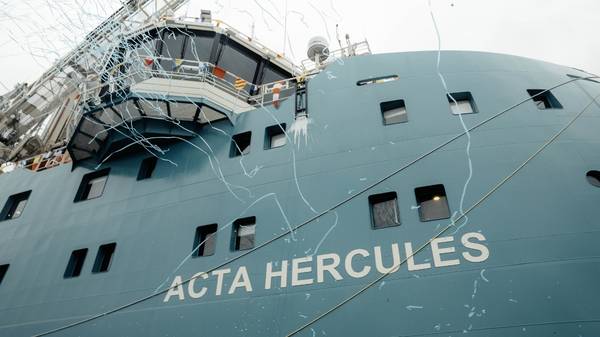
Acta Marine christens methanol dual-fuel vessel Acta Hercules in IJmuiden
Dutch operator marks the christening of its second newbuild CSOV. |
|
|
|
||
|
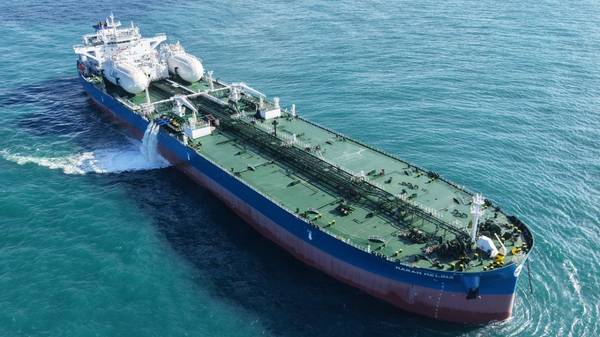
Angelicoussis Group takes delivery of fifth dual-fuel Suezmax tanker
Maran Tankers Management adds the 155,500-DWT Maran Melina to its fleet. |
|
|
|
||
|
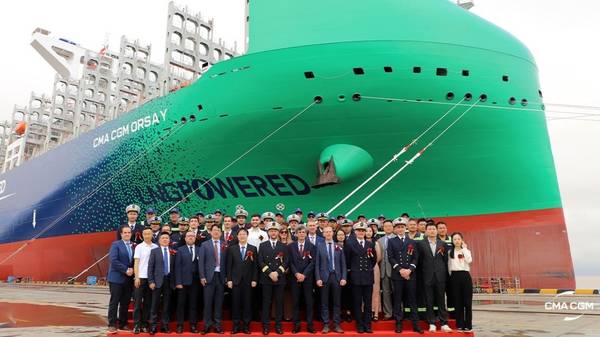
CMA CGM takes delivery of LNG-powered Orsay for Asia-Europe trade
24,212-TEU vessel joins 10-ship series, adding capacity to the carrier's FAL3 route. |
|
|
|
||
|
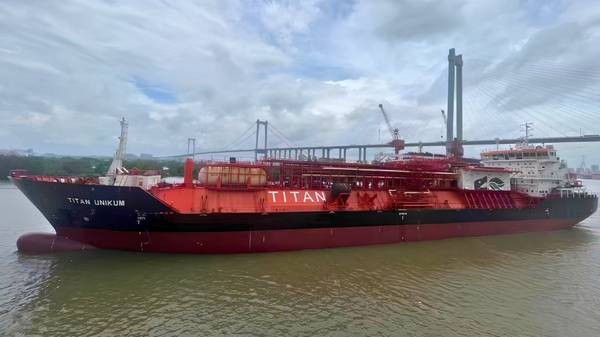
Titan Clean Fuels completes 15-year survey on LNG bunkering vessel Titan Unikum
Multi-gas carrier has undergone dry-docking work at a Chinese yard, preparing it for future upgrades. |
|
|
|
||
|
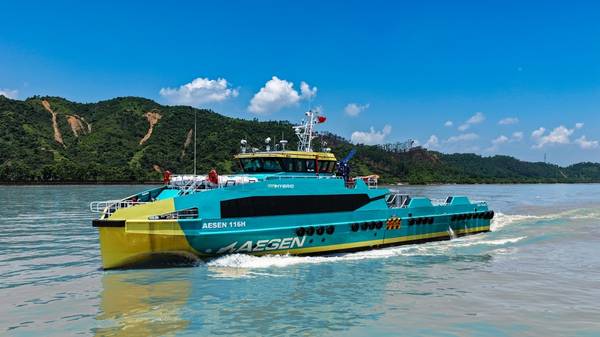
Lehmann Marine’s CUBE battery system debuts in China aboard hybrid crew boat
German battery maker’s first Chinese installation targets fuel savings on a Cheoy Lee-built vessel for a Singapore operator. |
|
|
|
||

|
Iino Lines secures transition loan from Mizuho Bank for LPG dual-fuel VLGC
Japanese shipowner finances the acquisition of Lumi Aurora through a green transition finance framework aligned with ICMA guidelines. |
|
|
|
||
|
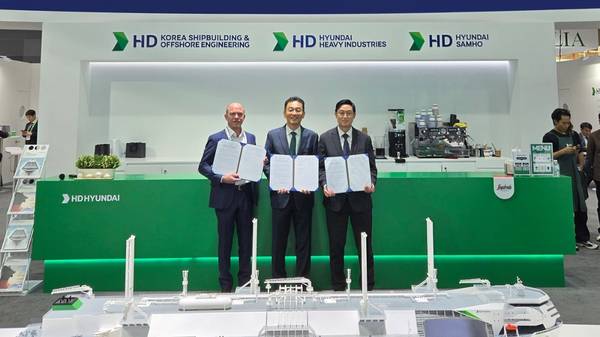
ABS, HD KSOE and Siemens partner on digital twin technology for ammonia-fuelled ship safety
Three firms will combine CFD analysis and digital twin technology to assess ammonia leak scenarios in vessel design. |
|
|
|
||
| Swedish government bans scrubber wastewater discharges [News & Insights] |
| Electric and hybrid ferries could cut Sea of Marmara emissions by 63%, IMO study finds [News & Insights] |
| NYK shares two years of ammonia-fuelled tugboat data with IMO [News & Insights] |
| IMO and EMSA gather maritime experts to address seafarer training for alternative fuels [News & Insights] |
| IMO seminar examines technical hurdles facing ammonia as a marine fuel [News & Insights] |
| IMO sub-committee finalises revised methanol fuel safety guidelines [News & Insights] |