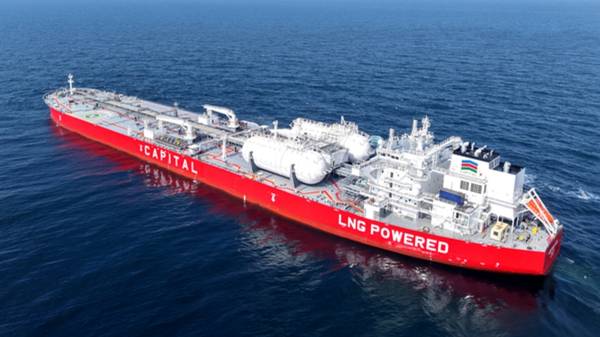
The world's largest provider of shuttle tanker services,
Teekay, has teamed up with
Wartsila to develop a new LNG-fuelled shuttle tanker concept which has already received
four vessel orders for Teekay worth more than EUR 110 million.
The ships are to be built at the Samsung Heavy Industries (SHI) yard in South Korea and feature an assortment of Wartsila's latest technology innovations, all of which are said to be central to the concept's overall performance gains.
In addition to operating on LNG as the primary fuel, the dual-fuel engines will also be able to run on a mixture of LNG and recovered volatile organic compounds (VOC) - the gas evaporating from the oil cargo tanks during loading.
By utilising the recovered VOC as fuel rather than venting it to the atmosphere, harmful emissions are said to be eliminated and the ships' bunker consumption significantly reduced. Wartsila
unveiled the new fuel-saving system last month.
The concept is also claimed to reduce nitrogen oxide (NOx) emissions from the engines' exhaust by more than 80 percent, almost entirely eliminate sulphur oxide (SOx) emissions, and reduce particulate emissions by more than 95 percent.
Furthermore, the LNG-fuelled vessel offers a significant reduction in fuel consumption compared to conventional solutions, the project partners say.
"Together with Teekay, we have developed a concept that takes the shuttle tanker sector into a new era, and which is further evidence of Wartsila's ability to transform shipping by developing and utilising the very latest technologies. These ships will have tremendous operational flexibility with unmatched manoeuvring capability, and will achieve what all operators are striving for today, namely optimal economic and environmental performance," commented
Roger Holm, President, Wartsila Marine Solutions.
"
This new shuttle tanker design will set new standards for both fuel consumption and CO2 emissions," added
Terje Rusdal, Project Manager at Teekay.
Among the many features of the ship is the Wartsila Hybrid system, on which the power distribution will be based. The Hybrid system uses batteries for fuel savings, peak load shaving, and added overall system redundancy. This directly impacts the main machinery, resulting in fewer running hours with correspondingly lower maintenance time and costs.
Wartsila's scope also comprises the full electric and automation system, which includes the Wartsila Low Loss Hybrid (LLH) system and batteries; the Wartsila LNGPac fuel storage and supply system; the Wartsila VOC system for recovering and liquefying the VOC with a storage and supply system; Wartsila 34DF dual fuel gas engines; the fuel mixing system with liquid VOC and LNG as the main fuel for the engine; gas turbines to handle the surplus gas; Wartsila cargo and ballast pumps; and a Wartsila inert gas generator.
Also included in Wartsila's integrated solution for this vessel concept is
Eniram's Vessel Performance Management system. Eniram, a Wartsila company, will provide a data collection platform with the capabilities to optimise the vessel's operations, while also providing the owners with analytics and reporting.
The Performance Management system is designed to ensure that the full potential of the vessel - as well as the fleet - are utilized.