Fri 19 Feb 2016, 14:30 GMT

Global Vision Market Report


Market report from Global Vision Bunkers B.V.


The bullish data on US oil inventories released by the API on Wednesday evening and the fact that Iran will support any actions of other oil producers (although it won't freeze its own production levels) bolstered oil prices on Thursday morning. Still, the latest decisions didn't change market fundamentals as the accord between countries like Saudi Arabia and Russia over freezing ouput at January levels rather has a psychological effect than a factual one. Even though the API's data supported oil prices, the figures were completely different to analysts' expectations, which is why we had already cautioned in our early morning news that the DOE's data might provide a different picture. We thus regarded market fundamentals as neutral. The technical constellation was neutral as well, as it didn't provide any sustainable cues either. After having edged lower on Thursday morning, oil futures regained ground around noon. Prices broke above Wednesday's lows but as decisive cues were lacking, they failed to extend their gains. After having stabilized on a higher level in the early afternoon, oil futures slumped after the release of the DOE's data, ending the day near fresh lows. However, losses were limited late at night by reports on Iraq agreeing to freeze its output at January levels. The RSI is neutral at the ICE and at the NYMEX charts, unable to give off any bullish or bearish signals. However, the Stochastic indicator might give off a selling signal if the black line drops below the red line. Thursday's lows will be pivotal for a bearish signal. If oil futures sustainably fall below these levels, stop-loss selling orders might be triggered automatically, generating a selling signal of the Stochastik indicator. At the Brent chart the 7-period moving average and the 21-period moving average are converging. If they cross, a bullish signal would be triggered. Since there aren't any fresh cues so far, we are still assessing the technical constellation as neutral.

ICE Gasoil contract for March delivery settled at 321.25 USD on Thursday, this was +0.50 USD above Wednesday's settlement. With some 70,500 deals, the traded volume (front month) was above average.

U.S.

Nymex above average: Oil futures remained near Thursday evening's lows in early electronic trading this morning. The traded volume at NYMEX is above average this morning. Investors are now waiting for the European financial and forex markets to open as well as for the release of some economic indicators, and comments from the OPEC.

Refinery utilisation increased unexpectedly sharply - by 2.2% - in the week ending February 19. This leads to expect that the first cycle of seasonal refinery maintenance in the USA has been concluded. At 88.3%, refinery utilisation is still lower than it was one year ago despite the increase in refinery run rates. A year ago, refinery utilisation pegged at 90.0%. Refinery throughput might thus continue rising in the coming weeks. US crude oil imports have significantly increased by 0.795 mbpd. However, this rise hasn't yet made up for the 1.1 mbpd-decline last week's data had shown. Thanks to the rise in US imports, overall crude oil stockpiles showed builds despite the higher refinery run rates and in contrast to the draw reported by the API on Wednesday night. Product demand increased in the reported week. However, after having climbed to 3.482 mbpd, distillate is still approximately 19.1% lower than a year ago. The combination of a still rather low demand and a higher refinery output made distillate futures rise. This provided bearish cues. Gasoline inventories sharply increased as well, even though demand (9.203 mbpd) was 11.1% higher than a year ago. Since the builds in gasoline stockpiles were more significant than expected, this category also provided bearish cues. Total product demand grew by 3.8%, climbing back to 19.7 mbpd. Like 51,000 bpd-drop in US crude oil production (to 9.14 mbpd), this is a bullish factor. Overall, the bearish aspects outweighed the bullish ones, though. That is why the DOE's data rather put oil futures under pressure.

Houston (ex-wharf indications 19-2)
380cst $142
180cst $210.50
MGO $343.50

New Orleans (ex-wharf indications 19-2)
380cst $146
180cst $189.50
MGO $329

Singapore (delivered indications 19-2)

Brent is losing momentum with -$0.36 for Apr contracts. Singapore paper is following with -$6.25 for 180cst with -$6.25 for 380cst for Feb, and for Mar 180cst -$6.25 and 380cst with -$5.95 with MGO contracts Feb with -$0.31 and in Mar with -$0.32 .The cargo market is reacting now to the bullishness midweek on paper with 180cst +$12.66, 380cst with +$12.42 and MGO with +$2.59.

380cst $159
180cst $168
MGO $298

Fujairah (delivered indications 19-2)

380cst $151
180cst $170
MGO $419

ARA (Amsterdam - Rotterdam - Antwerp)

Indications for delivered bunkers:
380cst : $135
MGO 0.1%S: $390

BP   MGO  

Svitzer Balder vessel. Battery-methanol harbour tug completes sea trials ahead of Gothenburg deployment  

Svitzer Balder is claimed to be the most powerful electric escort tug in the world.

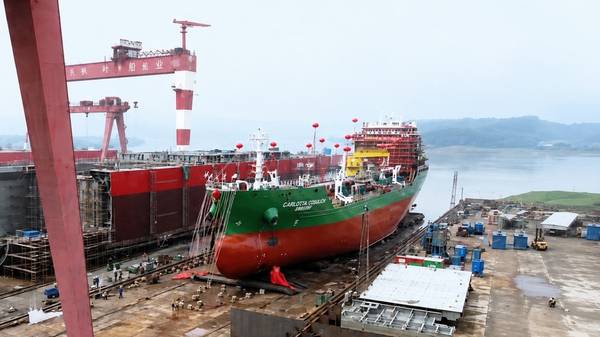
Launching ceremony of Nave Orbit vessel. Changhong International launches fourth LR2 tanker for Navios  

Chinese shipbuilder floats 115,000-tonne LR2/Aframax product tanker with methanol and LNG conversion capability.

Nippon Yuka Kogyo logo. Nippon Yuka Kogyo launches lubrication oil analysis service for ammonia-fuelled engines  

Japanese company offers condition monitoring service to support adoption of ammonia as a marine fuel.

Steel cutting ceremony of vessel with builder's hull no. S1128. CIMC Pacific Offshore Engineering advances two 20,000-cbm LNG bunkering vessel projects  

Two sister vessels for Singapore and Luxembourg owners reach construction milestones in China.

MPA and SSA logo side by side. Singapore maritime sector to accelerate AI adoption under new partnership  

MPA and SSA sign MOU to support AI implementation across shipping operations and bunkering.

Aerial view of a ship-to-ship (STS) transfer operation. Portland Port receives licence for LNG ship-to-ship transfer operations  

UK port can now support direct LNG transfers, reducing transit times and streamlining logistics operations.

Martin White, CEO of Stream Marine Group. Seafarer training must match pace of alternative fuel adoption, says Stream Marine Training  

Training provider highlights regulatory gap as methanol, ammonia and hydrogen gain traction in shipping.

Anji Luck vessel. Jiangnan Shipyard delivers final methanol-ready car carrier to Anji Logistics  

The 9,500-vehicle capacity vessel completes a 12-ship series built for SAIC’s logistics arm since 2022.

Bunker vessel alongside a ship during fuel transfer. Nippon Biofuel secures METI funding for Africa-based marine biofuel supply chain  

Japanese company to establish Jatropha cultivation and biofuel production facilities in Mozambique and Ghana.

Everllence B&W 6G60ME-LGIA HPSCR engine. Everllence’s ammonia-fuelled engine passes factory acceptance test ahead of October delivery  

Engine built by HHI-EMD will power Eastern Pacific Shipping’s very large ammonia carriers.