This is a legacy page. Please click here to view the latest version.
Mon 4 Jun 2018, 12:06 GMT

Gothenburg set to launch LNG bunker facility in August


Port prepares for growth in LNG bunker demand and the industry's transition to renewable gas.


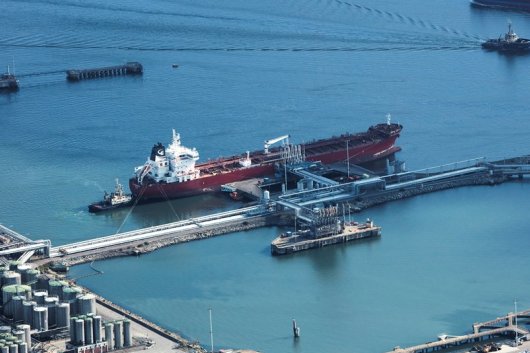
At berth 519 (where the red ship in the picture is located), LNG bunkering is possible via pipeline (pipe-to-jetty) directly to ships.
Image credit: Port of Gothenburg
Swedegas's new LNG bunkering facility in Gothenburg is set to become operational in August, Port of Gothenburg reports.

With the launch of the new facility, customers calling at the port will be able to bunker LNG either ship-to-ship, directly from a road truck or pipe-to-jetty.

All three methods will be possible whilst vessels are loading or unloading.

Scalable biogas facility

The Swedegas facility will be supplied with LNG via trailers or tank containers, which will be unloaded at a discharge station. The gas will then be distributed via pipeline to the vessels at the quayside.

The facility is scalable and can be expanded to meet the needs of the market. It also has the capability to receive liquefied biogas (LBG).

"We always build infrastructure that can handle both natural gas and renewable gas. It must be simple for shipping to gradually increase the mix of renewable gas as the transition progresses," said Johan Zettergren, Swedegas chief executive.

Skangas and Barents NaturGass

LNG supplier Skangas is already operating in Gothenburg, supplying ships with LNG using the ship-to-ship delivery method.

And Port of Gothenburg last week confirmed that it had entered into an agreement with Norway's Barents NaturGass for the supply of LNG via ISO containers from key European terminals.

Building for growth

In terms of LNG bunkering statistics, Gothenburg has recorded positive growth since the first LNG bunkering operation in the autumn of 2016. In the first full year, 111 LNG-fuelled ships called at the port. This year, meanwhile, LNG was bunkered on 44 occasions between January and April.

Jill Soderwall, Head of Commercial Operations at the Energy Port, remarked: "We can see that the demand for LNG will increase at the Port of Gothenburg, and it is vital that the number of alternatives continues to grow. With the Swedegas facility, the port will have more LNG choices than previously on a competitive market with several gas suppliers, whilst at the same time there will be a larger range of bunkering methods. This will offer greater flexibility, more stable access, and better service for LNG purchasers."

Current status of fleet fuel types chart. LNG-fuelled container ships dominate January alternative-fuel vessel orders  

Container ships accounted for 16 of 20 alternative-fuelled vessels ordered in January, DNV reports.

Rick Boom, CIMAC and Professor Lynn Loo, GCMD. GCMD and CIMAC sign partnership to advance alternative marine fuel readiness  

Two-year agreement aims to bridge operational experience with technical standards for decarbonisation solutions.

Renewable and low-carbon methanol project pipeline chart as of January 2026. Renewable methanol project pipeline reaches 58.2m tonnes by 2031, GENA reports  

Project Navigator Methanol tracks 275 projects, including e-methanol, biomethanol and low-carbon methanol facilities globally.

Petrobras logo. Petrobras adjusts bunker pricing and minimum order volumes at Santos  

Brazilian supplier discontinues volume discount tier and lowers minimum order quantity from 1 March.

Viking Grace vessel. Viking Line secures biogas supply for 2026 after tenfold increase in biofuel use  

Åland-based ferry operator aims to maintain 50% biogas blend throughout the year on two vessels.

GNV Aurora vessel. GNV takes delivery of second LNG-powered vessel Aurora from Chinese shipyard  

Vessel to enter service on Genoa–Palermo route in April, completing first fleet renewal phase.

Tangier Maersk vessel. Maersk takes delivery of first methanol-capable vessel in 9,000-teu series  

Tangier Maersk is the first of six mid-size container ships with methanol-capable dual-fuel engines.

IBIA MFM bunkering training course graphic. IBIA to run surveyor training course for mass flow meter-equipped bunkering in Rotterdam  

One-day course scheduled for 19 February aims to prepare professionals for MFM-equipped bunkering operations.

CO2 carrier vessel aerial view. MOL secures two 12,000-cbm CO2 carriers for Northern Lights expansion  

Japanese shipowner to deliver vessels in 2028 for cross-border carbon transport and storage project.

MOL and ONGC VLEC long-term charter signing. MOL and ONGC sign 15-year charter deal for two ethane carriers  

Japanese shipowner expands fleet to 16 vessels with newbuildings scheduled for delivery in 2028.


↑  Back to Top