Fri 2 Feb 2018, 11:23 GMT

Gothenburg starts construction of land-based LNG bunker facility


Will be available to ships calling at Gothenburg's Energy Port.


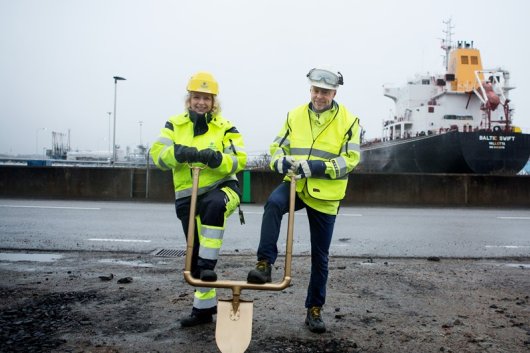
Jill Soderwall from the Port of Gothenburg and Johan Zettergren from Swedegas broke ground for Gothenburg's new LNG facility at the Energy Port.
Image credit: Swedegas / Port of Gothenburg
Construction of a new liquefied natural gas (LNG) facility is now under way at the Port of Gothenburg. It is due to become fully operational later this year.

Gothenburg witnessed its first LNG bunker delivery when Terntank's vessel, the Ternsund, was supplied with the fuel in 2016. Since then, operating regulations and routines at the Swedish port have been developed and efficiency is said to have been improved, whilst there has been a steady rise in the number of LNG bunkering operations.

Currently, Skangas supplies vessels with LNG using the ship-to-ship delivery method in Gothenburg. During the third quarter of 2017, Skangas completed Gothenburg's first LNG bunkering whilst loading was taking place. The company's chartered vessel, the Coralius, also performed its first Gothenburg LNG bunker delivery and its first supply of LNG in open sea to a vessel that cooled down its tanks in order to switch from diesel oil to LNG, just outside Gothenburg.

Skangas has been joined in Gothenburg by Swedegas, which owns and runs the Swedish gas transmission network and which will be expanding the number of LNG supply options at the port with the construction of a facility designed to ensure safe and quick land-based LNG bunkering whilst vessels are loading and discharging at the Energy Port.

"With both Skangas and Swedegas operating at the Port of Gothenburg, we have two companies that complement each other with different offerings. Shipping lines now have a further incentive to consider switching to LNG," said Jill Soderwall, Vice President and Head of Commercial Operations at the Energy Port.

LNG will arrive at the new LNG facility by trailer or in containers, and will be distributed via a 450-metre vacuum-insulated cryogenic pipeline to the quayside.

The facility marks the first step in the construction of a broader solution for the gas infrastructure at the Port of Gothenburg, with the potential to connect to the gas transmission network. In time, Swedish industry and land transport could also make use of the facility.

"As is the case with the gas transmission network, in which both natural gas and biogas can be transported, the new facility will be flexible and can also be used for the storage and transport of renewable gas. Customers with access to the transmission network can already choose biogas, and this is something we are looking to extend to the shipping sector as the next step in their transition to environmentally correct alternatives," said Johan Zettergren, Swedegas Chief Executive.

The EU has assigned the project Project of Common Interest (PCI) status, which means that it is among the most prioritised infrastructure projects in Europe. The EU, via the INEA (Innovation and Networks Executive Agency), has also confirmed that support measures are in place to ensure the project reaches fruition.


Container ship near a port. Ammonia emerges as most feasible alternative fuel for deep-sea shipping in 2050 emissions study  

Research combining expert survey and technical analysis ranks ammonia ahead of hydrogen and methanol.

Cargo vessel at sea. EMSA study examines biodiesel blend spill response as shipping adopts alternative fuels  

Research addresses knowledge gaps on biodiesel-conventional fuel blends as marine pollutants and response measures.

BIMCO ETS BARECON clause 2026 graphic. BIMCO adopts ETS clause for bareboat charters, delays biofuel provision  

BIMCO’s Documentary Committee has approved an emissions trading compliance clause while requesting further work on a biofuel charter provision.

SALEFORM 2025 standard form graphic. BIMCO and Norwegian Shipbrokers’ Association launch SALEFORM 2025 ship sale contract  

Updated agreement addresses banking changes, compliance requirements and environmental regulations affecting vessel transactions.

Everllence H2 test engine. Everllence develops hydrogen test bench for marine engines  

German engine maker upgrades Augsburg facility under HydroPoLEn project backed by federal maritime research funding.

CMA CGM Osmium vessel. CMA CGM names 13,000-teu methanol-fuelled containership in South Korea  

CMA CGM Osmium to operate on Asia–Mexico service as part of the carrier’s decarbonisation strategy.

NorthStandard logo. NorthStandard publishes biofuel guide as marine insurance claims emerge  

White paper addresses quality issues and compliance requirements as biofuel testing volumes surge twelvefold.

Clean Maritime Fuels Platform (CMFP) logo. Maritime fuel platform calls for EU shipping ETS revenues to fund clean fuel deployment  

Clean Maritime Fuels Platform urges earmarking of national emissions trading revenues for renewable fuel infrastructure.

Seatransport 73m SLV Lloyd’s Register grants approval for hybrid nuclear power design for amphibious vessels  

Classification society approves Seatransport’s concept integrating micro modular reactors with diesel-electric systems.

Everllence ME-LGIE engine. Everllence and Vale partner on ethanol-powered marine engine development  

Brazilian mining company to develop dual-fuel ethanol engines based on ME-LGI platform.