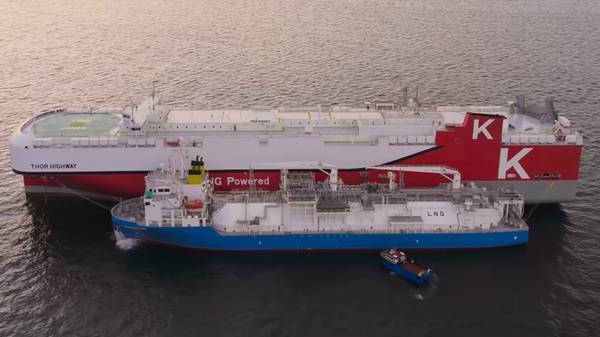
Bomin Linde LNG GmbH & Co. KG, a provider of liquefied natural gas (LNG) as fuel for the marine market, has revealed that its first project will be the construction of a liquefied natural gas terminal intended to provide ships with cleaner fuel at the
Port of Hamburg. This is based on the completion of a feasibility study conducted by the
Hamburg Port Authority and
Linde AG.
Bomin Linde LNG GmbH & Co. KG is a joint venture bewteen Linde AG and Bomin, which is a subsidiary of
Marquard & Bahls AG. Following the launch of the business earlier this year, the company has been focusing on the implementation of initial projects to build storage and refuelling infrastructure for liquefied natural gas (LNG) in several European ports.
The first specific step taken by the joint venture is the construction of a terminal for refuelling ships with LNG at the Port of Hamburg. Potential methods of implementation are currently being evaluated in order to comply with the legal criteria necessary to set up a small scale LNG terminal at the premises of
Oiltanking - a subsidiary of Marquard & Bahls - in Hamburg.
Following the recent economic and eco-political developments, LNG is forecast to have a promising future as an alternative ship fuel. As of 2015, sulphur emission limits will be reduced significantly for shipping in the North and Baltic Seas. On the one hand, LNG offers the ship proprietors and owners the opportunity to sustainably fulfill the new emission standards while simultaneously reducing the operating costs of their ships. On the other hand, the Port of Hamburg will have the opportunity to gain a pioneering role in the introduction of LNG as an alternative ship fuel in Europe.
According to a study by the Danish Maritime Authority, it is estimated that the potential demand for the maritime sector in the North Sea, Baltic Sea and the English Channel will be approximately 4 million tonnes of LNG in the year 2020.
"The shipping industry is very eco-friendly measured by the emissions per tonne kilometer,” said
Frank Horch, Hamburg’s Senator of Commerce. "Nevertheless shipping is also facing stricter requirements in terms of environmental conservation: Sulphur content in fuels will globally be limited. The Bomin Linde joint venture’s activities are an auspicious occasion for our port. We are hereby sending out a strong signal that we are taking sustainability seriously in Hamburg.”
Hamburg Port Authority has already recognized this great opportunity and, together with Linde Group, has taken the initial step by successfully conducting a feasibility study on the construction of LNG infrastructure.
”The Port of Hamburg has set itself the task of bringing economy and environment al protection in line. In this context, the use of LNG represents an important step forward“, stated
Jens Meier, Managing Director of Hamburg Port Authority.
Hamburg Port Authority not only supports the development of an LNG infrastructure, but also plans to become one of the first users of LNG. The port plans to be operating a vessel running on LNG technology by 2014.
"We have to solve the chicken-and-egg problem when it comes to introducing a new fuel for shipping in Europe. With Bomin Linde LNG as a reliable partner actually providing LNG as a fuel in strategically important ports, the construction of ships that are fuelled with LNG will experience a considerable boost. LNG is by far the most environmentally friendly and economically sound option for complying with the new sulfur and nitrogen emission limits," said
Mahinde Abeynaike, Managing Director responsible for infrastructure development and finance at Bomin Linde LNG GmbH & Co. KG.
"The interest in LNG on the market is very big. In addition to the technical advantages offered by LNG, the expected increasing price difference between expensive oil and the more favorable price level of gas is an important aspect. The ecological sense of responsibility felt with in the shipping industry and by its customers is also playing an increasingly important role", added Ruben Benders, Managing Director responsible for Sales and LNG procurement.