Mon 22 Oct 2012, 13:06 GMT

Global Vision Market Report


Brent crude oil climbed towards $111 per barrel on Monday as fighting in Beirut and Gaza raised fears for the security of fuel supplies from the Middle East, helping stem a four-day decline in prices. Brent lost 4% last week on global economic uncertainty. But growing violence in parts of the Middle East, which supplies a third of the world's oil, has helped counter concerns over weaker fuel demand.

After the price increase on Thursday evening oil futures traded slightly higher on Friday morning. Gunfights in the region near the border between Turkey and Syria made oil futures test their resistance lines. When the WTI crude breached the 92.55 dollars bar in the early afternoon, further technical selling orders were triggered. In the course of the evening sentiment changed traders began to cut their long positions and to take some profit ahead of the weekend. This was triggered by several factors: unconvincing economic data published at the end of the week, the imminent re-commissioning of the biggest North Sea oil field Buzzard and of the Keystone pipeline (Canada/USA) at the weekend, and stock markets that marked losses as the EU's summit rather disappointed investors. Technical selling pressure at oil markets increased when futures breached their supports. Moreover market players reduced their riskier assets ahead of the weekend, particularly because the WTI's frontmonth contract (November) expires this Monday. Only near the psychological support at 90.00 dollars were the WTI crude's losses limited. In early trade on Monday morning there was a slight counter-reaction that had on the one hand been caused by some technical profit taking from short positions but also by the delay in the re-commissioning of the Keystone pipeline in the USA and the Buzzard oil field in the North Sea.

ICE Gasoil contract for November delivery settled at 996.50 dollars on Friday. This was ±0.00 dollars compared to Thursday's settlement. With some 61,100 deals the traded volume was on average.

At the WTI charts the stochastic indicator is clearly bearish this morning, whereas the lines of the indicator at ICE already converge again. The merely technical situation thus remains slightly bearish, even though Friday's massive profit taking favour a counter-reaction this morning. Therefore, according to analysts, oil futures' downward potential is limited and prices are likely to consolidate above the intraday-lows they have marked so far.

U.S.

Nymex access bullish: Oil prices have edged slightly higher in East-Asia and Globex electronic trading this morning, as the Nikkei 225 and the euro marked some gains and Friday's profit taking favoured an upward correction in the early morning. The traded volume is above average. Market players now look ahead to the performance of stock and forex markets as well as today's economic indicators.

Houston (ex-wharf indications 19-10)

380cst $625
180cst $678
MGO $1050

New Orleans (ex-wharf indications 19-10)

380cst $633
180cst $683
MGO $1055

Singapore (correct as per 14:30hrs LT-delivered indications)

Crude is bullish with WTI -$1.67. Singapore paper is decreased with -$7.00 for 180cst and -$6.80 for 380cst for Oct, and for Nov 180 cst -$6.80 and 380cst -$7.10 with MGO contracts Oct -$2.44 and Nov -$2.42 The cargo market is stable with 180 cst +$1.52 380cst +$1.23 and MGO -$0.79.

The Singapore fuel oil markets rose app. $1.0 during the morning window last Friday. The latest Singapore residual inventory reported a draw of 0.28 mbbl to 19.32 mbbl. The delivered bunker premiums weakened to around $3.75 above cargo prices last Friday. This morning the markets are trading slightly higher.

380 cst $637
180 cst $648
MGO $938

ARA (Amsterdam - Rotterdam - Antwerp)

High and low sulphur fuel oil loadings in Rotterdam remained hindered by ongoing operational delays at loading installations. The nearest bunker hub of Antwerp reported good operations and good product availability.

Rotterdam

Indications for delivered bunkers:

380cst : $ 615
(1.0 %) :$ 645
180cst: $ 647
(1.0 %):$ 677
MGO 0.1%S: $975

MGO  

Bermuda Container Line (BCL) logo. Bermuda Container Line imposes emergency bunker surcharge citing Iran War fuel price spike  

Shipping operator to add $150 per TEU charge from 1 May amid geopolitical fuel cost pressures.

China flag. Zhejiang’s first methanol-powered container ship launches in Jiaxing  

Vessel uses methanol propulsion technology to reduce carbon dioxide emissions by 90%.

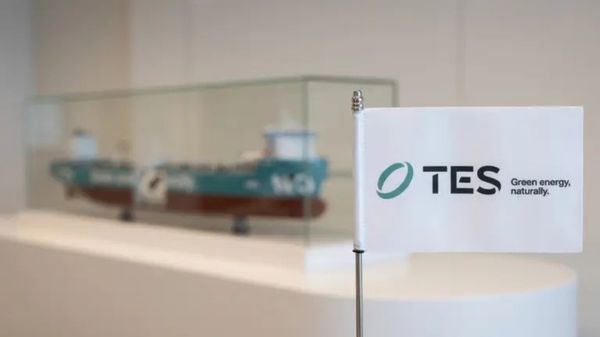
TES flag with a model vessel in the background. TES joins SEA-LNG coalition to advance e-methane as marine fuel  

Green energy company targets 1m tonnes annual e-methane production by 2030 for shipping decarbonisation.

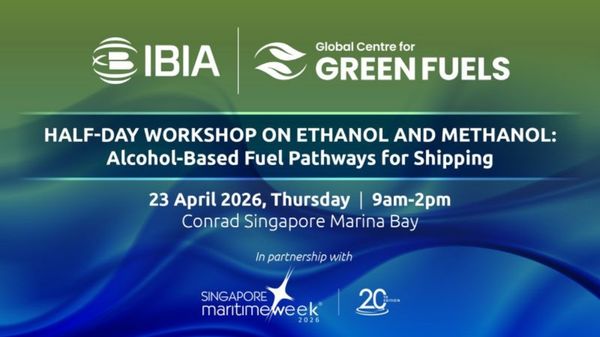
Ethanol and methanol workshop graphic. IBIA to host workshop on ethanol and methanol marine fuels during Singapore Maritime Week  

Half-day event will examine alcohol-based fuel pathways and integration into shipping’s multi-fuel landscape.

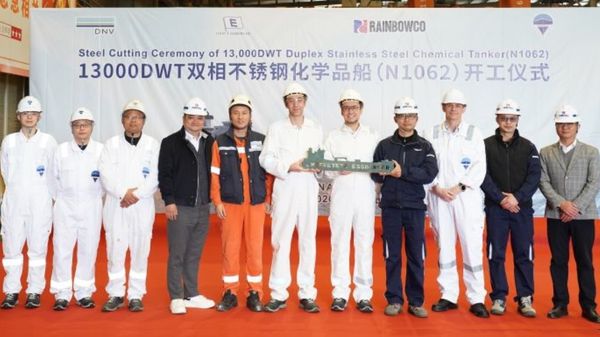
Steel-cutting ceremony for 13,000-dwt vessel. ROC begins construction of second chemical tanker for Essberger  

Chinese shipbuilder holds steel-cutting ceremony for 13,000-dwt methanol-ready vessel with ice class capability.

Norsepower and CHIC sign agreement. Norsepower and Cosco Shipping Heavy Industry Equipment sign wind propulsion cooperation agreement  

Wind propulsion technology provider partners with Chinese shipyard to scale rotor sail production.

Wärtsilä logo. Shipping firms struggle to prioritise decarbonisation investments amid regulatory uncertainty, Wärtsilä survey finds  

Survey of 225 maritime executives reveals 70% say uncertainty hinders investment decisions despite regulatory pressure.

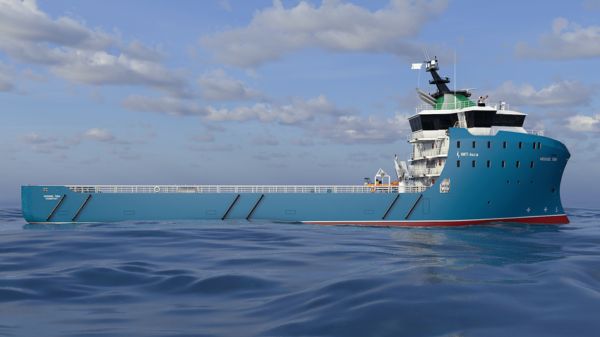
IMT Isca G-Flex vessel render. Longitude Engineering unveils IMT Isca G-Flex PSV design with alternative fuel capability  

Naval architecture firm launches adaptable platform support vessel design based on the IMT-984 G-Class hull.

Philippos Ioulianou, EmissionLink. Shore power infrastructure is key to cutting ferry emissions in European cities, says EmissionLink  

Port electrification is needed to enable vessels to switch off engines at berth, reducing urban pollution.

Maritime and Port Authority of Singapore logo. Singapore prioritises maritime resilience amid geopolitical uncertainty, eyes digitalisation and green fuels  

MPA chief outlines the sector’s adaptation to supply chain disruptions while advancing automation and alternative fuels.