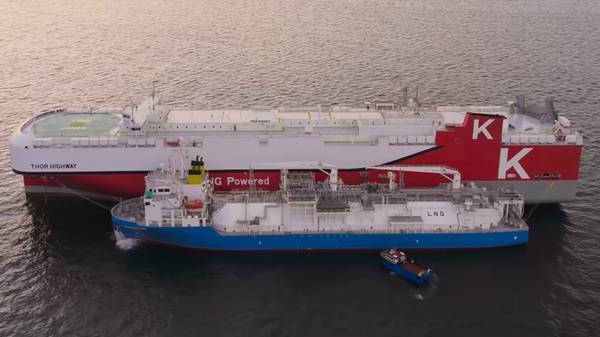
Source - BIMCO (the Baltic and International Maritime Council)
The agreement in late June by seven Baltic ports to promote the development of an LNG bunkering infrastructure in the region marks a further important step in ensuring a future global role for natural gas as a clean-burning marine fuel.
The combination of liquefied natural gas (LNG) bunkering and the burning of natural gas in ship engines has been put forward as one of three possible ways of complying with the International Maritime Organization's (IMO) tightening regime governing the control of harmful pollutants in ship exhaust emissions. The other two options are the continued use of heavy fuel oil (HFO) in tandem with exhaust gas scrubbers and the burning of low-sulphur marine gas oil (MGO)/marine diesel oil (MDO) in ship propulsion systems.
The shipping industry acknowledges that the LNG option will be chosen by many ship owners, but the extent of this take-up remains the big question. Although the burning of natural gas in marine engines meets all existing and proposed emissions standards, the provision of LNG bunkering infrastructure in ports and special shipboard fuelling systems poses logistical and cost-related challenges.
Ship owners will have to weigh up a range of factors when coming to a final decision, but the three key parameters influencing payback times and lifecycle costs are the investment costs for LNG tank systems; the price difference between LNG, MGO/MDO and HFO; and the percentage of time a ship operates within emission control areas (ECAs).
For the wider maritime community the key upcoming dates on the emissions control calendar are 1 January 2015, when permissible sulphur levels in the exhausts of ships sailing in ECAs must be drastically reduced; the Tier III nitrogen oxide (NOx) cuts planned for 2016; and the new global sulphur cap due in either 2020 or 2025.
As the North and Baltic Seas are the originally designated ECAs, it is not surprising that there is a great deal of interest in the LNG option in Scandinavia and Northern Europe. Spurred by a national tax on NOx emissions,
Norway has pioneered the use of LNG as a ship fuel. The breakthrough ship was the 95-metre long, cross-fjord passenger/car ferry
Glutra in 2000 and there are now 27 LNG-powered vessels that are not LNG carriers in service worldwide. All but one of the vessels, a Rotterdam-based inland waterway tanker, are small ships engaged in Norwegian coastal service.
Furthermore, support for the LNG option is growing. As of early June 2012, there were more than 30 additional LNG-fuelled vessels on order. While a good proportion of this contracted tonnage is also being built for service in Norwegian waters, the country is also serving as a springboard for the spread of the concept into the Baltic and North Seas.
The current orderbook includes a 57,000 gross ton (GT) passenger/car ferry that will shuttle between
Finland and
Sweden, a pair of Ro/Ro cargo ships earmarked for North/Baltic Sea duties, a Finnish patrol vessel, a Wadden Sea ferry and two 4,500 m3 LPG/ethylene carriers that will operate in the North Sea. The latter pair will be the first gas tankers that are not LNG carriers to run on LNG.
The seven Baltic ports that have agreed to promote the development of LNG bunkering infrastructure are
Aarhus,
Helsingborg,
Helsinki,
Malmö-Copenhagen,
Tallinn,
Turku,
Stockholm and
Riga. The project was initiated by the Baltic Ports Organization (BPO) and one-half of the EUR 4.8 million scheme will be financed by the European Union's TEN-T transport infrastructure programme.
The initiative commits the participants to a harmonized approach in their drive to realize the required LNG infrastructure. This means that the ports will share the results of their environmental impact assessments, LNG terminal and bunkering vessel feasibility studies, project proposals, regional market studies and safety manual development work. In this way the bunkering infrastructure that each of the ports elects to provide can draw benefit from the communal effort, not least in the ability to make informed, cost-effective decisions.
The intention is to open the dialogue beyond the ports themselves to include the full range of participants that would have a stake and play a key role in any LNG bunkering infrastructure development. Such players will include ship owners, terminal operators, gas utilities, energy traders and bunkering companies. One of the outcomes of the BPO project, which is scheduled for completion in December 2014, will be the preparation of an LNG guidebook which will lay down best practices and recommendations on how to develop port LNG infrastructure.
The LNG as marine fuel option has traditionally been compromised by the reluctance of ship owners to provide their ships with the ability to burn natural gas in the absence of an adequate LNG bunkering infrastructure. The refusal by gas and terminalling companies to build expensive bunkering facilities when there were no LNG-powered ships to fuel completed this classic chicken-and-egg scenario.
The approach of the entry-into-force dates for the stricter ship emission requirements; the relatively high price of oil; and the long lead times involved in providing the necessary LNG bunkering infrastructure are helping to provide the momentum that is overcoming the traditional roadblocks. The growing orderbook of LNG-fuelled ships and initiatives such as the BPO port co-operation scheme are evidence that the logjam has been breached.
Ship owners can look forward with confidence to a time in the not-too-distant future when the LNG bunkering facilities will be an established part of the port infrastructure across the Baltic and North Sea regions. In addition to the seven ports mentioned above LNG terminal projects are at various stages of development in a number of other Northern European ports.
Sweden already has one small LNG terminal, at
Nynäshamn; is building another at
Lysekil; and is studying the construction of bunkering arrangements in
Gothenburg. The Norwegian gas liquefaction plant at
Risavika near
Stavanger is a key supplier of LNG for both Nynäshamn and a new terminal at
Fredrikstad near Oslo and will be despatching cargoes to a number of additional Baltic receiving facilities over the next few years.
Projects that will provide bunkering stations at
Brunsbüttel, which is strategically located at one end of the Kiel Canal and the mouth of the River Elbe, and at
Hirtshals in Denmark are also poised to move ahead.
Hamburg, too, is studying the provision of an LNG fuel supply chain, including a dedicated bunker vessel.
Another key feature of Northern Europe's evolving LNG infrastructure is the bunkering hub role that a number of large LNG import terminals will play.
Poland is building such a facility and the provision of a bunkering station is a strategic part of the arrangement. Elsewhere, a similar
Finnish import terminal/bunkering hub project is poised for take-off.
Two existing LNG import terminals are also being equipped to provide a bunkering service. The
Zeebrugge terminal in Belgium, which is already capable of loading small coastal LNG carriers at its main jetty, is being provided with a second jetty able to accommodate even smaller LNG bunkering tankers.
The role of the Gate import terminal at the entrance to
Rotterdam harbour will be similarly augmented to enable the commencement of bunkering operations at the port, including for a growing fleet of LNG-powered inland waterway vessels. Because the main Gate import terminal is unlikely to be able to undertake the bunker hub function itself, a supply of LNG will be directed to a new small-scale depot in the vicinity.