Mon 5 Dec 2011, 13:03 GMT

NOL cuts fuel costs with 'new era' of ships


Newly-christened 10,000-TEU vessels will consume less fuel and emit less greenhouse gases.


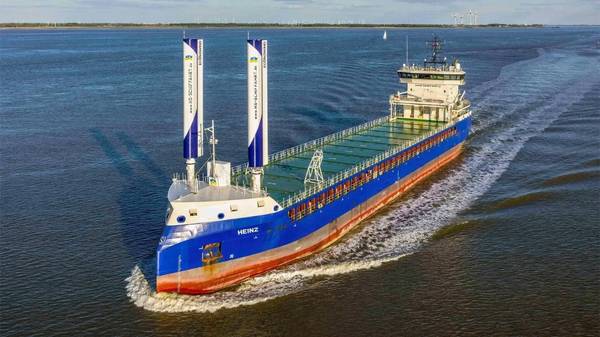
Singapore-based shipping and logistics giant NOL Group has christened the 350-meter APL Chongqing [pictured] and sister ship the APL Gwangyang.

At 10,000-TEUs (twenty-foot equivalent units) of capacity, the two vessels are the largest in the fleet of NOL's container shipping line - APL. They are the first of 32 vessels APL will commission by 2014 to gain economies of scale, fuel efficiency and competitiveness in an industry moving rapidly to ships of 10,000-TEUs and larger.

"Today marks a milestone," said Group CEO Ng Yat Chung in ceremonies at shipbuilder Hyundai Heavy Industries' docks in Ulsan, South Korea. "We're upsizing and upgrading, and when we're done we'll have the strongest fleet in our company's 165-year history."

The christening also fulfills a promise. In 2010, NOL opened its Global Service Center in Chongqing, China, and proposed to name a ship after the Yangtze River metropolis of 32 million people. APL has chosen the largest ship in its fleet for the honour. Chongqing is the largest city in China and the only municipality in western China directly under the central government.

Wang Yi, President, Chongqing Foreign Trade and Economic Relations, attended the christening of the APL Chongqing. He formulates development strategies for the city's import and export business, formulates foreign investment regulation there and is responsible for economic cooperation with foreign enterprises.

Lisa Wang, an engineering consultant from Chongqing, served as Godmother for the APL Chongqing and broke a ceremonial champagne bottle over the hull. Kathy Koo, Chairwoman of Seoul, Korea-based Pantos Logistics Co., Ltd., was Godmother for the christening of the APL Gwangyang.

NOL said its two new ships will replace older and smaller vessels in its fleet. With greater cargo capacity, improved design and more efficient engines, the APL Chongqing and APL Gwangyang should reduce operating costs and also reduce the environmental impact of container shipping.

The new vessels will consume less fuel and emit less exhaust than the ships they replace. Because the ships also have greater cargo capacity, they will reduce the amount of emissions-per-container carried.

The company said both vessels will be deployed in the trade between Asia and Europe.


WinGD methanol and ethanol webinar invitation. WinGD to host webinar on methanol- and ethanol-flexible fuel engine technology  

Engine manufacturer will discuss market outlook, regulations and operational experience with alcohol-based marine fuels.

Peninsula graduate programme group photo. Peninsula opens applications for 2026 graduate programmes in marine fuels trading  

Two-year scheme offers positions across six global locations starting in September, combining hands-on experience with structured development.

Collin She, Oilmar DMCC. Oilmar DMCC promotes Collin She to key account manager role  

She will lead strategic customer relationships and drive growth opportunities in Singapore and the wider region.

Areion vessel. Dorian LPG takes delivery of dual-fuel VLGC capable of carrying ammonia  

The 93,000-cbm Areion can run on LPG or fuel oil and transport ammonia cargoes.

FSRU Toscana alongside Green Zeebrugge vessel. RINA awards ISCC EU certification to OLT Offshore LNG Toscana for bio-LNG supply  

Certification enables bio-LNG use in the EU as a renewable fuel under RED II and RED III directives.

World Shipping Council at IMO meeting. WSC calls for safe maritime corridor as 20,000 seafarers remain trapped in the Persian Gulf  

Industry body urges IMO member states to establish safe passage and supply access.

Graphic promoting Auramarine webinar titled 'Sustainable Fueling Part 3: Ammonia - next alternative fuel in marine'. Auramarine to host webinar on ammonia as marine fuel in April  

Finnish firm will explore ammonia’s role in maritime decarbonisation at its third spring webinar.

Front cover of study by WinGD and Envision Energy titled 'Renewable Fuel Economics: An OPEX illustration based on current costs'. Green ammonia could reach cost parity with VLSFO and LNG by 2050, study finds  

WinGD and Envision Energy study projects green ammonia operational costs competitive with conventional marine fuels.

Elenger Marine's LNG bunkering vessel Optimus alongside Brittany Ferries’ Saint-Malo. Bureau Veritas verifies methane emissions on Brittany Ferries’ LNG vessels  

Verification enables ferry operator to report measured methane slip instead of regulatory default values.

Map showing existing and planned Emission Control Areas (ECAs). Alliance calls for urgent black carbon action as new Arctic emission control areas take effect  

Canadian Arctic and Norwegian Sea ECAs now in force, with compliance deadline set for March 2027.