Thu 2 Sep 2010, 05:28 GMT

Brightoil acquires five VLCCs


Bunker supplier in agreement to build five VLCCs at a total cost of US$537.5 million.


Brightoil Petroleum (Holdings) Ltd., one of the largest service providers of marine bunkering in China, has announced that the group has entered into five shipbuilding contracts to acquire five 318,000 DWT VLCC crude oil carriers at a total consideration of US$537,500,000 (equivalent to approximately HK$4.2 billion).

Brightoil said 50 percent of the consideration will be payable in different stages over the shipbuilding period and the remaining 50 percent of the consideration (subject to adjustments) will be payable upon delivery of the VLCCs, which is expected to be between July 2012 to March 2013. The total consideration is expected to be funded by bank financing and internal resources of the group.

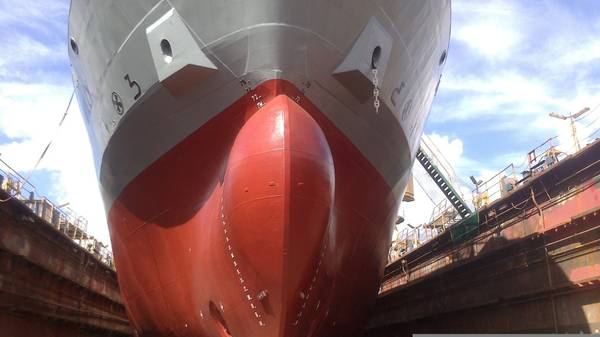
The five 318,000 DWT VLCCs, are to be built, launched, equipped and completed by Hyundai Heavy Industries Co. Ltd. and will be built to Common Structural Rules (CSR), the latest standard for newly-built tankers.

Brightoil said the VLCCs will be fitted with the latest main engines, which will offer reduced fuel consumption, improved energy efficiency and lower emissions, thus confirming the group's commitment to protecting the environment.

The VLCCs will also be equipped with heating coils and blending equipments, allowing more flexibility in cargo trading and bunkering operations.

The purchase of the VLCCs will greatly increase the group's oil carrying capacity and is in line with Brightoil's strategy of building a fleet of ocean-going vessels to support its global expansion plan for its marine bunkering business.

Commenting on the acquisition, Dr. Sit Kwong Lam, Chairman and CEO of the group, said, "The timing of acquiring the VLCCs is highly attractive and the consideration is reasonable. Together with the 4 ocean-going oil tankers with over 100,000 DWT each already acquired, the group will have 9 high quality oil tankers to support our rapid expansion in the marine bunkering business worldwide. The ocean-going oil tankers will be mainly used for transporting crude oil or fuel oil internationally. The group intends to operate these oil tankers for in-house fuel oil procurement, so as to lower the operating cost for our global marine bunkering business, and to charter out spare capacity to generate additional revenue."


Container ship near a port. Ammonia emerges as most feasible alternative fuel for deep-sea shipping in 2050 emissions study  

Research combining expert survey and technical analysis ranks ammonia ahead of hydrogen and methanol.

Cargo vessel at sea. EMSA study examines biodiesel blend spill response as shipping adopts alternative fuels  

Research addresses knowledge gaps on biodiesel-conventional fuel blends as marine pollutants and response measures.

BIMCO ETS BARECON clause 2026 graphic. BIMCO adopts ETS clause for bareboat charters, delays biofuel provision  

BIMCO’s Documentary Committee has approved an emissions trading compliance clause while requesting further work on a biofuel charter provision.

SALEFORM 2025 standard form graphic. BIMCO and Norwegian Shipbrokers’ Association launch SALEFORM 2025 ship sale contract  

Updated agreement addresses banking changes, compliance requirements and environmental regulations affecting vessel transactions.

Everllence H2 test engine. Everllence develops hydrogen test bench for marine engines  

German engine maker upgrades Augsburg facility under HydroPoLEn project backed by federal maritime research funding.

CMA CGM Osmium vessel. CMA CGM names 13,000-teu methanol-fuelled containership in South Korea  

CMA CGM Osmium to operate on Asia–Mexico service as part of the carrier’s decarbonisation strategy.

NorthStandard logo. NorthStandard publishes biofuel guide as marine insurance claims emerge  

White paper addresses quality issues and compliance requirements as biofuel testing volumes surge twelvefold.

Clean Maritime Fuels Platform (CMFP) logo. Maritime fuel platform calls for EU shipping ETS revenues to fund clean fuel deployment  

Clean Maritime Fuels Platform urges earmarking of national emissions trading revenues for renewable fuel infrastructure.

Seatransport 73m SLV Lloyd’s Register grants approval for hybrid nuclear power design for amphibious vessels  

Classification society approves Seatransport’s concept integrating micro modular reactors with diesel-electric systems.

Everllence ME-LGIE engine. Everllence and Vale partner on ethanol-powered marine engine development  

Brazilian mining company to develop dual-fuel ethanol engines based on ME-LGI platform.


 Recommended