Mon 21 Sep 2009, 11:02 GMT

Finance package for Ghana's sole refinery


US$300 million loan facility to be used to finance the state-owned Tema Oil Refinery


Ecobank Development Corporation (EDC) has said that it will 'arrange and syndicate' a US$300 million facility to finance Ghana's only oil refinery.

The state-owned Tema Oil Refinery, located around 30 kilometres from the capital, Accra, has been out of operation since the beginning of this year for maintenance, and recently due to difficulties in sourcing crude supplies.

EDC, the investment banking arm of the Ecobank group and Ecobank Ghana, its Ghanaian subsidiary, have been retained by the Government of Ghana to advise on the financial restructuring of the country's only oil refinery.

“The oil sector is strategic to the Ghanaian economy. We are very pleased to be advising the government of Ghana on this important assignment which will have an important impact on the oil sector and the economy.” said Arnold Ekpe, Chief Executive of the Ecobank Group.

As advisors, EDC and Ecobank Ghana will review and validate the level of indebtedness of Tema Oil Refinery’s current debt. They will also arrange and syndicate a US$300 million facility (or the equivalent in Ghana cedis) to refinance the refinery’s existing debt and its working capital requirements.

They will further arrange a US$300 million term facility to strengthen Tema Oil Refinery’s balance sheet, and arrange additional funds to make up for any financing gaps. The two companies will also lead and manage the eventual re-capitalization of Tema Oil Refinery.

EDC is a leading pan-African investment bank with a presence on the stock exchanges in Nigeria, Ghana and the BRVM in Cote d’Ivoire. EDC has been a leader in investment banking in Africa for a number of years and has been involved in a number of landmark fundraising and advisory transactions, including acting as co-advisor to the Government of Ghana on its US$750 million sovereign bond, and lead advisor for the recapitalisation of Ghana Telecom.

“We welcome the opportunity to serve as advisors to the Government of Ghana for the financial restructuring and refinancing of Tema Oil Refinery,” said Michael Ashong, Managing Director of EDC.

Ecobank Ghana is one of the largest banks in Ghana with 50 branches across the country.

EDC and Ecobank Ghana are both subsidiaries of Ecobank Transnational Incorporated (ETI), the parent company of the Ecobank Group.

When fully operational Tema Oil Refinery refines crude oil into marine fuel, gasoline, diesel, liquefied petroleum gas, kerosene, aviation turbine kerosene (Jet A1) and cracked fuels.

News of the plan to refinance the country's only refinery will be positive news with regards to bunker suppliers being able to source products from the facility and the expected increase in the number of ships calling there.

Demand for bunker fuel in West Africa has grown in recent years. The offshore market alone is reported to be between 4 million and 5 million metric tonnes per year.

Competition between suppliers in the area has also increased. At the beginning of last year, Aegean Marine Petroleum S.A. stationed its own floating storage tanker M/T Fos off the coast of Ghana and began making deliveries of marine fuel on January 15. The vessel, which has a total storage capacity of 70,000 metric tonnes is anchored off Tema.

Aegean also has three bunker vessels, M/T Aegean Tulip, M/T Aegean VII and Medoil III which are able to make delveries in various locations including Ivory Coast, Togo, Benin, Nigeria, Cameroon, Equatorial Guinea and Gabon.

In April 2009, the company announced that it would also be deploying the newly-acquired bunkering tanker Aegean Star to the company's West African market by the end of the second quarter of 2009.

Meanwhile, in October 2008, rival supplier Addax Bunkering Services, which offers bunker supply services to customers along the West African coast and in the North Atlantic, added the 7,500 deadweight tonne (dwt) Anuket Ruby and the 9,500 dwt Anuket Topaz to its fleet of vessels. Both vessels are carrying out deliveries off the coast of West Africa.


World Kinect Corporation logo. World Kinect marine segment posts record quarterly gross profit amid bunker price volatility  

Marine division delivers its best-ever quarterly result as the conflict in the Middle East drives bunker price swings.

Explora III vessel. Explora Journeys takes delivery of first LNG-powered ship in its fleet  

Explora III, delivered by Fincantieri in Genoa, marks the brand’s first LNG-fuelled vessel.

Patrick Ryan, Keyyong Hong and Jinyoung Cho. ABS grants approval in principle for nuclear-powered 15,000-teu containership concept  

The concept design, developed with two Korean research institutes, features a marine molten salt reactor.

Tsuneishi logo. T-SOL delivers first Japan-built methanol fuel supply system  

The system, which received ClassNK approval in principle in 2024, will be installed on a Kamsarmax bulk carrier.

Port of Rotterdam. Rotterdam records 0.4% rise in total throughput for H1 2026  

LNG throughput up 1.7% to 6.4m tonnes, with exports increase attributed partly to greater use of LNG as a marine fuel.

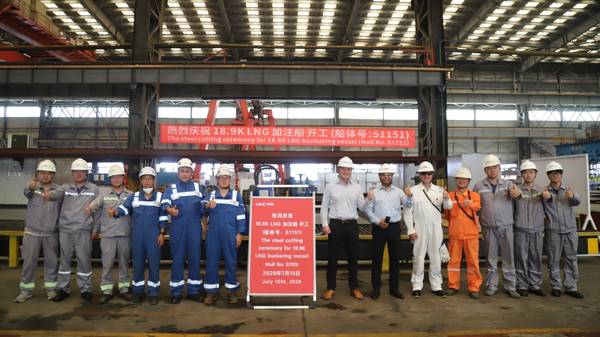
Steel-cutting ceremony of vessel with builder's hull no. S1151. Construction begins on LNG bunkering vessel for Shell  

Ceremony held for first of two 18,900-cbm vessels being built for Purus Marine.

Singapore skyline. Monjasa seeks supply trader in Singapore  

Role focused on developing and maintaining supplier relationships for the firm's back-to-back operations.

Panama City skyline. Monjasa hiring trader for Panama physical trading team  

Bunker firm looking for candidates with at least two years' experience in sales, trading, shipping, logistics, or similar commercial role.

CIMC SOE building. CIMC SOE and Sinopec Clean Energy sign contract for 12,000-cbm LNG bunkering vessel  

Vessel is scheduled for delivery in 2028 and will serve China’s coastal LNG bunkering network.

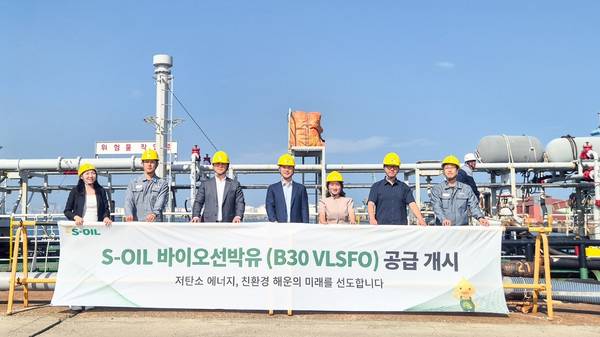
S-Oil B30 VLSFO supply launch. S-Oil begins supplying B30 VLSFO from Ulsan  

South Korean refiner S-Oil enters the bio-bunkering market with a vertically integrated Ulsan supply chain.