Thu 25 Apr 2019, 11:35 GMT

Algeciras plans to become 'reference point' for LNG bunkering


Port's president calls for competitive framework on issues such as fees for accessing gas import plants.


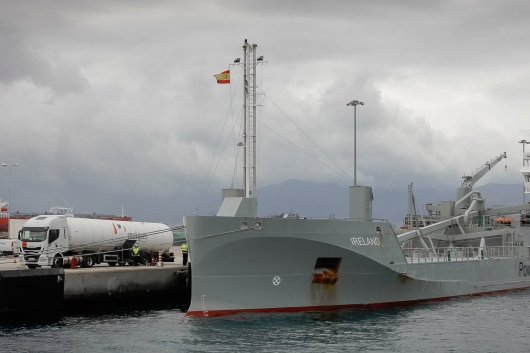
A Molgas Energía truck supplies LNG to the MV Ireland at the port of Algeciras, Spain.
Image credit: Port of Algeciras
The president of Algeciras Port Authority, Gerardo Landaluce, says the port plans to consolidate its position as a leading hub for the supply of liquefied natural gas (LNG) to vessels.

Speaking on Wednesday at the third conference of the CORE LNGas Hive project, which was set up to develop an LNG logistics network to promote the use of gas as a fuel for transport, Landaluce explained that efforts were focused on making Algeciras a 'reference point' for the use of LNG in the maritime sector.

Echoing Landaluce's words, Salvador de la Encina, president of the government organization that coordinates port policy, Puertos del Estado, posited that Spain and Spanish ports had become "a reference in terms of LNG handling and technology", noting that the country already had the basic infrastructure in place with six LNG plants located at ports, plus 40 percent of Europe's and 5.35 percent of the world's LNG storage capacity.

Algeciras, ranked by the EU as Europe's sixth-biggest container port by TEU volume in 2017, was the first location in Spain to witness an LNG bunker delivery back in mid-2012, carried out by Cepsa.

However, it then took more than five years for the second LNG delivery to take place at the Andalucian port when the dry cargo vessel MV Ireland was supplied with LNG on December 10, 2017, in a truck-to-ship operation performed by Molgas Energía, with product sourced from Enagás's regasification plant in Huelva.

Landaluce noted on Wednesday that vessels using LNG as a marine fuel benefit from paying lower port fees, whilst also stressing the need for a competitive regulatory framework on issues such as fees for accessing gas import plants.

The Core LNGas Hive project is coordinated by Enagás, co-financed by the European Commission and comprises more than 40 partners in Spain and Portugal.

Discussing the initiative, Claudio Rodríguez, director of infrastructure at Enagás, remarked: "The Hive project will enable Spain to lead, at European level, the maritime sector's energy transition process. It is a leadership based on the recently completed 50-year history of LNG in our country and ratified, above all, through the development of an innovative, competitive and sustainable logistics network."


Bermuda Container Line (BCL) logo. Bermuda Container Line imposes emergency bunker surcharge citing Iran War fuel price spike  

Shipping operator to add $150 per TEU charge from 1 May amid geopolitical fuel cost pressures.

China flag. Zhejiang’s first methanol-powered container ship launches in Jiaxing  

Vessel uses methanol propulsion technology to reduce carbon dioxide emissions by 90%.

TES flag with a model vessel in the background. TES joins SEA-LNG coalition to advance e-methane as marine fuel  

Green energy company targets 1m tonnes annual e-methane production by 2030 for shipping decarbonisation.

Ethanol and methanol workshop graphic. IBIA to host workshop on ethanol and methanol marine fuels during Singapore Maritime Week  

Half-day event will examine alcohol-based fuel pathways and integration into shipping’s multi-fuel landscape.

Steel-cutting ceremony for 13,000-dwt vessel. ROC begins construction of second chemical tanker for Essberger  

Chinese shipbuilder holds steel-cutting ceremony for 13,000-dwt methanol-ready vessel with ice class capability.

Norsepower and CHIC sign agreement. Norsepower and Cosco Shipping Heavy Industry Equipment sign wind propulsion cooperation agreement  

Wind propulsion technology provider partners with Chinese shipyard to scale rotor sail production.

Wärtsilä logo. Shipping firms struggle to prioritise decarbonisation investments amid regulatory uncertainty, Wärtsilä survey finds  

Survey of 225 maritime executives reveals 70% say uncertainty hinders investment decisions despite regulatory pressure.

IMT Isca G-Flex vessel render. Longitude Engineering unveils IMT Isca G-Flex PSV design with alternative fuel capability  

Naval architecture firm launches adaptable platform support vessel design based on the IMT-984 G-Class hull.

Philippos Ioulianou, EmissionLink. Shore power infrastructure is key to cutting ferry emissions in European cities, says EmissionLink  

Port electrification is needed to enable vessels to switch off engines at berth, reducing urban pollution.

Maritime and Port Authority of Singapore logo. Singapore prioritises maritime resilience amid geopolitical uncertainty, eyes digitalisation and green fuels  

MPA chief outlines the sector’s adaptation to supply chain disruptions while advancing automation and alternative fuels.