Tue 26 Jun 2018, 09:31 GMT

Skangas performs first ever LBG bunker delivery


Liquefied biogas supplied to the Fure Vinga in Gothenburg.


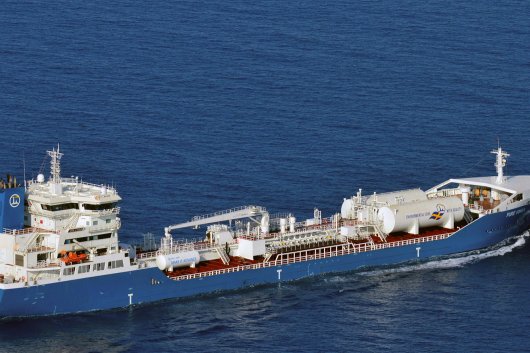
Furetank Rederi's newbuild chemical tanker, the Fure Vinga, is able to run on both liquefied natural gas (LNG) and liquefied biogas (LBG).
Image credit: Skangas
Skangas reports that it supplied Furetank Rederi's recently launched Fure Vinga with liquefied biogas (LBG) during the vessel's recent call to Gothenburg.

The LBG product was transported from the biogas facility of Skangas's parent company, Gasum, located in Lidkoping - aproximately 130 kilometres north-west of Gothenburg.

The Fure Vinga was supplied with LBG via a truck-to-ship operation.

In a statement, Skangas explained that, because both LNG and LBG mainly consist of methane gas, the existing LNG supply infrastructure can be used for the delivery of LBG without any modifications - meaning that the same trucks, ships, tanks and marine filling stations can be used for both products.

Lars Hoglund, CEO of Furetank, commented: "Running vessels on liquefied natural gas is our contribution to a more environmentally friendly environment. We will, however, contribute by increasing the sustainability. Using liquefied biogas was a natural step in this direction."

"No doubt LBG will be a clear option for us. It is proven by this operation that it can be available from our existing LNG supplier and not at least with the same quality as our current LNG fuel," Hoglund added.

Tommy Mattila, sales and marketing director at Skangas, said: "This is the first time we are supplying LBG to a marine customer."

"To be increasingly greener with renewable biogas is possible because we use the same infrastructure that we've built throughout northern Europe. This [means] that LNG and LBG will continue to walk hand in hand as the availability of LBG on the market is on the rise."

The Fure Vinga was delivered in April and bunkered with LNG for the first time in Europe on May 19 - at the Spanish port of Cartagena. The vessel's maiden LNG delivery in Amsterdam was recently performed by Titan LNG.

According to ship-tracking data, the Fure Vinga last departed from the port of Gothenburg during the early hours of June 26 and was heading for the Swedish port of Donso.

Mount Asahi vessel. CSSC delivers LNG dual-fuel bulker to Eastern Pacific nearly four months early  

210,000-tonne Mount Asahi handed over ahead of contract schedule.

Mount Vision vessel. New Times Shipbuilding delivers three LNG dual-fuel tankers in four days  

Chinese yard hands over one VLCC and two Aframax-size crude tankers within a single week.

Mercedes Pinto vessel TTS LNG bunkering. Baleària ferry completes LNG bunkering at regular berth in Las Palmas for first time  

LNG refuelling of Mercedes Pinto set to take place weekly without changing berth.

Baltic Timber vessel. Baltic Shipping Company takes delivery of wind-assisted hybrid coaster  

3,550-dwt vessel is fitted with Econowind VentoFoils and a battery package.

Pakistan flag. Vitol Bunkers launches first commercial bunkering service at Gwadar Port  

Company begins offering HSFO, VLSFO and LSMGO at the Pakistani deepwater port.

Port of Singapore. Trailing 3-month bunker sales fall to lowest since April 2025 in Singapore  

Bunker volume of 13.569m tonnes sold between April and June was worst result in 14 months.

Glander International Bunkering logo. Glander International Bunkering reports $23.4m pre-tax earnings amid volatile shipping markets  

Bunker trading company says new fuels volumes doubled over the past year, driven by client demand.

Aerial view of tanker vessel at sea. ISO-compliant fuels increasingly causing operational problems, Lloyd’s Register warns  

Latest FOBAS report finds fuel quality risk shifting beyond off-specification fuels.

Bioethanol bunkering at the Port of Santos. Bunker One completes Latin America’s first bioethanol bunkering of a deep-sea container vessel  

500,000-litre delivery at Santos marks a first for bioethanol as a marine fuel.

Maritime Technologies Forum (MTF) logo. MTF issues safety management guidelines for methanol-fuelled ships  

New MTF report offers recommendations for developing and strengthening safety management systems for methanol as a fuel.