Mon 4 Jun 2018, 12:06 GMT

Gothenburg set to launch LNG bunker facility in August


Port prepares for growth in LNG bunker demand and the industry's transition to renewable gas.


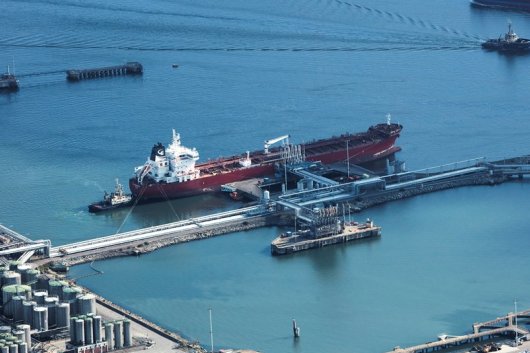
At berth 519 (where the red ship in the picture is located), LNG bunkering is possible via pipeline (pipe-to-jetty) directly to ships.
Image credit: Port of Gothenburg
Swedegas's new LNG bunkering facility in Gothenburg is set to become operational in August, Port of Gothenburg reports.

With the launch of the new facility, customers calling at the port will be able to bunker LNG either ship-to-ship, directly from a road truck or pipe-to-jetty.

All three methods will be possible whilst vessels are loading or unloading.

Scalable biogas facility

The Swedegas facility will be supplied with LNG via trailers or tank containers, which will be unloaded at a discharge station. The gas will then be distributed via pipeline to the vessels at the quayside.

The facility is scalable and can be expanded to meet the needs of the market. It also has the capability to receive liquefied biogas (LBG).

"We always build infrastructure that can handle both natural gas and renewable gas. It must be simple for shipping to gradually increase the mix of renewable gas as the transition progresses," said Johan Zettergren, Swedegas chief executive.

Skangas and Barents NaturGass

LNG supplier Skangas is already operating in Gothenburg, supplying ships with LNG using the ship-to-ship delivery method.

And Port of Gothenburg last week confirmed that it had entered into an agreement with Norway's Barents NaturGass for the supply of LNG via ISO containers from key European terminals.

Building for growth

In terms of LNG bunkering statistics, Gothenburg has recorded positive growth since the first LNG bunkering operation in the autumn of 2016. In the first full year, 111 LNG-fuelled ships called at the port. This year, meanwhile, LNG was bunkered on 44 occasions between January and April.

Jill Soderwall, Head of Commercial Operations at the Energy Port, remarked: "We can see that the demand for LNG will increase at the Port of Gothenburg, and it is vital that the number of alternatives continues to grow. With the Swedegas facility, the port will have more LNG choices than previously on a competitive market with several gas suppliers, whilst at the same time there will be a larger range of bunkering methods. This will offer greater flexibility, more stable access, and better service for LNG purchasers."

Container ship near a port. Ammonia emerges as most feasible alternative fuel for deep-sea shipping in 2050 emissions study  

Research combining expert survey and technical analysis ranks ammonia ahead of hydrogen and methanol.

Cargo vessel at sea. EMSA study examines biodiesel blend spill response as shipping adopts alternative fuels  

Research addresses knowledge gaps on biodiesel-conventional fuel blends as marine pollutants and response measures.

BIMCO ETS BARECON clause 2026 graphic. BIMCO adopts ETS clause for bareboat charters, delays biofuel provision  

BIMCO’s Documentary Committee has approved an emissions trading compliance clause while requesting further work on a biofuel charter provision.

SALEFORM 2025 standard form graphic. BIMCO and Norwegian Shipbrokers’ Association launch SALEFORM 2025 ship sale contract  

Updated agreement addresses banking changes, compliance requirements and environmental regulations affecting vessel transactions.

Everllence H2 test engine. Everllence develops hydrogen test bench for marine engines  

German engine maker upgrades Augsburg facility under HydroPoLEn project backed by federal maritime research funding.

CMA CGM Osmium vessel. CMA CGM names 13,000-teu methanol-fuelled containership in South Korea  

CMA CGM Osmium to operate on Asia–Mexico service as part of the carrier’s decarbonisation strategy.

NorthStandard logo. NorthStandard publishes biofuel guide as marine insurance claims emerge  

White paper addresses quality issues and compliance requirements as biofuel testing volumes surge twelvefold.

Clean Maritime Fuels Platform (CMFP) logo. Maritime fuel platform calls for EU shipping ETS revenues to fund clean fuel deployment  

Clean Maritime Fuels Platform urges earmarking of national emissions trading revenues for renewable fuel infrastructure.

Seatransport 73m SLV Lloyd’s Register grants approval for hybrid nuclear power design for amphibious vessels  

Classification society approves Seatransport’s concept integrating micro modular reactors with diesel-electric systems.

Everllence ME-LGIE engine. Everllence and Vale partner on ethanol-powered marine engine development  

Brazilian mining company to develop dual-fuel ethanol engines based on ME-LGI platform.