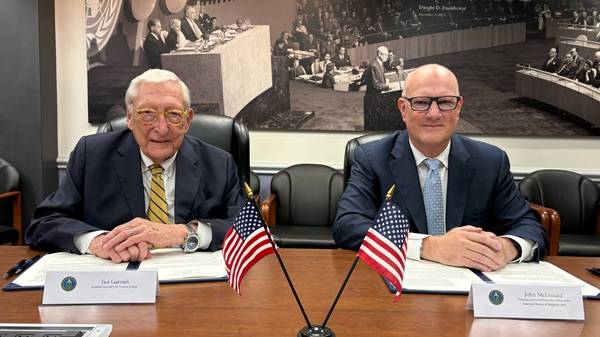
The American Bureau of Shipping (ABS), a leading provider of classification services to the global offshore industry, has entered into a joint development project (JDP) with South Korea's
Daewoo Shipbuilding & Marine Engineering (DSME) to develop the industry's first LNG-fuelled drillship.
The JDP will aim to address the challenges associated with storing and managing cryogenic liquefied natural gas (LNG) safely by combining DSME's experience developing and applying LNG technology to floating structures with ABS's technical standards and experience working on a number of gas-fuelled, LNG and regasification unit projects.
"This project builds on years of collaboration between ABS and DSME to evaluate innovative design concepts and new approaches that serve the needs of our clients and feature enhanced safety and efficiency standards," said
Dr. Hoseong Lee, ABS Vice President, Global Korea Business Development and ABS Korea Energy Technology Center in Busan.
"We are targeting the Gulf of Mexico as a key market for an LNG-fuelled drillship where, given the abundance of affordable shale gas resources in the US, LNG as a marine fuel makes good economic sense," added Lee.
"DSME and ABS are recognized worldwide as leaders in technology research, shipbuilding, marine engineering and production of commercial vessels used in offshore operations," commented DSME CTO and Executive Vice President
Dr. Sung Geun Lee, adding: "We are pleased to collaborate on this first-of-its-kind offshore structure leveraging our cutting-edge technologies and coupling these with ABS' experience validating new floating concepts."
To initiate the project, DSME has performed a concept design, comparison between two types of LNG storage tanks and analysis of the fuel gas supply system that will be installed on the drillship. ABS's scope of work calls for concept design review, basic engineering review and a risk assessment of the tank space and access area, fuel gas supply system, machinery space and access area and associated configurations.
The verification aspect of the JDP will rely on ABS's experience as a classification society for the offshore and energy industry for more than 60 years and its experience with LNG.
"Many North American vessel owners and operators are making the switch to LNG to achieve substantial operating savings by reducing fuel consumption and lowering emissions to meet the strict sulphur requirements in the North American Emissions Control Area," remarked ABS Executive Vice President, Energy Development
Ken Richardson. "ABS already has taken the critical first step to develop guidance that addresses the first application of LNG technology on US-flagged support vessels for Gulf of Mexico operations. An LNG-fuelled drillship is another groundbreaking concept that illustrates how deepwater applications are evolving."
ABS has provided approval in principle (AIP) to numerous floating concepts designed to produce oil or natural gas as well as the largest LNG carriers currently in service and has evaluated a number of gas-related marine projects based on the application of prescriptive requirements and advanced risk analysis to verify compliance with accepted safety standards.
"With safety and environmental efficiency playing a vital role in improving operational performance, ABS will continue to engage industry to develop and promote technical solutions that work to reduce emissions across the board," ABS said.