Thu 22 Aug 2013, 06:31 GMT

Dual-fuel engines for Denmark's first LNG-powered ferry


Vessel is set to operate between Jutland and Samsø in the autumn of 2014.


Finnish firm Wärtsilä is to supply the main propulsion generating sets for a new, environmentally friendly, double-ended ferry. The ship, which is set to be the first gas-fuelled ferry for a domestic route in Denmark, will operate between Jutland and the island of Samsø and will carry passengers, cars and trucks.

The vessel has been designed by the Danish company OSK-ShipTech A/S and will be built for the Danish municipality Samsø Kommune by Remontowa Shipbuilding S.A. in Gdansk, Poland. Wärtsilä signed the contract in June.

The ferry will be powered by four Wärtsilä 20DF dual-fuel engines running on liquefied natural gas (LNG) and, according to Wärtsilä, will have extremely low emission levels.

The dual-fuel engine technology pioneered by Wärtsilä is designed to allow a seamless switch to conventional marine fuels if necessary, thus providing the operator with a high level of redundancy.

The new ferry project is being closely monitored by other municipalities and governmental bodies in Denmark and abroad. Samsø Kommune actively promotes environmental sustainability through its 'Green Island' image featuring renewable energy, low pollution and recycling activities. The vessel is scheduled to be operational in autumn 2014.

The new ferry will be one of the smallest ships to be powered by Wärtsilä 20DF engines and the design of the 100-metre long double-ended ship is tailored to its operating profile and route. It is set to be the first Danish ferry to operate on LNG fuel. LNG bunkering is planned to take place at Hou harbour in Jutland.

"The overriding priorities for the owners were to achieve the highest possible level of operational reliability to support the local business but with focus on environmental sustainability, which, among others, means to ensure excellent overall efficiency in energy consumption. By selecting Wärtsilä technology these aims will be met, and we are delighted to be a partner in this trend setting project," commented Aaron Bresnahan, Vice President Sales, Wärtsilä Ship Power.


Meera naming ceremony. Naming ceremony held for LPG dual-fuel ammonia carrier  

VLAC Meera named during event held in China on 10 July.

IMO Council 137th session IMO adopts Singapore-led resolution on protection of shipping lanes  

Thirty co-sponsors back a resolution reaffirming navigational rights under international law.

TT-Line Green Ship 2.0 illustration. TT-Line orders second LNG-hybrid battery ferry for Baltic Sea operations  

German ferry operator doubles down on LNG-hybrid technology with a second next-generation newbuild.

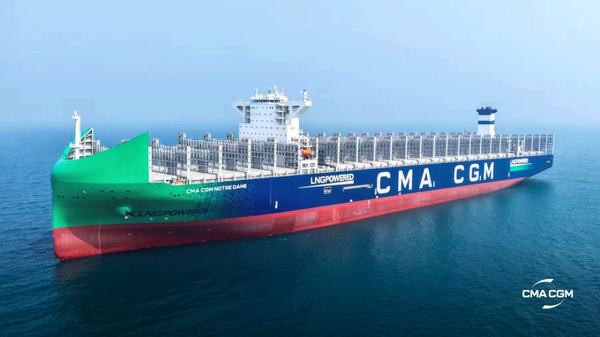
CMA CGM Notre Dame and Gas Agility ship-to-ship (STS) bunkering operation. CMA CGM Notre Dame receives first European bio-LNG bunkering during Rotterdam maiden call  

LNG-powered container ship takes on bio-LNG derived from agricultural waste.

Carnival Destiny steel-cutting ceremony. Fincantieri marks 30 years with Carnival as steel cutting begins for new LNG-powered Carnival Destiny  

Italian shipbuilder Fincantieri has begun construction of the first of three new Ace-class ships for Carnival Cruise Line.

Svitzer Thames vessel. DP World and Svitzer bunker first HVO-fuelled harbour tug at London Gateway  

Carbon inset scheme expands as tug switches from marine diesel to HVO.

CM Shenzhen and Da Qing 268 ship-to-ship (STS) bunkering operation. Venture Energy and Sinopec HK complete 'Hong Kong’s largest ever green bunkering'  

Delivery of 1,000 tonnes of methanol to ro-ro vessel hailed as new record for Hong Kong.

Soo Yong Koo, Seascale Energy. Seascale Energy appoints Soo Yong Koo as business development director  

Industry veteran hired to drive customer growth in Asia and beyond.

Arctic Tern vessel. Wallenius Wilhelmsen takes delivery of first methanol-ready Shaper Class vessel  

The dual-fuel Arctic Tern will enter service on the Asia–Europe trade almost immediately.

Al Muraykh vessel. Hapag-Lloyd signs shore power agreement with Hamburg Port Authority  

Deal commits the carrier to using onshore power supply at all Hamburg terminals.