Lloyd's Register has won a
Maritime and Port Authority of Singapore (MPA) contract to develop operational procedures and technical standards required to develop LNG bunkering capabilities in the Port of
Singapore.
In the contracted work, which has already commenced, Lloyd's Register will identify technical specifications, LNG bunkering procedures, and development of crew competency for LNG bunkering in the Port of Singapore, to support Singapore in developing its ambitions to develop the capability and infrastructure to supply LNG as a fuel for ships.
Commenting on the news,
Ng Kean Seng, Marine Country Manager for Lloyd's Register in Singapore, said: "Singapore is supporting efforts to create a clean fuel future for global shipping by developing LNG bunkering operations. We are supporting Singapore in realising that ambition. We have assembled a global team experienced in addressing the requirements and in identifying what needs to be done to really address safety and the operational issues to make safe LNG bunkering possible."
Lloyd's Register will provide detailed guidance to MPA on what is required to ensure that the technical specifications of hardware are identified; the right operational procedures are established; port safety and emergency planning is provided for; and personnel competence can be developed effectively and put in place.
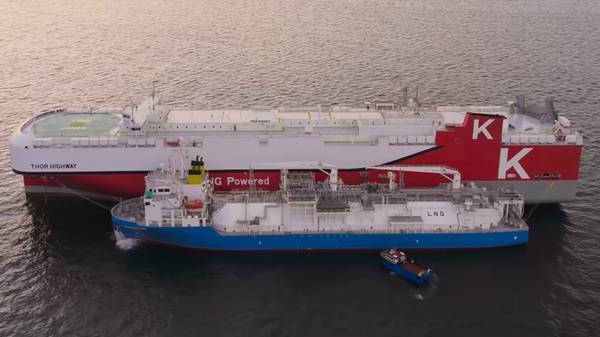
Much of Lloyd's Register’s experience is from decades of LNG carrier classification leadership and understanding ship-to-ship (STS) transfer of LNG. STS has been a principal area of development for the large-scale transfer of gas. Most recently, risk leadership undertaken for bunkering operations at the port of
Stockholm to support the high-volume bunkering required for the
Viking Grace passenger ship project, now successfully in operation carrying 2,800 passengers between Stockholm and Turku, has further added to Lloyd’s Register’s experience and track record.
Luis Benito, Global Marine Marketing Manager, Lloyd's Register, remarked: "This contract allows us to apply the knowledge and experience gained in the technical consultancy, de-risk and classification approvals we have delivered to recent innovative gas transferring systems and gas fuelled ships globally, and support Singapore Port to get ready for real LNG bunkering operations, both for short-sea and deep sea shipping, making safe LNG bunkering possible."
Some of Lloyd's Register's marine LNG achievements:
• Project addressing bunkering in Stockholm covered the port specific, practical details of safe LNG bunkering operations including: connection and start-up; normal disconnection, drain and purge; emergency disconnection, relief, purge; and operability issues (utilities, turn-around time, availability etc.) making safe LNG bunkering possible while passengers embark and disembark the ship.
• First classification society to conduct risk assessment and develop operational manuals for STS LNG transfers of major LNG carrier owners in use today in lightering and FSRU operations.
• First classification society to develop and issue rules for use of LNG as fuel for marine main propulsion systems (as applied on the LNG fuelled Viking Grace now in operation in the Baltic).
• First classification society to execute full risk analysis of combined operations involving STS LNG transfer with regasification and high pressure (HP) gas export in an offshore environment.
• Completed risk analyses for the majority of the FSRU terminals operating with STS LNG transfer at port.
• Led the way in certification of a regasification terminal with STS cargo transfer operations via LNG shuttle tankers - currently in operation in Argentina.
• Developed a proprietary interactive demand model, which is able to assess the likely scale of demand for LNG-fuelled new construction and LNG as a fuel for deep sea shipping up to 2025.
• Evaluation, testing and certification of the most commonly used cryogenic hoses for LNG bunkering and emergency release systems (ERS) for LNG fuel transfer operations.
• Developed expertise in establishing training tools for crew competence development, and risk management in the marine, oil and gas sectors.
Image: Singapore's LNG terminal, which opened for business in May 2013.