This is a legacy page. Please click here to view the latest version.
Thu 24 May 2018, 07:00 GMT

Inventories, Iran and OPEC in spotlight


By A/S Global Risk Management.


Michael Poulson, Global Risk Management.
Image credit: Global Risk Management
Yesterday's weekly oil inventories deviated hugely from expectations and sent oil prices down, but only for a short blip. Comments from Iranian leader likely supported oil prices, making markets ignore the fairly bearish oil inventory report.

Brent oil price shortly touched $78.4 before heading back upwards to current levels of around $79.5. According to the weekly oil inventory report from the Energy Information Administration (EIA), U.S. crude oil inventories grew by 5.8 mio. barrels, gasoline by 1.88 mio. barrels, while distillates fell by 0.95 mio. barrels.

Iran's leader commented on the nuclear deal, addressing the European countries which signed the lifting of sanctions against the country in 2015. According to the Iranian supreme leader, "European banks should safeguard trade with the Islamic Republic. We do not want to start a fight with these three countries, but we don't trust them either". The comments are made after U.S. president a couple of weeks ago withdrew from the deal.

As oil prices increase, focus is increasingly turning to the OPEC/non-OPEC meeting next month. Talks are that some of the oil producers could offset the potential supply disruptions from Iran (sanctions being re-imposed) and Venezuela (production dwindling on economic havoc). OPEC and non-OPEC oil producers last year agreed to curb output by 1.8 mio. barrels per day in order to bring global oil inventories back to 5-year average and re-balance the oil market.

Turning to economic data, today sees a row of central bank speeches (ECB, BoE, Fed) and the ECB publishes account of monetary policy meeting this afternoon.


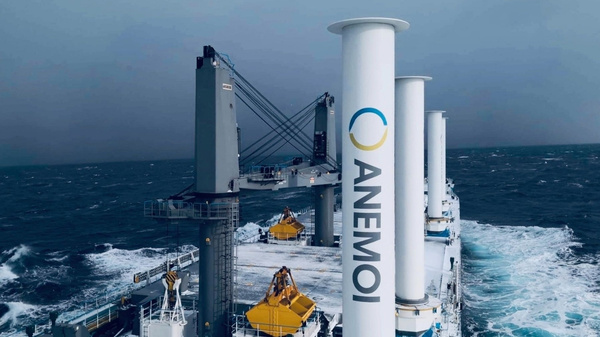
Oriental Aquamarine vessel. HMM deploys Korea's first MR tanker with wing sail technology  

Oriental Aquamarine equipped with wind-assisted propulsion system expected to cut fuel consumption by up to 20%.

BC Ferries vessel render. ABB to supply hybrid-electric propulsion for BC Ferries' four new vessels  

Technology will enable ferries to run on biofuel or renewable diesel with battery storage.

Alternative marine fuels port graphic. LNG-fuelled boxships sustain alternative fuel orderbook share despite market slowdown  

Alternative fuels maintained 38% of gross tonnage orders in 2025, driven by container segment.

Conceptual diagram of the MOL–ITOCHU strategic alliance. MOL and ITOCHU sign MoU for cross-industry environmental attribute certificate partnership  

Japanese shipping and trading firms to promote EACs for reducing Scope 3 emissions in transport.

CPN as China's No. 1 marine biofuel supplier in 2025 graphic. Chimbusco Pan Nation delivers 170,000 tonnes of marine biofuel in China in 2025  

Supplier says volumes quadrupled year on year, with a 6,300-tonne B24 operation completed during the period.

V.Group and Njord logo side by side. V.Group acquires Njord to expand decarbonisation services for shipowners  

Maritime services provider buys Maersk Tankers-founded green technology business to offer integrated fuel-efficiency solutions.

Container vessel manoeuvring in port. Has Zhoushan just become the world's third-largest bunker port?  

With 2025 sales of 8.03m tonnes for the Chinese port, Q4 data for Antwerp-Bruges will decide which location takes third place.

Monjasa Oil & Shipping Trainee (MOST) trainees. Monjasa opens applications for global trainee programme  

Marine fuel supplier seeks candidates for MOST scheme spanning offices from Singapore to New York.

Singapore's first fully electric harbour tug. Singapore's first fully electric tug completes commissioning ahead of April deployment  

PaxOcean and ABB’s 50-tonne bollard-pull vessel represents an early step in harbour craft electrification.

Fuel for thought: Hydrogen report cover. Lloyd's Register report examines hydrogen's potential and challenges for decarbonisation  

Classification society highlights fuel's promise alongside safety, infrastructure, and cost barriers limiting maritime adoption.


↑  Back to Top