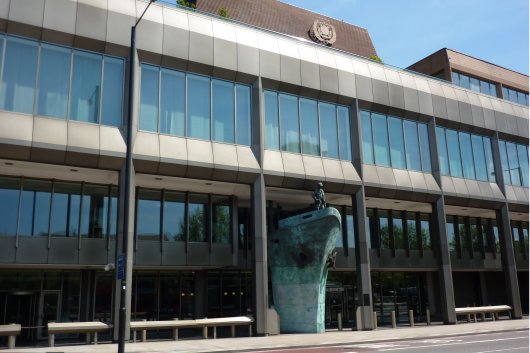
The International Maritime Organization's (IMO) Marine Environment Protection Committee (MEPC) is meeting for its 72nd session in London between April 9-13.
During the meeting, a number of bunker-related issues are scheduled to be discussed, including the implementation of the global sulphur limit in 2020; the mandatory data collection system for fuel oil consumption of ships; the fuel oil quality best practice guidance; the reduction of greenhouse gas emissions from ships; and measures to reduce risks of use and carriage of heavy fuel oil as fuel by ships in the Arctic.
A summary of the key issues has been provided below.
What?
Marine Environment Protection Committee (MEPC), 72nd session
Chair: Mr. Hideaki Saito (Japan)
When and where?
April 9-13, 2018, at IMO Headquarters in London.
Highlights
Implementation of sulphur 2020 limit
The 0.50% limit on sulphur in fuel oil on board ships (outside designated emission control areas or ECAs, where the limit is 0.10%) will come into effect on 1 January 2020.
The MEPC is expected to consider for approval, with a view to adoption at MEPC 73 (22-26 October 2018), draft amendments to MARPOL Annex VI to prohibit the carriage of non-compliant fuel oil.
The exception would be for ships fitted with an approved 'equivalent arrangement' to meet the sulphur limit - such as an exhaust gas cleaning system (EGCS) or so-called 'scrubber' - which are already permitted under regulation 4.1 of MARPOL Annex VI.
For a ship without an approved equivalent arrangement, the effect of the draft amendment, which would enter into force on 1 March 2020, would be that the sulphur content of any fuel oil used or carried for use on board shall not exceed 0.50%.
IMO's Sub-Committee on Pollution Prevention and Response (PPR) is currently developing guidelines to support the implementation of the 2020 sulphur limit. An intersessional working group will meet 9 to 13 July 2018. The MEPC will be asked to approve receiving draft guidelines on ship implementation planning for 2020 directly from the intersessional working group to MEPC 73 in October, in order to ensure appropriate guidelines can be considered by MEPC 73 and issued in good time.
Mandatory data collection system for fuel oil consumption of ships
MARPOL amendments to make mandatory the data collection system for fuel oil consumption of ships entered into force on March 1, 2018. They require data collection to start from calendar year 2019. MEPC 72 will be updated on the status of the development of the IMO Ship Fuel Oil Consumption Database, which was launched in March 2018. Relevant matters concerning implementation of the requirement are due to be considered.
Fuel oil quality - best practice guidance
The MEPC will consider draft best practice guidance for fuel oil purchasers/users; and for fuel oil providers.
The best practices are intended to assist in assuring the quality of fuel oil delivered to, and used onboard ships, with respect to both compliance with the MARPOL requirements and the safe and efficient operation of the ship.
Heavy fuel oil in the Arctic
The MEPC will consider the development of measures to reduce risks of use and carriage of heavy fuel oil as fuel by ships in Arctic waters.
The MEPC is expected to consider submitted proposals on what type of measures should be developed, with a view to giving clear instructions to the Sub-Committee on Prevention of Pollution (PPR 6) to start the work when it next meets in early 2019.
Currently, the use and carriage of heavy fuel oil is banned in the Antarctic under MARPOL Annex I regulation 43. It is recommended in the Polar Code that the same rules are applied in the Arctic.
Reduction of greenhouse gas emissions from ships
The MEPC is expected to adopt an initial strategy on the reduction of GHG emissions from ships.
The initial strategy will be a framework for Member States, which is expected to set out the future vision for international shipping, the levels of ambition to reduce GHG emissions and guiding principles; to include candidate short-, mid- and long-term further measures with possible timelines and their impacts on states as well as identify barriers and supportive measures including capacity building, technical cooperation and R&D.
It is anticipated that the MEPC will establish a working group on the reduction of GHG emissions from ships.
The Intersessional Working Group on Reduction of GHG Emissions from Ships, which holds its third meeting on April 3-6, is expected to finalize the text of the draft initial strategy and provide a report to MEPC 72.
Further work on energy efficiency requirements
Energy-efficiency design standards for new ships and associated operational energy-efficiency measures for existing ships became mandatory in 2013, with the entry into force of relevant amendments to MARPOL Annex VI.
The MEPC is expected to adopt draft amendments to regulation 21 of MARPOL Annex VI regarding Energy Efficiency Design Index (EEDI) requirements for ro-ro cargo and ro-ro passenger ships.
The Committee will be informed that over 2,700 new ocean-going ships have been certified as complying with the energy efficiency standards.
The MEPC will receive a report on progress by the correspondence group on review of the Energy Efficiency Design Index (EEDI) beyond phase 2. The correspondence group is expected to make an interim report to MEPC 73 (October 2018) with a final report to MEPC 74 (Spring 2019) providing a recommendation on the time period and reduction rates for EEDI phase 3 requirements.
Meeting information
Who?
All 172 IMO Member States and three Associate Members may attend as well as all Parties to MARPOL. Intergovernmental organizations and international non-governmental organizations are also invited.
Hours:
Morning, 09.30-12.30 (break: 11:00-11:30); afternoon, 14.30-17:30 (break 16:00-16:30)
Approval:
Final report and working group reports are expected to be approved on Friday, April 13.
Amendments are expected to be adopted on Friday, April 13.