Thu 23 Sep 2010, 19:25 GMT

Using existing technology to cut fuel costs


Manufacturer says fuel savings of up to 9% can be achieved by using its ‘next generation’ hull coating.


Ahead of the forthcoming Marine Environmental Protection Committee (MEPC) meeting, International Paint, a leading marine coatings manufacturer and part of AkzoNobel, today said that improved efficiency and reduced CO2 emissions can be achieved by utilizing simple, proven and readily available technology.

International Paint has pioneered the development of Fluoropolymer Foul Release technology, which is said to produce fuel savings and an associated emissions reduction of up to 9% as well as improved service speed. To date over 400 vessels are now using this technology, branded Intersleek 900, as a means of improving both operational and environmental efficiencies.

“If 400 vessels were using sails, solar power, or any other complex, high profile technology, the industry would be lauded as one of the world’s most environmentally progressive transport industries,” said John Wilsher, Market Manager, Intersleek, International Paint.

“The reality is that it is the simple, proven solutions that are already making a significant impact, without necessarily receiving the recognition they deserve at an international level.”

Wilsher continued: “It is becoming increasingly clear that ship owners and operators will struggle to fully embrace complex technologies that require specialist skills to operate and often engender high maintenance costs. The reality is that Fluoropolymer Foul Release technology is a quick win for the industry, and a great example of how a simply applied technology can have a huge impact on improving efficiency and reducing emissions. If Intersleek 900 was applied to the whole commercial fleet, CO2 emissions could be reduced by almost 100 million tonnes every year. Few, if any, technologies in other sectors can say that.”

"Fluoropolymer Foul Release technology is the most advanced ‘next generation’ hull coating within the shipping industry. The 9% reduction is a conservative estimate with some vessels realising significantly more and represents efficiencies gained over extended periods," International Paint added.


Map showing existing and planned Emission Control Areas (ECAs). IMO adopts Northeast Atlantic ECA covering waters from Portugal to Greenland  

New ECA to enter into force in September 2027, connecting existing European zones with Canadian Arctic waters.

Renewable and low-carbon methanol project pipeline chart as of April 2026. Renewable methanol project pipeline reaches 61 MMT as China groundbreakings accelerate  

GENA Solutions reports pipeline growth despite concerns over construction readiness for Chinese projects.

Rendering of a diesel-electric chemical tanker. Berg Propulsion to supply propulsion system for Akdeniz-built chemical tanker  

Turkish shipyard Akdeniz orders diesel-electric propulsion package for an 8,000-dwt vessel destined for Transka Tankers.

Ningyuan Diankun vessel. China Classification Society certifies 740-teu pure-electric container ship  

Ning Yuan Dian Kun features battery-swapping capability and is claimed to eliminate 1,462 tonnes of CO2 annually.

UK ETS and FuelEU Maritime event graphic. Lloyd’s Register to host UK ETS and FuelEU Maritime briefing in London  

Event on 12 May will examine maritime emissions regulations ahead of UK ETS expansion.

Ruri Planet vessel. Japanese shipbuilder delivers dual-fuel LNG bulk carrier Ruri Planet  

The 209,000-tonne Capesize vessel can run on heavy fuel oil or LNG.

L&T Energy GreenTech and Itochu agreement signing. L&T Energy GreenTech signs 300,000-tonne green ammonia supply deal with Itochu  

Indian firm to supply Japanese trading house from planned Kandla facility for marine fuel applications.

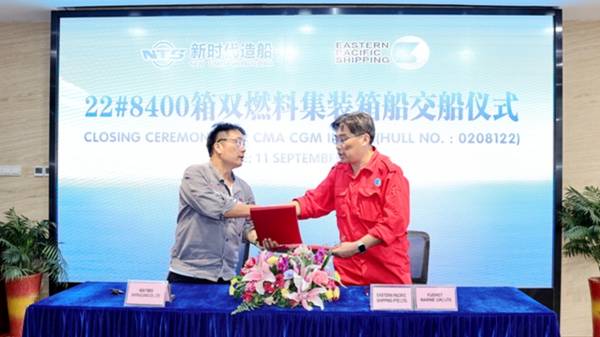
CMA CGM Iron vessel. Methanol-powered container ship is named CMA CGM D’Artagnan  

French shipping group adds vessel to methanol fleet as part of net-zero target.

Maersk Tahiti vessel. Bound4blue completes second suction sail installation for Maersk Tankers  

Four 24-metre eSAIL units fitted on Maersk Tahiti at Chinese shipyard in April.

Aerial view of Port of Yokohama. Asia-Pacific ports advance cross-sector hydrogen and e-fuel infrastructure  

Accelleron report highlights a coordinated approach combining energy, industry and shipping demand to stimulate market development.