Tue 8 Sep 2009, 15:16 GMT

UK Navy chooses 'fuel saving' technology


Navy aims to lower flagship fuel consumption and emissions with latest coating technology.


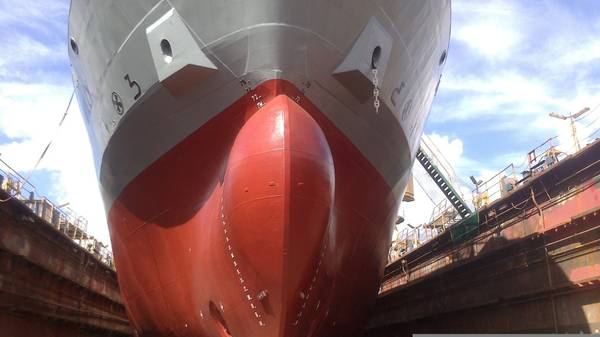
The UK’s Ministry of Defence (MoD) has selected coatings specialist International Paint to use its latest 'fuel saving' technology, Intersleek 900, for the hull of the UK Navy’s flagship ‘HMS Ark Royal’.

She is the latest UK MoD vessel to benefit from Intersleek foul release coatings which aim to cut fuel consumption and reduce emissions.

As part of the Ark Royal’s Contractor Support Period at Portsmouth Naval Dockyard in the UK, the 20,600 ton Invincible Class aircraft carrier has had her underwater hull coated with the company's premium fluoropolymer foul release coating, a move estimated to cut fuel costs by as much as 9% and reduce the 1985 built vessel’s emissions by a similar margin.

Since Intersleek 700 was applied to the hull of the Type 23 frigate HMS Northumberland in January 2005, no fewer than 18 UK Navy vessels have been coated with Intersleek foul release systems. Intersleek 700 has been applied to the hulls of four frigates and three recently built Type 45 destroyers whilst Intersleek 900 has been applied to a range of naval vessels including a Type 42 destroyer, six minesweepers, three new T45 destroyers, a helicopter carrier, a landing ship and a frigate.

“We are delighted that the Ministry of Defence has chosen the latest generation hull coating, Intersleek 900, for HMS Ark Royal”, said Matthew Goodall, International Paint’s UK Navy account manager.

“We already supply Intersleek 900 to a number of world navies which have confirmed substantial fuel savings, cuts in emissions and other in-service performance benefits. HMS Ark Royal is an icon and deserves the very best in coatings technology”.

Paul Scantlebury, Product Support Manager for BVT stated, “Foul release technology is a huge stride forward for underwater painting processes; it provides considerable cost savings over its life expectancy in both fuel and future docking plans."


IBIA MFM bunkering training course graphic. IBIA announces new date for mass flow meter training course in Rotterdam  

Training scheduled for 12 May follows mandatory MFM implementation at Rotterdam and Antwerp-Bruges ports.

A Maersk vessel, pictured from above. Maersk and Hapag-Lloyd suspend Strait of Hormuz transits amid Middle East security crisis  

Container carriers reroute services around the Cape of Good Hope as military conflict escalates.

Map of Middle East. Operations continue as normal at most Middle East ports  

Most facilities operating normally, with exceptions in Bahrain, Oman and Saudi Arabia.

Photograph of the 93,000-cbm very large ammonia carrier (VLAC) Gaz Ronin. Naftomar takes delivery of 93,000-cbm dual-fuel ammonia carrier  

Gaz Ronin features a MAN dual-fuel engine with high-pressure selective catalytic reduction technology.

Aurora Botnia leaving harbor. AYK Energy completes world’s largest marine battery retrofit on Wasaline ferry  

Aurora Botnia receives 10.4 MWh battery system, bringing total capacity to 12.6 MWh.

Steel cutting ceremony for an LNG dual-fuel 307,000-tonne crude oil tanker with builder's hull no. 113. Dalian Shipbuilding begins construction on LNG dual-fuel crude tanker  

Development is one of a number of milestones reported by parent company over the past few days.

Photograph of Sallaum Lines' Ocean Breeze vessel with 'Introducing The Blue Corridor' overlaid text. Sallaum Lines launches Blue Corridor sustainability initiative for Europe–Africa ro-ro trade  

Company deploys LNG-capable vessels with AI routing and eco-speed protocols on new green shipping corridor.

The platform supply vessel Viking Energy. Eidesvik Offshore signs yard contract for ammonia retrofit of PSV Viking Energy  

Halsnøy Dokk to convert platform supply vessel as part of EU-backed Apollo project.

Vanquish tanker alongside Jette Theresa oil/chemical tanker docked at terminal. North Sea Port completes risk analysis for alternative fuel bunkering operations  

Port authority says LNG, hydrogen, methanol and ammonia can be safely refuelled across its facilities.

Container ship near a port. Ammonia emerges as most feasible alternative fuel for deep-sea shipping in 2050 emissions study  

Research combining expert survey and technical analysis ranks ammonia ahead of hydrogen and methanol.


 Recommended