Fri 25 Sep 2009, 09:21 GMT

Fuel efficiency tops agenda at Canada meeting


Shipping firms convene to discuss the issue of how to make ships more fuel-efficient.


How to make ships more fuel-efficient?" This was the key question posed at the 15th Canadian Committee meeting of classification society Germanischer Lloyd (GL).

More than 20 representatives of the Canada and U.S. Flags, ship owners and operators, yards, consultants, and port authorities attended the event hosted by Executive Vice President Americas Capt. Kevin Coyne and Committee Chairman Peter Cairns from the Shipbuilding Association of Canada.

"Reducing the environmental impact of shipping in order to upgrade its image as an environmentally friendly mode of transportation, is one of the most important topics for the maritime industry," he said in his introduction. Apart from fuel efficiency and emissions also statutory delegation and ship recycling was on the agenda.

Canada is currently implementing a National Shipbuilding Procurement Strategy aimed at renewing the federal fleet and building world-class shipbuilding capability in Canada, while providing more predictable work for the maritime industry. The overall goal is to strengthen the competitiveness of Canadian shipbuilding yards vis-à-vis European yards in building complex ships.

Greatest savings during design phase

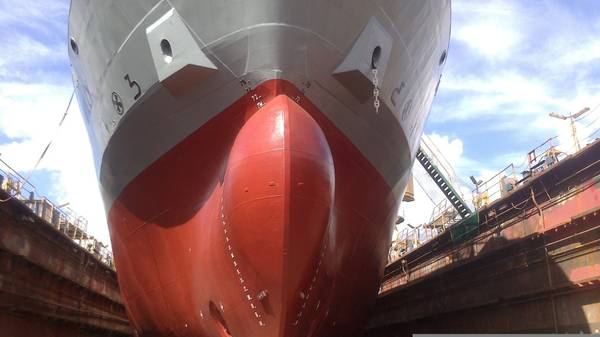
While there are significant savings from operational and low-level technical changes, the greatest savings generally can be achieved when engineering optimisations are taken into account, according to Germanischer Lloyd. The classification society says that most ships were designed for operating conditions that are no longer valid. For example, a ship with a design speed of 25 knots might be operated at 18 knots in today's environment. "Since its bulbous bow is not optimised for this speed, the generated wave patterns cause the water resistance to increase", explained Volker Höppner from GL subsidiary Future Ship. As a result, fuel costs rise.

But hull lines and bulbous bows alone are not the only determinants of resistance. Höppner said: "That is why FutureShip's ECO-Chances is designed to provide a holistic evaluation of a ship. Utilising advanced software tools, such as FutureShip's dedicated flow simulation/optimisation tools and powerful parametric modelling software, experts assess the ship from top to bottom to identify the most promising focus areas for optimisation." A typical evaluation might result in a series of five to six engineering options that offer significant fuel savings. These are presented with estimates of expected savings as well as estimated return on investment.

Some of the suggested options may require additional engineering before implementation. However, hydrodynamic optimisations, for example, often require detailed studies by experienced engineers with advanced software tools in order to optimise results. For these situations, FutureShip says it offers the services of their engineering experts and partners in the form of its ECO-Solutions service.

FutureShip offers a catalogue of services with a common objective: optimizing ships, both those in operation and those yet to be built. Services also comprise the FuelSaver programme, including CO2-analysis (ECO-Patterns) and operational fuel consumption analysis (ECO-Practices) services.


Monjasa Oil & Shipping Trainee (MOST) trainees. Monjasa opens applications for global trainee programme  

Marine fuel supplier seeks candidates for MOST scheme spanning offices from Singapore to New York.

Singapore's first fully electric harbour tug. Singapore's first fully electric tug completes commissioning ahead of April deployment  

PaxOcean and ABB’s 50-tonne bollard-pull vessel represents an early step in harbour craft electrification.

Fuel for thought: Hydrogen report cover. Lloyd's Register report examines hydrogen's potential and challenges for decarbonisation  

Classification society highlights fuel's promise alongside safety, infrastructure, and cost barriers limiting maritime adoption.

Bureau Veritas and Straits Bio-LNG sign MoU. BV Malaysia partners with Straits Bio-LNG on sustainable biomethane certification  

MoU aims to establish ISCC EU-certified biomethane production and liquefaction facility in strategic alliance.

Molgas Energy logo. Molgas becomes non-clearing member at European Energy Exchange  

Spanish energy company joins EEX as it expands European operations and strengthens shipper role.

Yiannis Diamandopoulos, Elinoil. Diamandopoulos appointed CEO of Elinoil as Aligizakis becomes chairman  

Greek marine lube supplier announces leadership changes following board meeting on 5 January.

Sustainable Marine Fuel Services webinar hosted by BV graphic. Bureau Veritas to host webinar on sustainable marine fuel transition challenges  

Classification society to address regulatory compliance, market trends, and investment strategies in February online event.

Inchcape Shipping Services logo. Inchcape to provide bunkering services from new Indonesian offices  

Port agency establishes presence in key bulk and tanker operation hubs handling 150 calls annually.

CPN launch of B100 marine biodiesel supply in Hong Kong graphic. Chimbusco Pan Nation launches B100 biodiesel supply in Hong Kong  

Bunker tanker Guo Si becomes Hong Kong's first Type II certified vessel for pure biodiesel operations.

Vox Apolonia vessel. Van Oord completes Dutch beach replenishment using 100% bio-LNG  

Dredger Vox Apolonia deposited 1 million cbm of sand at Noord-Beveland beach under Coastline Care programme.


 Recommended