Wed 7 Apr 2021, 15:34 GMT

World's first hydrogen cargo vessel set for Paris launch


Plan to have newbuild running on hydrogen by the end of 2021.


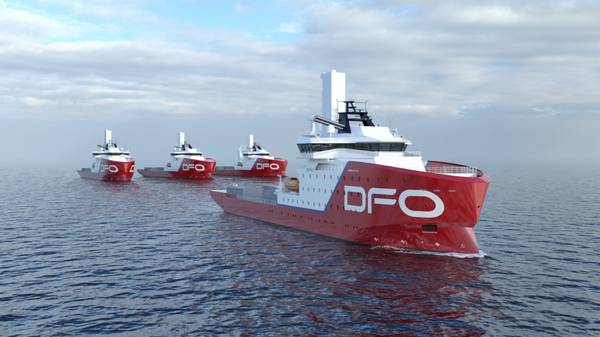
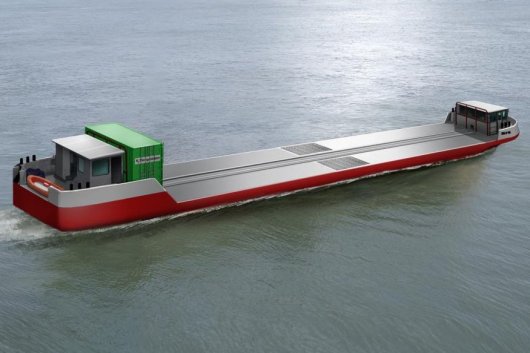
Illustration of the Flagships project vessel, set to be the world's first commercial cargo transport vessel to operate on hydrogen.
Image credit: Flagships
The innovation project Flagships is set to deploy the world's first commercial cargo transport vessel to run on hydrogen within the next few months.

A hydrogen-powered vessel owned by French inland shipowner Compagnie Fluvial de Transport (CFT), a subsidiary of Sogestran Group, is due to begin commercial operations along the river Seine in Paris later this year.

The vessel will operate on compressed hydrogen produced from electrolysis, enabling zero-emission operations.

The power generation system is supplied by ABB Marine & Ports, with fuel cells from Ballard. LMG Marin, meanwhile, is responsible for the vessel design, with hydrogen provided by local suppliers in the Paris region.

Funding and project development

The Flagships project was awarded EUR 5m of funding in 2018 from the EU's research and innovation programme Horizon 2020, under the Fuel Cells and Hydrogen Joint Undertaking (FCH JU) - a public-private partnership supporting research, technological development and demonstration (RTD) activities in fuel cell and hydrogen energy technologies in Europe - to deploy two hydrogen vessels in France and Norway.

The project's initial plan was to deploy a hydrogen push boat in the Lyon area, but as the broader potential for hydrogen in cargo transport emerged, the demo pusher was changed to an inland cargo vessel. The new vessel will instead be tasked with moving goods on pallets and in containers along the river Seine.

The shift in focus to an inland cargo vessel was based on the experience gained by Sogestran in Belgium, where Blue Line Logistics (BLL), another of its subsidiaries, operates three cargo vessels sailing under the concept name 'Zulu'.

One Zulu vessel has also been put into operation in Paris, and an additional two Zulu ships are currently under construction for the same market.

The Flagships project will install a hydrogen power generation system on one of the newbuilds, scheduled for delivery in September 2021.

Blue Line Logistics plans to have the ship operating on hydrogen before the end of 2021.

Commenting on the milestone project and the future, Bart Biebuyck, Executive Director at FCH JU, observed: "As we move through the energy transition, hydrogen technologies are gaining traction in the maritime sector. Flagships is a very exciting project for us, since it is leading the way to demonstrate how vessels operating on green hydrogen can decarbonise urban rivers. By translating technological innovations into commercial operations we can make zero-emissions inland vessels a reality in every European city!"

Flagships consortium

The Flagships consortium includes 12 European partners, with two shipowners - France's CFT and Norled of Norway - assisted by French support companies Sogestion and Sogestran.

The maritime OEM and integrator companies are Finnish firm ABB Marine & Ports and Norway's Westcon Power & Automation, whilst LMG Marin is responsible for the ship design.

Fuel cell technology is provided by Denmark-based Ballard Europe, with vessel energy monitoring and management by France's Pers-EE.


Kris Vedat, SmartSea. Smart ships failing to convert data into actionable intelligence, warns SmartSea  

Maritime technology firm claims vessels collect vast amounts of data but lack integration to support decision-making.

Energy Transition Outlook 2026 Hydrogen To 2060 report cover. DNV forecasts 100-fold growth in clean hydrogen by 2060, with China leading expansion  

Classification society projects $3.2tn investment in hydrogen sector, with maritime accounting for 15% of clean hydrogen use.

World Shipping Council logo. Dual-fuel container ship and vehicle carrier fleet surpasses 1,200 vessels  

World Shipping Council reports 65% year-on-year increase in operational dual-fuel vessels to 440 ships.

Sotiris Raptis, ECSA. European Shipowners calls for ETS revenue investment and fuel supplier mandate  

ECSA urges the EU to invest €9bn in annual ETS revenues in fuel production and infrastructure.

Sheen Mao Choong, SSA. Singapore bunker industry urged to prioritise resilience and collaboration  

SSA committee vice chair highlights energy security and crisis readiness at Marine Fuels Forum 2026.

Chia How Khee, TFG Marine and David Foo, MPA. TFG Marine receives bunker safety award from Singapore maritime authority  

Marine fuel supplier recognised for safety standards and operational performance at MPA Marine Fuel Forum.

Rotterdam skyline at night. Bunker surveyor sought in Rotterdam to meet increased demand  

Dutch firm MCE Marine Surveyors is recruiting for a quantitative fuel inspection role.

Emma Roberts, BHP. GCMD highlights BHP biofuel trials to address scaling challenges in maritime decarbonisation  

Mining company discusses need for traceability and coordinated progress across supply, cost and operational readiness.

Levante LNG vessel. Peninsula implements energy efficiency measures across bunker supply fleet  

Marine fuel supplier focusing on data-driven upgrades and operational measures to cut consumption.

Aerial view of a biogas plant. Centrica Energy gains ISCC certification to trade certified bio-LNG  

The energy trading arm of Centrica plc can now trade certified bio-LNG with customers.