Thu 4 Oct 2018, 11:14 GMT

Blockchain emissions MRV solution wins MIT Solve competition


MIT accolade goes to blockchain application designed to secure the chain of custody for marine fuel data.


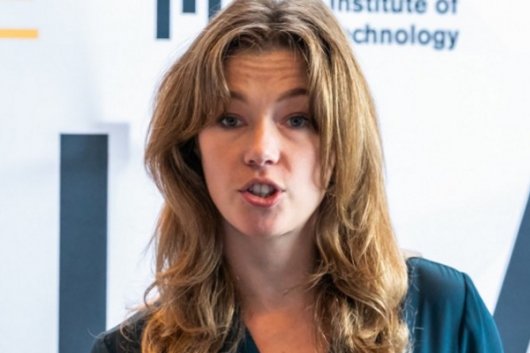
Deanna MacDonald, CEO of BLOC, presenting at the MIT's Solve Coastal Communities Challenge, for its work in developing emissions monitoring, reporting and verification (MRV) solutions for shipping.
Image credit: Blockchain Labs for Open Collaboration (BLOC)
Blockchain technology and governance specialist, Blockchain Labs for Open Collaboration (BLOC), has won the Massachusetts Institute of Technology (MIT) Solve Coastal Communities Challenge, for its work in developing emissions monitoring, reporting and verification (MRV) solutions for shipping.

BLOC was selected from 33 teams participating in the Solve Challenge Finals, which included a live pitch event at the UN General Assembly in New York.

The Solver teams were selected by Solve's Challenge Leadership Group judges as the most promising set of solutions tackling large-scale global challenges.

BLOC's MRV application focuses on building digital infrastructure to enhance coastal community health and safety through traceability of shipping emissions.

The solution is designed to secure the chain of custody for marine fuel data using blockchain in a real-world setting, thereby creating a decision support system for enforcing and complying with global environmental regulations, including the upcoming IMO 2020 sulphur cap, which will see the majority of the international shipping industry switch from using heavy fuel oil.

The MRV application builds upon the Marine Fuel Assurance prototype funded by Lloyd's Register Foundation as part of BLOC's Maritime Blockchain Labs (MBL) initiative.

Deanna MacDonald, CEO of BLOC, commented: "We are proud to have been a part of the MIT Solve competition and a winner in the Coastal Communities Challenge. Not only does this validate the importance of a solution to the fuels challenges in the shipping sector, it also provides us with a platform to create awareness and partnerships to bring this solution to market. Shipping emissions affect every corner of the world and yet have been largely ignored, this system will be a part of the shift towards solving this challenge with better global regulations and low-sulphur, compliant fuel for the maritime sector and we are thrilled to have the MIT Solve community supporting us in this endeavour."

MIT Solve's Executive Director, Alex Amouyel, remarked: "We are incredibly inspired by each new Solver selected at Solve Challenge Finals as they advance solutions to four of the world's biggest challenges. We had incredible diversity of solutions-nonprofits, for-profits, academic projects, all ages, and over 110 countries were represented. The judges had the difficult task of choosing the most promising ones.

"Today is just the start of the journey for our Solver teams; this is when the real work begins to broker partnerships with Solve members and partners on behalf of these innovators. We want to support our Solver teams so they can access mentors and experts to help validate and scale their solutions, as well as additional follow-on funding and in-kind resources."

BLOC is an organisation established to drive open, collaborative research and the prototyping of solutions that bridge the digital and the physical divide to solve global challenges.

BLOC's work in maritime is handled through Maritime Blockchain Labs (MBL), an industry consortium made up of stakeholders across the shipping industry which is funded by the Lloyd's Register Foundation.


Bermuda Container Line (BCL) logo. Bermuda Container Line imposes emergency bunker surcharge citing Iran War fuel price spike  

Shipping operator to add $150 per TEU charge from 1 May amid geopolitical fuel cost pressures.

China flag. Zhejiang’s first methanol-powered container ship launches in Jiaxing  

Vessel uses methanol propulsion technology to reduce carbon dioxide emissions by 90%.

TES flag with a model vessel in the background. TES joins SEA-LNG coalition to advance e-methane as marine fuel  

Green energy company targets 1m tonnes annual e-methane production by 2030 for shipping decarbonisation.

Ethanol and methanol workshop graphic. IBIA to host workshop on ethanol and methanol marine fuels during Singapore Maritime Week  

Half-day event will examine alcohol-based fuel pathways and integration into shipping’s multi-fuel landscape.

Steel-cutting ceremony for 13,000-dwt vessel. ROC begins construction of second chemical tanker for Essberger  

Chinese shipbuilder holds steel-cutting ceremony for 13,000-dwt methanol-ready vessel with ice class capability.

Norsepower and CHIC sign agreement. Norsepower and Cosco Shipping Heavy Industry Equipment sign wind propulsion cooperation agreement  

Wind propulsion technology provider partners with Chinese shipyard to scale rotor sail production.

Wärtsilä logo. Shipping firms struggle to prioritise decarbonisation investments amid regulatory uncertainty, Wärtsilä survey finds  

Survey of 225 maritime executives reveals 70% say uncertainty hinders investment decisions despite regulatory pressure.

IMT Isca G-Flex vessel render. Longitude Engineering unveils IMT Isca G-Flex PSV design with alternative fuel capability  

Naval architecture firm launches adaptable platform support vessel design based on the IMT-984 G-Class hull.

Philippos Ioulianou, EmissionLink. Shore power infrastructure is key to cutting ferry emissions in European cities, says EmissionLink  

Port electrification is needed to enable vessels to switch off engines at berth, reducing urban pollution.

Maritime and Port Authority of Singapore logo. Singapore prioritises maritime resilience amid geopolitical uncertainty, eyes digitalisation and green fuels  

MPA chief outlines the sector’s adaptation to supply chain disruptions while advancing automation and alternative fuels.