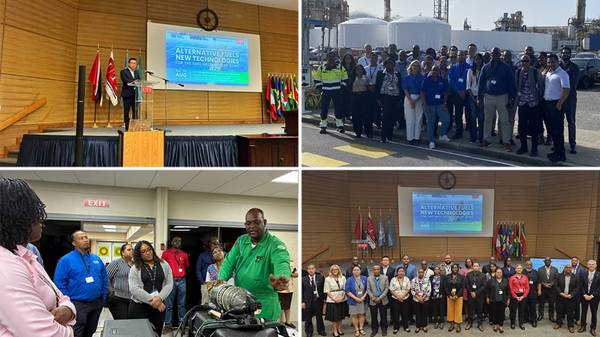
On December 4, the Pacific Merchant Shipping Association hosted The Future of Marine Fuels: Emission Control Area and Liquefied Natural Gas Conference in San Pedro, California.
Representing the U.S Coast Guard's (USCG)
Liquefied Gas Carrier National Center of Expertise, or LGC NCOE, were lieutenant commander
Anthony Hillenbrand and senior marine inspector
Scott LaBurn.
As a speaker and a panelist, Hillenbrand addressed over 50 industry, state and local agency representatives. His comments focused on services provided by the LCG NCOE and the status of national policies regulating LNG-fuelled vessels and LNG bunkering processes.
LGC NCOE
The LGC NCOE is one of six NCOEs in the United States focusing on providing consultation and technical services to the marine industry and Coast Guard on matters related to liquefied gas carriers; assist Coast Guard units with foreign gas carrier examinations; provide training opportunities to the Coast Guard and industry; and provide technical expertise to the development of regulations and policy.
Current Projects
The LGC NCOE predicts that liquefied gas carrier arrivals to the United States will grow from approximately 1,000 carriers per year to 3,800 carriers per year as proposed LNG export facilities gain federal and state approval and complete construction. To meet this projected demand, the LGC NCOE said it is working closely with Coast Guard headquarters, Force Readiness Command, and local units to ensure proper and timely training and personnel qualifications are being accomplished.
The LGC NCOE is also actively engaged in LNG bunkering. There are currently 10 dual-fuel vessels under construction or scheduled for construction.
Current Policy
Coast Guard policy currently being drafted include CG-OES Policy Letter 01-14 Guidelines for LNG Fuel Transfer Operations and Training of Personnel on Vessels Using Natural Gas as Fuel and CG-OES Policy Letter 02-14 Guidance Related to Vessels and Waterfront Facilities Conducting LNG Marine Fuel Transfer (Bunkering) Operations. Policy letter CG-01-12 Equivalency Determination – Design Criteria for Natural Gas Fuel Systems was approved and has been enforce since 2012.
The International Maritime Organization’s (IMO) current guidance concerning LNG-fuelled vessels is Resolution MSC.258 (86) Interim Guidelines on Safety for Natural Gas-Fuelled Engine Installations in Ships. This IMO guideline is effective until the new International Code of Safety for Gas-Fueled Ships (IGF Code) is approved, which is expected in 2017.