This is a legacy page. Please click here to view the latest version.
Tue 16 Oct 2018, 10:04 GMT

ONE revises earnings and bunker price forecasts downwards


Predicts full-year loss of $600m and average bunker price of $451.


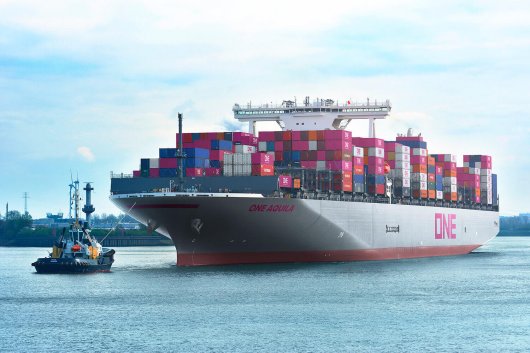
The container vessel One Aquila, operated by Ocean Network Express (ONE).
Image credit: Ocean Network Express (ONE)
Japan's Ocean Network Express Holdings, Ltd. (ONE) - a holding company for the container shipping businesses of parent companies Kawasaki Kisen Kaisha (K Line), Mitsui O.S.K. Lines (MOL) and Nippon Yusen Kaisha (NYK Line) - has revised its forecast for the first half (H1) and full year downwards.

As previously reported, ONE had expected to achieve a full-year (April 2018 to March 2019) net profit of $110m, but now predicts that it will instead post a loss after tax of $600m - $710m lower than the amount projected at the end of July.

And for H1 (April to September 2018), ONE anticipates a net loss of $310m - which is $272m below the $38m loss forecast two-and-a-half months ago.

Bunker prices revised downwards

In terms of bunker prices for H1 and the full year, ONE has actually revised its average figures slightly downwards for both periods.

ONE's full-year forecast is now $451 per tonne, which is $3 lower than July's price prediction, but still $68, or 17.8 percent, higher than April's $383-per-tonne expected figure.

And for H1, the revised average bunker price is $6 lower than July at $434 per tonne.

Reasons for downward revision

ONE said the two main reasons for the downward revision were the "stagnation" of liftings and utilization, and its inability to reduce costs sufficiently to address the rise in bunker prices.

Reasons for drop in liftings and utilization

Explaining the reason for the drop in liftings and utilization, ONE said it was due to "teething problems" - where staff were "short-handed" and "not completely familiarized with the newly introduced IT system" - when the new service was launched in April, and that it later "sought to regain lost ground during the peak season from July to September, but liftings and utilization remained lower than the outlook because the negative impact remained on its main Asia-North America routes and Intra-Asia routes".

ONE noted that the initial "teething problems" had been resolved - with staff shortages and skill levels addressed - but that "liftings and utilization are still on the way to recovery, and the target for additional cost reduction to address increased bunker prices, is expected to be lower than the target in the previously announced forecast".

Q1 results

As previously reported, the average bunker price paid by ONE's vessels between April and June was $407 per tonne, with the company posting a net loss after tax of $120m, which was said to be mainly due to higher-than-anticipated bunker prices and operational teething issues during the firm's start-up period.


Tangier Maersk vessel. Maersk takes delivery of first methanol-capable vessel in 9,000-teu series  

Tangier Maersk is the first of six mid-size container ships with methanol-capable dual-fuel engines.

IBIA MFM bunkering training course graphic. IBIA to run surveyor training course for mass flow meter-equipped bunkering in Rotterdam  

One-day course scheduled for 19 February aims to prepare professionals for MFM-equipped bunkering operations.

CO2 carrier vessel aerial view. MOL secures two 12,000-cbm CO2 carriers for Northern Lights expansion  

Japanese shipowner to deliver vessels in 2028 for cross-border carbon transport and storage project.

MOL and ONGC VLEC long-term charter signing. MOL and ONGC sign 15-year charter deal for two ethane carriers  

Japanese shipowner expands fleet to 16 vessels with newbuildings scheduled for delivery in 2028.

Vessels at sea. Dual-fuel container ship and vehicle carrier fleet reaches 400 vessels  

World Shipping Council reports 83% increase in operational dual-fuel vessels during 2025.

Photograph of a blue cargo vessel. Lloyd’s Register publishes first guidance notes for onboard hydrogen generation systems  

Classification society addresses regulatory gap as shipowners explore producing hydrogen from alternative fuels onboard.

Erasmusbrug bridge in Rotterdam. Rotterdam bunker industry faces upheaval as new regulations drive up costs and shift volumes  

Red III compliance costs and a mass flow meter mandate are creating operational challenges across the ARA region.

Neil Chapman, VPS. VPS appoints Neil Chapman as managing director for the Americas  

Maritime services company names industry veteran to lead regional operations and client partnerships.

Oil refinery infrastructure. Maritime industry shifts towards LNG as alternative fuel enthusiasm stalls  

Geopolitical concerns drive shipping leaders to prioritise established fuels over newer alternatives, survey finds.

OceanScore logo. OceanScore reaches $5m annual recurring revenue as emissions compliance demand grows  

Hamburg-based firm supports compliance workflows for more than 2,500 vessels as regulations enter operational phases.


↑  Back to Top


 Recommended