This is a legacy page. Please click here to view the latest version.
Mon 20 Aug 2018, 13:42 GMT

Vopak and Maersk to launch 0.5%S bunkering facility in Rotterdam


Anchor tenant Maersk to blend, store, handle and supply 2020-compliant fuel for ships calling at the Dutch port.


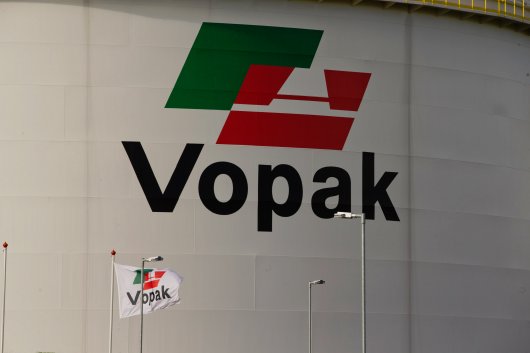
Vopak storage tank, pictured on September 17, 2013.
Image credit: Flickr
Royal Vopak has teamed up with A.P. Moller - Maersk to provide the Danish boxship operator with a 0.5-percent-sulphur-fuel bunkering facility at Europe's biggest bunkering port, Rotterdam.

The facility, located at Vopak Terminal Europoort, will enable Maersk to blend, store and handle different fuel types to ensure full compliance with the upcoming 0.5 percent global cap on fuel sulphur content in 2020.

As an anchor tenant in the modified facilities, Maersk, as well as any other interested third parties, will be able to supply vessels at the Dutch port with compliant fuels.

The joint initiative is expected to cater for around 2.3m metric tonnes per year - or roughly 20 percent of Maersk's global demand. As previously reported, Maersk consumed 6.131m tonnes of fuel in the first half of this year, and looks set to burn more than 12m tonnes in 2018 following November's acquisition of Hamburg Sud.

Commenting on the agreement, Maersk explained that its tie-up with Vopak addresses concerns regarding the handling and compatibility of fuels in the run-up to 2020.

"Member States within the International Maritime Organization, IMO, recently recognized that there are still some reservations and challenges relating to fuel handling and compatibility and this project plays a key role in providing A.P. Moller - Maersk with supply chain assurance looking at both quality and quantity of the compliant fuel," Maersk said.

"This long-term commitment with Vopak prepares A. P. Moller - Maersk for the paradigm shift of the 2020 IMO rules on sulphur, which will be a game changer for the entire industry," Maersk also noted.

Niels Henrik Lindegaard, Head of Maersk Oil Trading - ranked as Singapore's 27th-biggest bunker supplier in 2017 - remarked: "We trust that this initiative will put to rest some of the concerns the industry has on fuel availability as well as secure our continued competitiveness in the market."

Hari Dattatreya, Global Oil Director Royal Vopak, said: "We are very proud to serve A.P. Moller - Maersk with this dedicated 0.5% sulphur bunkering point in the heart of Rotterdam. With A.P. Moller - Maersk as an anchor customer, Vopak demonstrates the focus to position itself in the 0,5% sulphur fuels bunker market. We are dedicated to serve our customers to comply with the IMO 2020 regulations in the key global bunker hubs around the world."

Rotterdam bunker pricing

In its last financial report, released on Friday, Maersk observed that Rotterdam bunker prices in the second quarter (Q2) of 2018 were up year-on-year (YoY) by 43 percent, and 13 percent higher compared to Q1.

The shipper also posited that "forward market pricing points to bunker prices increasing by a further 2.4% in the second half of 2018 compared to Q2 2018. Thereafter, forward markets point to a 20% decline in bunker prices by Q4 2019".

"The anticipated decline [by Q4 2019] is driven by a wider bunker-crude oil spread, reflecting the market's view of the impact of the IMO 2020 sulphur regulations on demand for high[-]sulphur bunker fuels," Maersk added.


Areion vessel. Dorian LPG takes delivery of dual-fuel VLGC capable of carrying ammonia  

The 93,000-cbm Areion can run on LPG or fuel oil and transport ammonia cargoes.

FSRU Toscana alongside Green Zeebrugge vessel. RINA awards ISCC EU certification to OLT Offshore LNG Toscana for bio-LNG supply  

Certification enables bio-LNG use in the EU as a renewable fuel under RED II and RED III directives.

World Shipping Council at IMO meeting. WSC calls for safe maritime corridor as 20,000 seafarers remain trapped in the Persian Gulf  

Industry body urges IMO member states to establish safe passage and supply access.

Graphic promoting Auramarine webinar titled 'Sustainable Fueling Part 3: Ammonia - next alternative fuel in marine'. Auramarine to host webinar on ammonia as marine fuel in April  

Finnish firm will explore ammonia’s role in maritime decarbonisation at its third spring webinar.

Front cover of study by WinGD and Envision Energy titled 'Renewable Fuel Economics: An OPEX illustration based on current costs'. Green ammonia could reach cost parity with VLSFO and LNG by 2050, study finds  

WinGD and Envision Energy study projects green ammonia operational costs competitive with conventional marine fuels.

Elenger Marine's LNG bunkering vessel Optimus alongside Brittany Ferries’ Saint-Malo. Bureau Veritas verifies methane emissions on Brittany Ferries’ LNG vessels  

Verification enables ferry operator to report measured methane slip instead of regulatory default values.

Map showing existing and planned Emission Control Areas (ECAs). Alliance calls for urgent black carbon action as new Arctic emission control areas take effect  

Canadian Arctic and Norwegian Sea ECAs now in force, with compliance deadline set for March 2027.

Artistic impression of battery-electric ferry for operation on Perth’s Swan River. Lloyd’s Register to class Western Australia’s first electric ferry fleet  

Echo Marine Group partners with Lloyd’s Register on five battery-electric ferries for Perth’s Swan River.

Thomas Kazakos, secretary general of The International Chamber of Shipping (ICS). ICS condemns Middle East shipping attacks as 20,000 seafarers remain trapped  

Industry body calls for urgent state action to resupply vessels and enable crew changes.

Molslinjen ferry illustration. Molslinjen order propels Australia to top of battery vessel production rankings  

Danish ferry operator’s three-catamaran order at Incat Tasmania shifts global manufacturing landscape, analysis shows.


↑  Back to Top