Lading marine and offshore classification society, The
American Bureau of Shipping (ABS), has granted approval in principle (AIP) to a new liquefied natural gas (LNG) and regasification articulated tug barge concept introduced by
Waller Marine Inc.
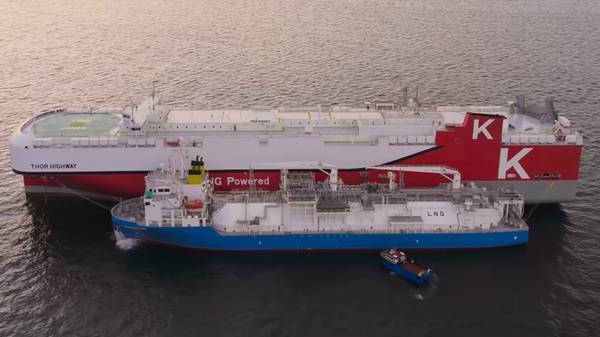
The vessel has the ability to load LNG from existing LNG terminals, liquefaction facilities or traditional LNG carriers and transport the LNG to existing tanks, traditional LNG carriers, trucks or marine vessels using LNG as a fuel.
The barge also is equipped for regasification of LNG directly to a pipeline or to a power plant. An additional feature will be the use of natural gas as a fuel in the dual fuel engines of the tug to drive the tug-barge unit.
According to ABS, the benefit of the LNG articulated tug and barge regas vessel (ATB RV) is that it allows LNG to be moved and delivered more efficiently on a small-scale basis in locations where large LNG infrastructure would be cumbersome, costly and time consuming.
The barge will be fitted with independent Type 'C' LNG tanks. To make most efficient use of the hull volume and maximize the cargo-carrying capacity of the barge, bi-lobe tanks of maximum width are centered along the barge centerline. The cargo containment system is split into four longitudinally located independent tanks, with each tank supported by a simple structure that isolates the tanks from hull loads. According to Waller Marine, these tanks will be constructed of either 9 percent nickel steel or stainless steel AISI 304L to contain the cargo at a minimum temperature of -163°C.
ABS worked with Waller from the inception of the project and has been the primary certification body in carrying out reviews, including conducting a program review.
“ABS has been a great resource in developing the LNG ATB RV product,” commented
Bill Hutchins, Waller Marine Vice President, Gas Solutions. “By conducting multiple meetings – including a HAZID (hazard identification) – ABS has helped us to ensure safety and regulatory aspects have been appropriately addressed.”
“ABS has worked closely with Waller Marine through the development of the LNG ATB RV,” said
Roy Bleiberg, ABS Director of Engineering, Americas Division. “We are pleased to be part of a project with the potential to improve the environmental impact of hydrocarbon emissions.”
Since AIP was granted, Waller Marine has moved into the detail design phase with a goal of creating multiple variations for clients around the world.