Wed 24 Oct 2018, 00:03 GMT

Experience-building phase gains support at MEPC 73


Issue set to be debated again on Wednesday before decision is made on whether the EBP is passed on to a working group.


A number of countries - including the Democratic People's Republic of Korea, Panama and the US - are understood to have spoken in favour of the experience-building phase (EBP) during Tuesday's session.
Image credit: Flickr
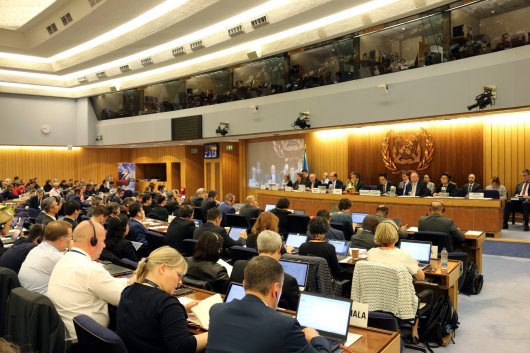
The proposed experience-building phase (EBP) - a data-gathering period with the purpose of providing greater transparency and detailed information on the compliance situation after the implementation of the global 0.5 percent cap on fuel sulphur content on January 1, 2020 - gained support from a number of member states during the second day of the International Maritime Organization's (IMO) 73rd Marine Environment Protection Committee meeting (MEPC 73).

Co-sponsored by the Bahamas, Liberia, Marshall Islands, Panama, BIMCO, Intercargo and Intertanko, the EBP concept was submitted to the MEPC in an August 31 document, MEPC 73/5/14, which last week also received the backing of the Trump Administration after the White House declared that it was throwing its support behind the EBP "in order to mitigate the impact of precipitous fuel cost increases on consumers".

During proceedings at IMO headquarters on Tuesday, a number of countries are understood to have spoken in favour of the EBP, including the Democratic People's Republic of Korea, Panama and the US.

The issue is set to be debated again on Wednesday, with as many as 20 member states set to speak before a decision is made regarding whether the EBP is passed on to a working group to formulate a plan.

Earlier this month, the EBP co-sponsors moved to clarify any "misconceptions" about their proposal. In a statement, they explained that they were "fully committed" to a January 1, 2020 sulphur cap implementation date, and that the EBP was not seeking to delay the adoption of the MARPOL Annex VI amendments prohibiting carriage of non-compliant fuel oil.

Also, rather than delay or weaken the enforcement provisions of MARPOL Annex VI, the co-sponsors said they are seeking to facilitate "a pragmatic approach" by Administrations in situations where a ship is not able to achieve compliance due to fuel non-availability and fuel quality problems, and that their aim is to provide greater transparency so that appropriate enforcement action in non-compliance situations is carried out in a consistent manner.

Furthermore, the EBP backers explained that a possible review of the regulatory framework of MARPOL Annex VI could not delay the implementation of the sulphur cap after it has already come into effect, and that it would only be possible to ascertain whether any improvements to the regulatory framework were necessary after knowing the actual implementation situation after January 1, 2020.

The co-sponsors conceptualize the EBP as a formalized data collection and analysis measure to closely monitor the implementation of the sulphur cap.

They envisage specific details on the plan for the data gathering and analysis to be developed during the period between MEPC 73 and MEPC 74 - either through expansion of the IMO GISIS database, or another separate reporting platform.

Their proposal does not include a fixed time frame, so that there is sufficient flexibility for it to be either shortened or extended to conclude when the fuel oil availability situation "stabilizes" globally.


WinGD methanol and ethanol webinar invitation. WinGD to host webinar on methanol- and ethanol-flexible fuel engine technology  

Engine manufacturer will discuss market outlook, regulations and operational experience with alcohol-based marine fuels.

Peninsula graduate programme group photo. Peninsula opens applications for 2026 graduate programmes in marine fuels trading  

Two-year scheme offers positions across six global locations starting in September, combining hands-on experience with structured development.

Collin She, Oilmar DMCC. Oilmar DMCC promotes Collin She to key account manager role  

She will lead strategic customer relationships and drive growth opportunities in Singapore and the wider region.

CM Hong Kong alongside Gang Rong vessel. Hong Kong completes first green methanol bunkering with CCS support  

China Classification Society provides technical oversight for methanol-fuelled vessel's inaugural Hong Kong refuelling operation.

Areion vessel. Dorian LPG takes delivery of dual-fuel VLGC capable of carrying ammonia  

The 93,000-cbm Areion can run on LPG or fuel oil and transport ammonia cargoes.

FSRU Toscana alongside Green Zeebrugge vessel. RINA awards ISCC EU certification to OLT Offshore LNG Toscana for bio-LNG supply  

Certification enables bio-LNG use in the EU as a renewable fuel under RED II and RED III directives.

World Shipping Council at IMO meeting. WSC calls for safe maritime corridor as 20,000 seafarers remain trapped in the Persian Gulf  

Industry body urges IMO member states to establish safe passage and supply access.

Graphic promoting Auramarine webinar titled 'Sustainable Fueling Part 3: Ammonia - next alternative fuel in marine'. Auramarine to host webinar on ammonia as marine fuel in April  

Finnish firm will explore ammonia’s role in maritime decarbonisation at its third spring webinar.

Front cover of study by WinGD and Envision Energy titled 'Renewable Fuel Economics: An OPEX illustration based on current costs'. Green ammonia could reach cost parity with VLSFO and LNG by 2050, study finds  

WinGD and Envision Energy study projects green ammonia operational costs competitive with conventional marine fuels.

Elenger Marine's LNG bunkering vessel Optimus alongside Brittany Ferries’ Saint-Malo. Bureau Veritas verifies methane emissions on Brittany Ferries’ LNG vessels  

Verification enables ferry operator to report measured methane slip instead of regulatory default values.