Fri 19 Oct 2018, 09:01 GMT

Bunker issues pack MEPC 73 agenda


Various marine fuel-related issues to be covered at next week's MEPC meeting in London.


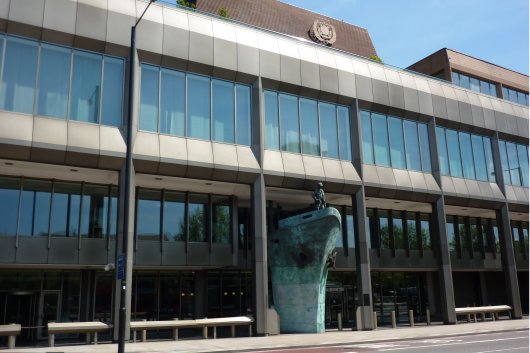
The International Maritime Organization's (IMO) headquarters in London.
Image credit: Flickr
The International Maritime Organization's (IMO) Marine Environment Protection Committee (MEPC) is meeting for its 73rd session in London between October 22-26.

During the meeting, a number of bunker-related issues are scheduled to be discussed, including the implementation of the global sulphur limit in 2020; the reduction of greenhouse gas emissions from ships; the use and carriage of heavy fuel oil as fuel by ships in the Arctic; and work on the energy efficiency of ships.

What?

Marine Environment Protection Committee (MEPC), 73rd session

Chair: Mr. Hideaki Saito (Japan)

When and where?

October 22-26, 2018, at IMO Headquarters in London.

Highlights

Implementation of sulphur 2020 limit

The new lower 0.5 percent limit on the sulphur content of marine fuel will be in force from January 1, 2020, under IMO's MARPOL treaty. The new limit will be applicable globally, while in designated Emission Control Areas (ECAs) the limit will remain even lower, at 0.1 percent.

The January 1, 2020 implementation date was adopted in 2008 and confirmed by IMO in October 2016, giving certainty to refineries, bunkering and shipping sectors.

IMO has been working with member states and the industry to support the implementation of the new limit. MEPC 73 is expected to approve ship implementation planning guidance as well as best practice guides for member states/coastal states and for fuel oil suppliers.

Enforcement, compliance with and monitoring of the new sulphur limit is the remit and responsibility of states party to MARPOL Annex VI. The MEPC is expected to adopt a complementary MARPOL amendment, which will prohibit the carriage of non-compliant fuel oil - unless the ship has an exhaust gas cleaning system ('scrubber') fitted.

Adoption of this amendment would not change in any way the entry into force date of the 0.5 percent limit from 1 January 2020. It is intended as an additional measure to support consistent implementation and compliance and enforcement by states, particularly Port State Control (PSC).

Most ships are expected to utilize new blends of fuel oil which will be produced to meet the 0.5 percent sulphur limit. Currently, the maximum sulphur limit in fuel oil is 3.5 percent globally and 0.1 percent in the four ECAs: the Baltic Sea area; the North Sea area; the North American area (covering designated coastal areas off the United States and Canada); and the United States Caribbean Sea area (around Puerto Rico and the United States Virgin Islands).

Reduction of greenhouse gas emissions from ships

The MEPC is expected to develop and agree a programme of actions to implement IMO's Initial Strategy on the reduction of GHG emissions from ships, which was adopted in April 2018.

An Intersessional Working Group, meeting the week preceding MEPC 73 (15-19 October), will initiate this work and report to the Committee.

Under the identified 'levels of ambition', the initial GHG strategy envisages a reduction in total GHG emissions from international shipping which, it says, should peak as soon as possible. Total annual GHG emissions from shipping should be reduced by at least 50 percent by 2050 compared to 2008, while, at the same time, efforts should be pursued towards phasing them out entirely.

The Initial Strategy refers to a range of candidate short-, mid- and long-term measures that will be considered by IMO. Short-term measures could be finalized and agreed between 2018 and 2023; mid-term measures, between 2023 and 2030; and long-term measures, beyond 2030.

Feeding in to the process towards adoption of a revised Strategy in 2023 will be the data collection system on fuel oil consumption of ships over 5,000 gross tons, which begins on January 1, 2019; and a fourth IMO GHG study, to be initiated in the first half of 2019.

Use and carriage of heavy fuel oil as fuel by ships in the Arctic

IMO has agreed that its Sub-Committee on Pollution Prevention and Response (PPR) should develop a ban on heavy fuel oil for use and carriage as fuel by ships in Arctic waters, based on an assessment of the impacts of such a ban.

MEPC 73 will consider, with a view to approval, an appropriate impact assessment methodology process.

Currently, the use and carriage of heavy fuel oil is banned in the Antarctic under MARPOL Annex I regulation 43. It is recommended in the Polar Code that the same rules are applied in the Arctic waters.

Energy efficiency of ships (EEDI review)

The MEPC will receive a report on progress by the correspondence group on review of the Energy Efficiency Design Index (EEDI) 'beyond phase 2'. The correspondence group has submitted an interim report to MEPC 73 with a final report due to be submitted to MEPC 74 (Spring 2019), providing a recommendation on the time period and reduction rates for EEDI 'phase 30' requirements. This could lead to a tightening of requirements for certain new ships.

Meeting information

Who?

All 172 IMO Member States and three Associate Members may attend as well as all Parties to MARPOL. Intergovernmental organizations and international non-governmental organizations are also invited.

Hours:

Morning, 09.30-12.30 (break: 11:00-11:30); afternoon, 14.30-17:30 (break 16:00-16:30)

Approval:

Final report and working group reports are expected to be approved on Friday, October 26.

Amendments are expected to be adopted on Friday, October 26.


Malik Supply logo. Malik Supply seeks bunker trader for Dubai office expansion  

Danish firm looking for experienced professionals with a minimum of two years in bunker trading.

Greenergy River vessel. NYK joint venture names first China-built dual-fuel LNG carrier in six-vessel CNOOC series  

174,000-cbm vessel uses both fuel oil and boil-off gas as fuel.

Steve Esau, Sea-LNG. Anew Climate joins SEA-LNG coalition to advance bio-LNG adoption in the maritime sector  

North American low-carbon fuels company brings liquefied biomethane supply to the coalition.

Na Hiro E Pae vessel. Wind propulsion breaks new ground on French Polynesian multipurpose vessel  

Bound4blue installs its eSAIL on what is believed to be the world’s first multipurpose vessel fitted with wind propulsion.

Levante LNG vessel. Peninsula outlines case for bio-LNG as near-term emissions pathway for LNG-fuelled vessels  

Company says bio-LNG offers operators a practical route to emissions cuts using existing infrastructure.

Saiful Haziq and David Foo. Fratelli Cosulich Bunkers receives MPA harbour craft workforce award  

Bunkering firm recognised for its support of Singapore's maritime training programme.

UK Chamber of Shipping logo. UK Chamber of Shipping publishes safety evidence base for alternative marine fuels  

New report covering five fuel pathways aims to support the industry’s safe transition to net zero.

Ammonia vessel render. Navigator Gas secures $121.8m loan for two ammonia carriers under construction in China  

Navigator Holdings and Amon Maritime joint venture locks in six-year post-delivery financing for dual-fuel vessels due in 2028.

Renewable methanol production illustration. US project cancellation marks first monthly contraction in renewable methanol pipeline in over three years  

GENA’s July 2026 data shows a 0.5 MMT pipeline contraction as North America loses ground.

Orica logo. Orica reaches FID on Australian renewable ammonia project as US mega-scale cancellation dents low-carbon pipeline  

GENA data shows project pipeline contraction as Air Products’ Louisiana complex is halted.