The UK government's
Marine Accident Investigation Branch (MAIB) has announced the launch of an investigation into the recent
engine room fire aboard the
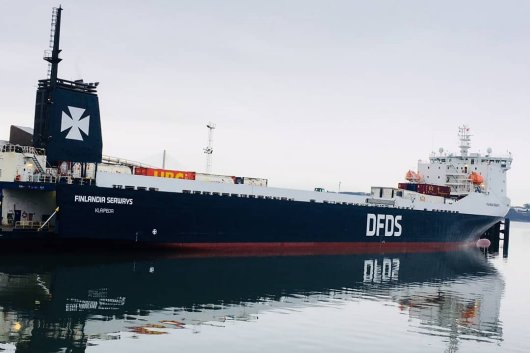
Finlandia Seaways - a DFDS vessel that was fitted with scrubber technology only a couple of years ago in an effort to reduce bunker costs on the Rosyth to Zeebrugge freight route.
"Following a review of evidence, the decision has been made to investigate the engine failure and subsequent fire on board the Lithuanian registered ro-ro cargo vessel, Finlandia Seaways, 11 miles east of Lowestoft, England on 16 April 2018. One crewman was injured," the MAIB said on Wednesday.
DFDS confirmed last month that the fire broke out in the engine room of the Finlandia Seaways at 22:13 hours on April 16 while it was on a voyage from Zeebrugge to Rosyth.
The ship was subsequently towed to DFDS's terminal in Immingham, where the cargo on board was discharged and DFDS carried out an inspection of the damaged vessel.
"The inspection revealed substantial damage to the ship's engine room, and we estimate that it will be out of service for several months for repairs," DFDS said last month.
Furthermore,
Kell Robdrup, Senior Vice President of DFDS routes connecting to the southern part of the North Sea, explained that the firm had been
unable to find a replacement vessel, and, as a result, the decision had been made to
close the route.
Referring to the fire, Robdrup said: "Unfortunately, this will bring about further losses on the route, and it means that
we have lost all hope of being able to turn around the route's loss-making situation. Therefore, we have no alternative but to close the route as we undoubtedly will lose clients who will be forced to seek alternative solutions for their transport."
Bunker-saving plan not enough
The decision to close the route followed a series of cost-cutting initiatives, which included
a 2015 agreement with Forth Ports to invest
EUR 6 million in scrubber technology and a fuel optimisation programme for the Finlandia Seaways, plus infrastructure adjustments at the Rosyth terminal to facilitate the double-stacking of containers on board the ro-ro cargo vessel.
The investment was designed to help secure the long-term sustainability of the route, with First Minister
Nicola Sturgeon stating at the time that "the Rosyth to Zeebrugge freight route is a vital link for Scotland's economy and hugely important for the large number of customers who use it to get their goods in and out of the country".
However, despite the investment, the route continued to make losses, and with the ship due to be out of service for several months as a result of the fire and a replacement vessel not possible, the idea of turning the route's fortunes around was described by Robdrup last month as being "unrealistic".
Financial results
On Wednesday, DFDS also announced that first-quarter (Q1) profit before tax rose year-on-year (YoY) by
18.1 percent to DKK 204 million ($32.5m).
Earnings before interest, taxes, depreciation, and amortization (EBITA) grew
9.5 percent to DKK 453m ($72.1m) compared to the prior-year period, whilst revenue was up
8.2 percent to DKK 3,485m ($554.7m).
Bunker consumption and costs in 2017
In its 2017 annual report, DFDS said total bunker costs rose by DKK 273.1m, or
27.3 percent, to DKK 1,300m (
$207m), up from DKK 999m the previous year.
Overall, fuel expenses made up
11 percent of the group's total costs last year.
In terms of bunker volume consumed, DFDS's fuel use increased by
4 percent in 2017, and although the actual amount consumed was not actually revealed in the document, DFDS had previously stated that the figure was expected to be around
480,000 tonnes. This year, fuel consumption is forecast to be approximately
500,000 tonnes.
At the time of the 2017 report's publication,
20 percent of bunkers consumed on passenger routes was financially hedged.