Fri 4 May 2018, 00:45 GMT

Finnlines orders three hybrid ro-ro ships with scrubbers


Vessels are to use fossil fuel whilst sailing and electricity when in port.


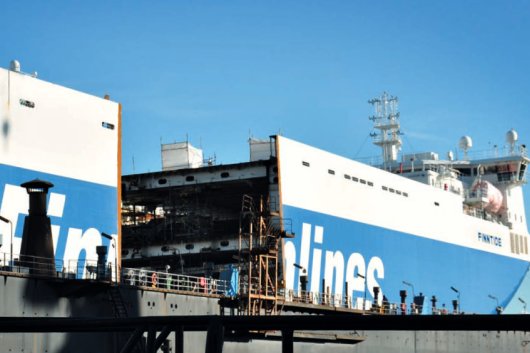
The Finntide was the first of Finnlines' Breeze-class ships to be lengthened at Remontowa shipyard in Gdansk.
Image credit: Finnlines
Finnlines has announced that it has signed an order for three bunker-saving ro-ro vessels that are to be fitted with emission abatement equipment.

The 238-metre-long ships are to be built at the Jinling shipyard in China, with delivery slated from 2020-2021. The total investment is expected to be more than EUR 200 million.

The design of the ships was carried out in cooperation with Nordic marine designer Knud E. Hansen.

According to Finnlines, the ships "will be among the most modern and environmentally friendly vessels in the Baltic". They are to be equipped with latest-generation engines that lower bunker consumption and CO2 emissions, and fitted with scrubbers to abate sulphur emissions and other particulate matter.

The ships will be hybrid ro-ro vessels that use fossil fuel whilst sailing and electricity while in port - hence guaranteeing zero emissions whilst in port.

They will be fitted with a lithium-ion battery bank that can be recharged during sailing and provide the electricity to the ship while at berth.

An air lubrication system under the keel will be used to create bubble layers that reduce friction and hydrodynamic resistance and consequently reduce fuel consumption and emissions as well.

Additionally, Finnlines says the energy efficiency of the ships will be optimised with the hull lines and propellers - including an advanced integrated propeller-rudder system.

Emanuele Grimaldi, CEO of Finnlines, remarked: "These green ro-ro vessels will be built taking all technological and environmental factors into account and thus will increase our energy efficiency further.

"These vessels will offer us the lowest possible fuel consumption and exhaust emissions and again, is in line with our investments in sustainable development.

"We are proud that these exceptional technologies on board will make the vessels the most innovative and efficient vessels in the world."


Truck-to-ship (TTS) LNG bunkering at Port of Palermo. Molgas completes first LNG bunkering operation at Palermo  

Spanish energy firm carries out maiden LNG delivery at Sicilian port.

Maersk 5,900-teu vessel. Tsuneishi China delivers third methanol dual-fuel boxship in series  

Zhoushan shipbuilder hands over another 5,900-teu Maersk container vessel.

Type approval test (TAT) for ME-LGIA ammonia engine. Everllence completes type approval test for ammonia engine ahead of sea trials  

Eight classification societies oversee testing of ME-LGIA ammonia engine at Copenhagen research centre.

Zhong Ran 23 vessel. CPN bunker barge becomes first vessel listed under Hong Kong’s new quality bunkering scheme  

Zhong Ran 23 achieves listing under the Marine Department’s voluntary mass flow metering initiative.

Peder Moller, Bunker Holding. Bunker Holding posts $73m pre-tax profit amid geopolitical headwinds and board overhaul  

Marine fuels exceeds its own expectations despite 4% revenue decline.

Oilmar Board of Directors graphic. Oilmar formalises governance structure with establishment of board of directors  

Dubai-based marine fuels trader Oilmar appoints three-member board.

Henrik Andersen, Vestas Wind Systems A/S. Vestas Wind Systems CEO appointed vice chair of Bunker Holding  

Henrik Andersen joins the board of the marine fuels group with more than two decades of international business experience.

Tina Revsbech, Maersk Tankers. Maersk Tankers CEO Tina Revsbech joins Bunker Holding board  

Danish USTC Group appoints shipping veteran to subsidiary’s board of directors.

Yampu vessel. CSL delivers world’s first battery-powered self-unloading bulk carrier  

MV Yampu will transport limestone for Adbri in Australia, with full electric operation targeted by 2031.

Illustration of hydrogen fuel cell system. NYK, Yanmar and Eneos to install hydrogen fuel cell system on new Tokyo dining cruise vessel  

Three Japanese companies are collaborating to bring hydrogen propulsion to a dining cruise ship due to enter service in 2027.