Thu 17 Nov 2016, 07:01 GMT

Aegean posts 55% jump in Q3 net income


Sales volumes rose by 25.8% to 4.26 million tonnes during the third quarter.


Aegean Marine Petroleum Network Inc. reports that net income attributable to shareholders for the third quarter rose by $3.754 million, or 55.2 percent, to $10.551 million, up from $6.797 million during the corresponding period in 2015.

For the first nine months of the year, net income increased by $9.677 million, or 37.0 percent, to $35.846 million, up from the previous year's figure of $26.169 million.

Between July and September, net income attributable to Aegean shareholders adjusted for the sale of non-core vessels and accelerated shares was $17.7 million, or $0.36 per basic and diluted share, which is an increase of $5.6 million, or 46.3 percent, compared to the same period in 2015.

Gross profit, which equals total revenue less directly attributable cost of revenue, rose by 4.7 percent to $88.44 million in the third quarter of 2016 compared to $84.4 million during the same period in 2015. For the first nine months of 2016, however, total revenue was down $424.27 million, or 12.8 percent to $2.88 billion.

Sales

Aegean reported a total revenue of $1.139 billion for the third quarter of 2016, which is an increase of 5.4 percent compared to the same period in 2015. This was said to be primarily due to the moderate increase in oil prices. Voyage and other revenues were $21.2 million, consistent with the same period in 2015.

For the three months ended 30th September, Aegean's marine fuel sales volumes increased by 25.8 percent to 4,258,954 metric tonnes, up from 3,386,511 tonnes last year.

Between January and September, Aegean sold 12,564,379 tonnes of marine fuel compared to 9,452,911 tonnes in the prior-year period, representing an increase of 3,111,468 tonnes, or 32.9 percent.

Operational metrics

For the third quarter, Aegean reported a gross spread per metric tonne of marine fuel sold - calculated by subtracting from the sales of the respective marine petroleum product the cost of the respective marine petroleum product sold and cargo transportation costs - of $18.6. The gross spread per metric tonne of marine fuel sold in the prior-year period was $21.6.

Aegean's adjusted EBITDA per metric ton of marine fuel sold was $8.84 during the third quarter compared to $9.29 per metric ton in 2015.

Comments

Commenting on the results, E. Nikolas Tavlarios, Aegean's President, said: "We delivered another quarter of solid results against a backdrop of slowness in the container segment and volatile commodity markets. Despite these headwinds, we continue to achieve profitability and strong volumes with our fourth consecutive quarter of selling more than 4 million metric tons of bunker fuel. Our diversified platform, recent expansion in new attractive markets and our back-to-back trading businesses contributed to our growth during the quarter."

Tavlarios added: "Aegean has transformed into a diversified business with operations around the world and we look forward to additional opportunities ahead. We are proud of what we have created and our ability to serve more customers across our global footprint as a leader in the physical supply and marketing of marine fuel. We remain committed to executing our strategic initiatives and leveraging our scale to drive growth and shareholder value."

Spyros Gianniotis, Aegean's Chief Financial Officer, remarked: "In addition to our strong operational performance, we are taking action to enhance efficiency through the sale of 5 non-core vessels year to date, including two in the third quarter, which will reduce operating costs by $9.5 million annually. We will continue to evaluate our markets and redeploy capital to opportunities we believe will generate the best return. During the quarter we strengthened our financial flexibility with the renewal of our $1 billion credit facility on improved terms."


Christiania Energy headquarters. Christiania Energy relocates headquarters within Odense Harbour  

Bunker firm moves to larger waterfront office to accommodate growing team and collaboration needs.

AiP award ceremony for 20K LNGBV design. HD Hyundai Heavy Industries receives design approval for 20,000-cbm LNG bunkering vessel  

Bureau Veritas grants approval in principle following joint development project with South Korean shipbuilder.

Lloyd’s Register technical committee meeting in Spain. Peninsula outlines dual role in FuelEU Maritime compliance at Lloyd’s Register panel  

Marine fuel supplier discusses challenges for shipowners and opportunities for suppliers under new regulation.

Current status of fleet fuel types chart. LNG-fuelled container ships dominate January alternative-fuel vessel orders  

Container ships accounted for 16 of 20 alternative-fuelled vessels ordered in January, DNV reports.

Rick Boom, CIMAC and Professor Lynn Loo, GCMD. GCMD and CIMAC sign partnership to advance alternative marine fuel readiness  

Two-year agreement aims to bridge operational experience with technical standards for decarbonisation solutions.

Renewable and low-carbon methanol project pipeline chart as of January 2026. Renewable methanol project pipeline reaches 58.2m tonnes by 2031, GENA reports  

Project Navigator Methanol tracks 275 projects, including e-methanol, biomethanol and low-carbon methanol facilities globally.

Petrobras logo. Petrobras adjusts bunker pricing and minimum order volumes at Santos  

Brazilian supplier discontinues volume discount tier and lowers minimum order quantity from 1 March.

Viking Grace vessel. Viking Line secures biogas supply for 2026 after tenfold increase in biofuel use  

Åland-based ferry operator aims to maintain 50% biogas blend throughout the year on two vessels.

GNV Aurora vessel. GNV takes delivery of second LNG-powered vessel Aurora from Chinese shipyard  

Vessel to enter service on Genoa–Palermo route in April, completing first fleet renewal phase.

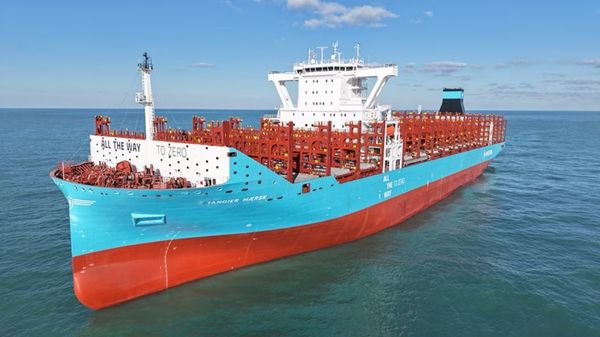
Tangier Maersk vessel. Maersk takes delivery of first methanol-capable vessel in 9,000-teu series  

Tangier Maersk is the first of six mid-size container ships with methanol-capable dual-fuel engines.