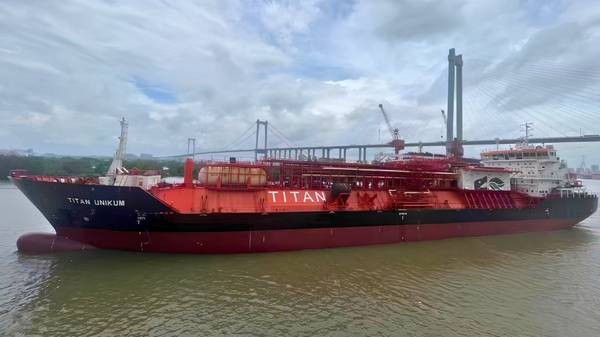
Titan LNG, a leading supplier of LNG to the marine and industrial markets in northwest Europe, says it has developed a new solution for the delivery of LNG to both sea-going and river barges in ports in the ARA (Amsterdam - Rotterdam - Antwerp) region, Europe's largest bunkering hub.
Following a process of research and development, and based on its knowledge and experience in the bunkering and LNG sectors, Titan LNG has designed and developed what is said to be the first LNG bunkering pontoon in North West Europe, the
Titan LNG Flex-Fueler.
The solution is designed to have a fixed location to supply inland waterway vessels, but also be navigated to larger sea-going vessels and supply LNG while they load or unload their cargo. As a result, the Flex-Fueler is said to minimize costs and maximizes operational efficiencies, while unlocking access to safe and quick LNG delivery in the key ARA region.
Titan LNG Flex-Fueler is currently more economical than conventional LNG bunker barge delivery due to its low operational and capital expenditure (CAPEX and OPEX) requirements, Titan LNG says.
Niels den Nijs, Commercial Director, Titan LNG, remarked: "It is critical that LNG bunkering infrastructure is developed to facilitate the efficient, cost effective, and safe delivery of LNG to both large and small LNG-fuelled vessels. Currently, truck-to-ship delivery provides the most flexibility, and is the only means of receiving LNG bunkers in the ARA region. However, there is an increase in larger LNG-fuelled vessels coming into the market, which cannot bunker at land-based LNG stations, as the deviation costs are too high or is simply not an option due to draft restrictions. The feedback that we have received from customers, ports and class societies has convinced us that Titan LNG Flex-Fueler is the missing link to safe, economical and speedy LNG delivery in the ARA region.
"The Titan LNG Flex-Fueler can act as a catalyst for a substantial increase in demand for LNG conversion - with current retrofitting costs decreasing as tanks and cryogenic equipment become cheaper due to economies of scale. We are working with other industry stakeholders, including ports, ship owners and operators as well as class to further develop the design and classification of the Titan LNG Flex-Fueler bunkering pontoon in advance of its official launch in Q1 2018."
Titan LNG Flex-Fueler boasts a double bottom, double hull with a length of 70 metres and will be fitted with up to four tanks, each with a capacity of 300 cubic metres (cbm). Two cranes will be used for flexible hose guidance, and the discharge capacity range is between 30 and 450 cbm of LNG per hour. Titan LNG Flex-Fueler is capable of loading and unloading via ex-wharf, ex-truck and ex-vessel.
The shipping industry is seeing an increase in demand for LNG and bunkering infrastructure in line with MARPOL Annex VI regulations that stipulates the requirement to burn clean fuel (with a sulphur content of less than 0.1%) in Emission Control Areas (ECAs). A global 0.5% sulphur limit could be implemented as early as 2020.
"With the price of crude predicted to rise to $55 per barrel from mid-2017, the return on investment (ROI) in switching to LNG is reduced to less than five years. The ROI will further accelerate as the global 0.5% sulphur limit is implemented in 2020, in conjunction with crude prices climbing to between $60 and $80 per barrel. This will act as a catalyst for a substantial increase in demand for LNG conversion, as new build and retrofitting costs are decreasing," Titan LNG explained.