Tue 11 Aug 2015, 10:27 GMT

Advisory service deal for FSRU construction


Vessel is to be adapted for handling small-scale LNG vessels for Gazprom's future LNG bunkering business.


Gazprom Marketing & Trading (GM&T) and OOO Gazprom Flot have signed an agreement to provide technical and commercial advisory services during the construction of a Floating Storage and Regasification Unit (FSRU). Both companies are subsidiaries of PAO Gazprom.

The FSRU was ordered by Gazprom earlier this year and is due to be built by Hyundai Heavy Industries (HHI) in Ulsan, South Korea. It is scheduled to be delivered in November 2017 and used to supply natural gas to the Kaliningrad Region of Russia.

According to Gazprom, the FSRU "will combine excellent LNG storage (max capacity 174,100 cbm) and natural gas processing (max sendout 500 mmscf/day) capabilities with superior sea-going (speed up to 19.5 knots), energy efficiency (BOR below 0.09%/day) and ice (Arc 4 ice class from the Russian Maritime Register of Shipping) characteristics, which will enable the FSRU's flexible utilisation as a regasification plant, an LNG shuttle or a conventional LNG carrier depending on the energy security situation in the Kaliningrad Region."

In addition, the FSRU will be adapted for handling small-scale LNG vessels for Gazprom's future LNG bunkering business in the Baltic Sea. It also includes expanded accommodation and specialised equipment for shipboard and LNG handling training of cadets from the Russian maritime universities.

GM&T's Shipping unit provided technical and commercial advisory to Gazprom during the development of the FSRU's technical specifications and the negotiation of the shipbuilding contract with HHI. Now it will be providing technical expertise and supervising the full cycle of the shipbuilding process, including the detailed design, construction, commissioning and delivery of FSRU. It will also provide advice on the selection of technology, with a specific emphasis on LNG ship-to-ship transfers, ice and cold temperature operations and small-scale LNG solutions.

Nikolai Grigoriev, Global Director of Shipping, GM&T remarked: "This project builds upon the strong technical expertise of GM&T in LNG and ice class shipbuilding and operations. We are extremely proud to support Gazprom, our parent company, and to be involved in the construction of the world's first ice-class FSRU with such advanced technical characteristics, and of such importance for Russia."

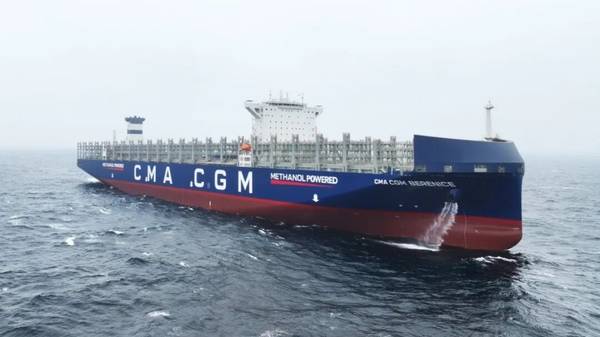
China flag. Zhejiang’s first methanol-powered container ship launches in Jiaxing  

Vessel uses methanol propulsion technology to reduce carbon dioxide emissions by 90%.

TES flag with a model vessel in the background. TES joins SEA-LNG coalition to advance e-methane as marine fuel  

Green energy company targets 1m tonnes annual e-methane production by 2030 for shipping decarbonisation.

Ethanol and methanol workshop graphic. IBIA to host workshop on ethanol and methanol marine fuels during Singapore Maritime Week  

Half-day event will examine alcohol-based fuel pathways and integration into shipping’s multi-fuel landscape.

Steel-cutting ceremony for 13,000-dwt vessel. ROC begins construction of second chemical tanker for Essberger  

Chinese shipbuilder holds steel-cutting ceremony for 13,000-dwt methanol-ready vessel with ice class capability.

Norsepower and CHIC sign agreement. Norsepower and Cosco Shipping Heavy Industry Equipment sign wind propulsion cooperation agreement  

Wind propulsion technology provider partners with Chinese shipyard to scale rotor sail production.

Wärtsilä logo. Shipping firms struggle to prioritise decarbonisation investments amid regulatory uncertainty, Wärtsilä survey finds  

Survey of 225 maritime executives reveals 70% say uncertainty hinders investment decisions despite regulatory pressure.

IMT Isca G-Flex vessel render. Longitude Engineering unveils IMT Isca G-Flex PSV design with alternative fuel capability  

Naval architecture firm launches adaptable platform support vessel design based on the IMT-984 G-Class hull.

Philippos Ioulianou, EmissionLink. Shore power infrastructure is key to cutting ferry emissions in European cities, says EmissionLink  

Port electrification is needed to enable vessels to switch off engines at berth, reducing urban pollution.

Maritime and Port Authority of Singapore logo. Singapore prioritises maritime resilience amid geopolitical uncertainty, eyes digitalisation and green fuels  

MPA chief outlines the sector’s adaptation to supply chain disruptions while advancing automation and alternative fuels.

Aerial photograph of Zhoushan Island. China exports first domestically blended biofuel for marine use from Zhoushan  

A vessel carries 2,600 tonnes of biofuel blend to Qingdao Port for international ship refuelling.