Fri 26 Jun 2015, 09:46 GMT

Construction of tanker with 'improved fuel efficiency' under way


Ship design is said to achieve improved fuel efficiency via a G-series MAN ME slow-speed main engine and an optimized hull form.


General Dynamics NASSCO, a wholly owned subsidiary of General Dynamics, has commenced construction of the second of three 50,000-deadweight-tonne, 330,000-barrel cargo capacity product tankers for SEA-Vista Newbuild III LLC, a subsidiary of SEACOR Holding Inc.

Each LNG-conversion ready product tanker is to be constructed at the NASSCO shipyard in San Diego.

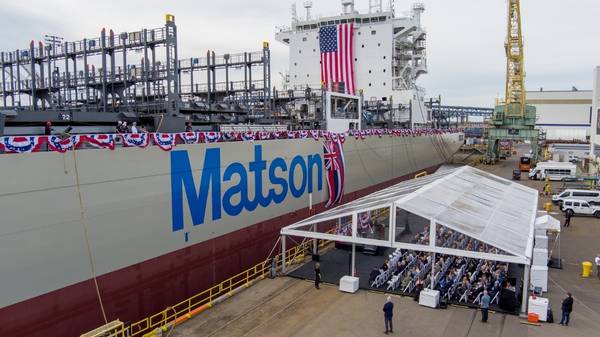
Representatives from General Dynamics NASSCO and SEA-Vista attended the start of construction ceremony held at the NASSCO shipyard on Thursday, June 25. The honoree, senior director for human resources at NASSCO, Debora Burke, signalled the beginning of construction by pressing a button to cut the first piece of steel.

"We are pleased to begin construction on the second state-of-the-art Jones Act-qualified tanker for our customer, SEA-Vista," said General Dynamics NASSCO vice president and general manager Kevin Graney. "NASSCO remains committed to building the most economical and environmentally-sound products for Jones Act owners and operators - and these tankers exemplify that commitment."

These new 610-foot-long vessels are a continuation of the ECO MR Tanker design, offering improved fuel efficiency and incorporating the latest environmental protection features, including a ballast water treatment system and reduced emissions.

The tankers were designed by DSEC Co Ltd, a subsidiary of South Korea's Daewoo Shipbuilding & Marine Engineering (DSME).

DSEC's ECO design is said to achieve improved fuel efficiency through several features, including a G-series MAN ME slow-speed main engine and an optimized hull form.

The tankers will have conversion-capable, dual-fuel-capable auxiliary engines and the ability to accommodate the future installation of an LNG fuel-gas system and tanks.

"Each of these tankers will play a key role in offering SEA-Vista's customers the most modern and fuel efficient vessels available as they address their Jones Act transportation requirements for the movement of their current and projected crude oil and refined product volumes in the U.S.," General Dynamics said.

The Jones Act is a U.S. federal statute that provides for the promotion and maintenance of the American merchant marine. Amongst other purposes, the law regulates maritime commerce in U.S. waters and between U.S. ports and it requires that ships carrying cargo between U.S. ports be built in U.S. shipyards.


Ubuntu Humanity alongside Fuelng Bellina vessel. DNV says existing LNG infrastructure can support low-GHG methane transition  

Classification society finds biomethane and e-methane compatible with current LNG fleet and bunkering networks.

IBIA bunker buyers working group graphic. IBIA launches Bunker Buyers Working Group for fuel procurement end users  

New forum aims to represent shipowners, charterers and ship managers in policy and regulatory discussions.

Carbon registry process diagram. MOL and Shell launch book-and-claim scheme for marine biofuel emissions credits  

Japanese shipping firm partners with Shell to offer environmental attribute certificates from third-party vessel operations.

Renewable Energy Directive (RED III) policy brief cover. Bureau Veritas releases report on EU Renewable Energy Directive’s impact on shipping  

Classification society examines RED III compliance challenges as member states transpose the directive into national law.

New York City skyline. IBIA to hold 2026 annual convention in New York  

The event marks the first time in recent years that the association’s gathering has been held in the Americas.

Port of Barcelona delegates. Port of Barcelona advances shore power rollout for cruise terminals  

Installation of OPS systems begins at MSC and Royal Caribbean terminals as port reorganises infrastructure.

NACKS bulk carriers with rotor sails. Anemoi and NACKS secure ClassNK approval for Ultramax rotor sail designs  

Two configurations for wind-assisted propulsion systems on bulk carriers receive approval in principle.

DP World London vessel. Elbdeich Reederei takes delivery of first methanol-capable feeder vessel  

German shipowner receives 1,250-teu dual-fuel newbuild from Chinese yard, with three more to follow.

AuctionConnect and Asyad Shipping logos. Asyad Shipping adopts AuctionConnect digital bunker platform under three-year deal  

Middle East shipping company to implement auction-based procurement system across fleet operations.

Fuel for thought: LNG for Cruise report cover. LNG remains the most deployable decarbonisation option for cruise shipping, Lloyd’s Register report finds  

Classification society’s latest research examines the fuel’s role in the sector’s energy transition and pathway to net zero.