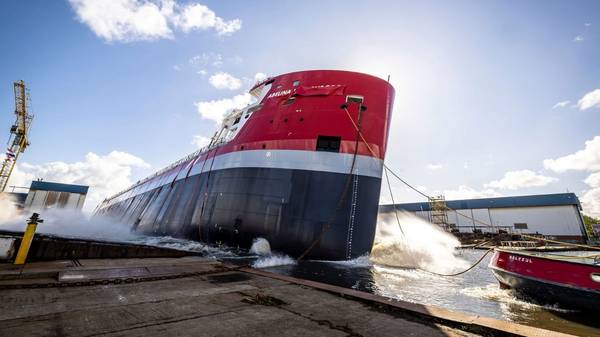
On April 18, General Dynamics NASSCO launched the
Isla Bella, the world's first LNG-powered containership. More than 3,400 shipbuilders, their families, and others attended the event at the San Diego-based shipyard.
The containership, part of a two-ship contract signed in December 2012, was built for logistics and transportation company
TOTE.
In a statement, NASSCO said: "When delivered, the ships will be the cleanest of their kind and size - anywhere in the world," The Isla Bella was also NASSCO's 100th vessel launch.
U.S. Representative Duncan D. Hunter was the principal speaker. The ship's sponsor, Mrs. Sophie Sacco - wife of Michael Sacco, president of the Seafarers International Union of North America, AFL-CIO - christened the ship with a traditional champagne bottle break over the ship's hull. General Paul J. Selva, Commander of the U.S. Transportation Command, also spoke at the event.
The ship's name, Isla Bella, was unveiled during the ceremony.
"The launch of the Isla Bella signals a very significant milestone for the thousands of men and women at NASSCO. Not only does it commemorate NASSCO's 100th ship launch, it validates NASSCO's capability to break new ground in green ship technology and lead in the design, construction and conversion of ships to take advantage of the economic and environmental benefits of LNG," said
Fred Harris, president of General Dynamics NASSCO.
The 764-foot-long Marlin class containerships will be the largest dry cargo ships of any kind in the world powered by LNG.
"This ground-breaking green ship technology will dramatically decrease emissions while increasing fuel efficiency as compared to conventionally powered ships. The ships will also include a ballast water treatment system, making them the greenest ships of their size anywhere in the world," NASSCO said.
Upon delivery in late 2015, the Jones Act-qualified ships are to operate between Jacksonville, Florida, and San Juan, Puerto Rico.
In addition to its government construction business, which over the past decade has delivered 16 ships to the U.S. Navy, NASSCO maintains an extensive history of commercial shipbuilding. In the past decade, NASSCO delivered eleven commercial ships and currently has ten commercial ships under contract, including the two Marlin Class containerships for TOTE.
For its commercial work, NASSCO partners with South Korean shipbuilding power, DSME, for access to state-of-the-art ship design and shipbuilding technology.