Tue 22 Jul 2014, 13:35 GMT

ICS calls for harmonised port state control in ECAs


Association is concerned that governments are not prepared to implement new regulations in a uniform manner, in order to prevent a 'potentially serious' market distortion.


Source: The International Chamber of Shipping (ICS)

The International Chamber of Shipping (ICS) is encouraging the Paris Memorandum of Understanding on Port State Control to ensure that a harmonised approach to PSC inspections has been developed in advance of the 1 January 2015 deadline with respect to the implementation of the 0.1% Sulphur Emission Control Areas (ECAs), established in accordance with MARPOL Annex VI.

ICS has underlined the shipping industry’s commitment to full compliance with the IMO sulphur ECA requirements from January 2015. However, ICS is concerned that information collected by its member national ship owners’ associations suggests that many governments are not yet prepared to implement the requirements in a uniform manner, in order to ensure the prevention of a potentially serious market distortion.

ICS Secretary General, Peter Hinchliffe explained: “The shipping industry is investing billions of dollars in order to ensure compliance with this major regulatory change, and the huge costs involved could have a profound impact on the future structure of the entire shipping industry. We therefore think it is vital that governments get the details of any PSC intervention right as we enter a new world in which fuel costs for many ships will increase overnight by 50% or more.”

He added: “There is only six months to go and it is vital that the Paris MOU and its Member States – in co-ordination, as may be appropriate, with the United States and the European Commission – clarify all of the details of ECA implementation with respect to PSC inspection as soon as possible. ICS believes it is important for the maintenance of fair competition that implementation occurs throughout the Paris MOU region in a consistent and harmonised manner.”

ICS has just written to the Paris MOU in order to draw attention to the global shipping industry’s serious concern with respect to the sulphur ECA implementation. With the exception of the United States, all of those coastal nations that are located within the IMO sulphur ECAs (in North America, the North Sea and the Baltic) are party to the Paris MOU.

ICS has raised a number of PSC inspection issues with respect to MARPOL Annex VI on which ICS believes it is vital that a harmonized approach is developed and agreed by the Paris MOU in advance of the implementation date. These issues include:

Whether – as ICS believes should be the case – the principal method of inspection will only involve looking at the bunker delivery note (BDN), with further sampling/analysis of fuel only normally taking place when examination of the BDN suggests clear grounds to suspect non-compliance, or when there is a previous history of non-compliance with MARPOL Annex VI;

The procedures to be followed, with reference to applicable IMO Guidelines, in the event that sampling or analysis is undertaken during PSC inspections;

The procedures that might be followed with respect to ships that transit an ECA without calling at a Port State located within an ECA;

The extent to which a consistent approach will be shown with respect to any discretion for minor technical violations (e.g. those that might arise from fuel switching when a vessel enters an ECA) as opposed to deliberate use of the wrong grade of fuel, or with respect to any discretion that might be applied for a limited period after January 2015;

And the criteria to be applied during PSC inspections with respect to alternative compliance measures such as Exhaust Gas Cleaning Systems (‘scrubbers’) or LNG.

Issues with respect to scrubbers that ICS believes require a harmonised approach include the acceptability of ‘closed loop’ and ‘open loop’ systems, and the extent to which overboard discharges will be subject to inspection by reference to the relevant IMO Guidelines.

It is hoped that the Paris MOU will give serious consideration to the issues raised by ICS at the next meeting of its Management Advisory Board, in order to provide clarity.

Image: Peter Hinchliffe, Secretary General of the International Chamber of Shipping (ICS) and its sister organisation, the International Shipping Federation (ISF).


Washington State Hybrid-Electric 160-Auto Ferry vessel render. Corvus Energy to supply battery systems for Washington State Ferries hybrid vessels  

ABB selects Corvus for two new 160-vehicle ferries as part of $3.98bn electrification plan.

Vinssen and Mana Engineering sign MoU. Vinssen, Mana Engineering partner on hydrogen fuel cell retrofit for 800-teu feeder vessel  

South Korean and Dutch firms to pursue Lloyd’s Register approval for hybrid retrofit concept.

Hercules Elisabeth vessel. Hercules Tanker Management takes delivery of second Ultra-Spec vessel in China  

Hercules Elisabeth is the second of 10 hybrid-ready tankers designed for alternative fuels.

Wolf 1 vessel. Petrol Ofisi launches fuel supply tanker Wolf 1  

Turkish bunker supplier adds 1,750-dwt vessel with alternative fuel infrastructure to fleet.

BIMCO meeting. BIMCO to convene for adoption of biofuel clause and ETS provisions at February meeting  

Documentary Committee to consider new contractual frameworks for alternative fuels and emission trading scheme compliance.

Sea Change II vessel render. Incat Crowther and Switch Maritime develop 150-passenger hydrogen ferry for New York  

Design work begins on 28-metre vessel with 720 kg hydrogen capacity and 25-knot speed.

Aerial view of a container vessel. HIF Global signs heads of agreement with German eFuel One for 100,000 tonnes of e-methanol annually  

Deal covers supply from HIF’s Uruguay project, with e-methanol meeting EU RED III standards.

Welcoming of Kota Odyssey at Jordan’s Aqaba Container Terminal. PIL’s LNG-powered vessel makes maiden call at Jordan’s Aqaba port  

Kota Odyssey is Pacific International Lines’ first LNG-fuelled ship to call at the Red Sea port.

Celsius vessel. RMK Marine to equip Celsius LNG bunker vessel with gas combustion unit  

Turkish shipbuilder adds specialised equipment to support cool-down and gassing-up operations for LNG vessels.

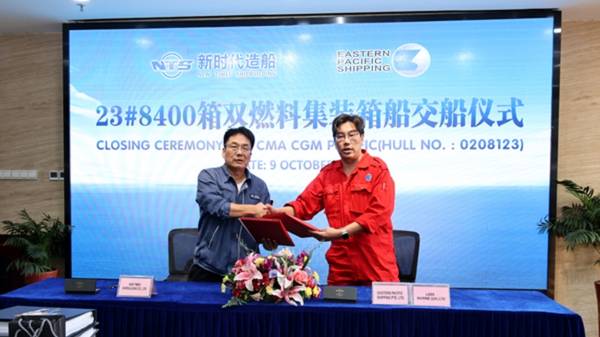
CSL and CMA CGM contract signing. Cochin Shipyard signs contract with CMA CGM for six LNG-fuelled container vessels  

Indian shipbuilder to construct vessels for French shipping company.