Thu 27 Mar 2014, 13:06 GMT

Construction of Gdansk oil terminal under way


Polish terminal to store petroleum products and chemicals. Project is expected to be completed in 2018.


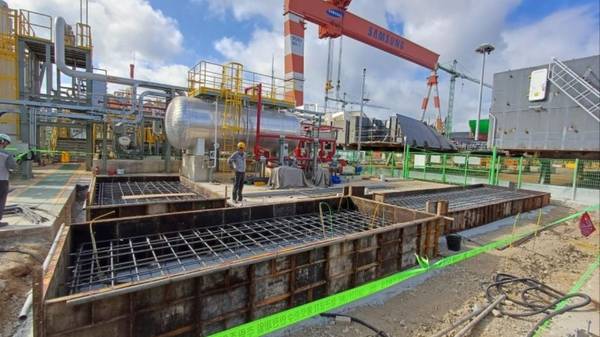
Construction work is under way to build a crude oil terminal at the port of Gdansk. The project is being managed by petroleum logistics firm PERN "Przyjazn" S.A..

A ceremony to mark the occasion was attended by the Prime Minister of Poland, Donald Tusk. During the event, the Prime Minister said that the development of an infrastructure in Gdansk promotes the energy security of Poland.

"I am very pleased that we have witnessed a process of diversification of energy supply in Poland. We try to achieve diversity and self-sufficiency of energy sector, adapt it to the needs of the 21st century," said Tusk.

"It is the first investment of this kind in Poland and one of 16 similar ones implemented all over the world. Owing to the terminal, Poland will join a group of countries which deal with international trade in crude oil, fuels and chemical products. It is a chance to improve the competitiveness of the Polish economy and for flexible solutions in case of a shortage of fuels on the market," commented Chancellor of the Exchequer, Włodzimierz Karpiński.

Last month, PERN announced the approval of its plan to construct a crude oil terminal in Gdansk. The building permit was signed by the governor of Pomerania on January 24, allowing PERN to start construction and assembly works.

The project is scheduled to be implemented in two stages. The first stage includes the development of six tanks for crude oil with a capacity of 62,500 cubic metres (cbm) each (375,000 cbm in total) as well as their necessary accompanying infrastructure. Its completion will make it possible to handle, store and provide other services dedicated to crude oil.

The second stage involves the construction of tanks with a capacity of 325,000 cbm for storing petroleum products, chemicals, aviation fuel JET-A as well as bio-components added to fuels. A railway siding and a road tanker station are due to be built at the same time.

"It is a very important decision not only for this undertaking but also for the future of crude oil and petroleum products logistics in our country. It is also a very good signal that the first sea hub in Poland, technologically complex and advanced, will be developed according to the schedule," remarked Marcin Moskalewicz, President of the Board of PERN.

Phase I of the crude terminal project is being developed by an international consortium whose leader is Warszaw-headquartered engineering and construction company IDS-BUD Sp. z o.o.. The cost of the project is estimated at 415 million zlotys (approximately US$ 137 million). It is expected to be operational at the end of 2015.

The terminal's design was prepared by engineering company Gazoprojekt. The entire undertaking is expected to be completed in 2018.


American Bureau of Shipping (ABS) logo. ABS introduces nuclear-ready notation for marine and offshore assets  

The classification society has released what it describes as an industry-first notation to support future nuclear conversion of vessels and offshore assets.

AiP handover ceremony for NEXTGEN Energy Hub (NGEH) design. ABS grants approval in principle for Seatrium’s NEXTGEN Energy Hub design  

The hub concept integrates ammonia bunkering, power generation and electric vessel charging in a single unit.

Jumbo Maritime crew aboard vessel. Jumbo orders two methanol-ready L-Class heavy lift vessels from Dajin Heavy Industry  

Dutch heavy lift specialist Jumbo signs newbuilding contract for two 25,000-dwt vessels.

China flag. Zhoushan completes first bonded bunker operation at Majishan port area  

The operation marks full fuel supply coverage across all general cargo terminals in Zhoushan's port system.

US dollar banknotes. Port of Long Beach launches $1m methanol bunkering challenge for oceangoing vessels  

A $1m prize aims to kick-start commercial methanol bunkering at one of North America's busiest ports.

Core Power, Athlos Energy, Deon Policy Institute and ABS logos. Greece floating nuclear study finds no fundamental barriers to implementation  

A PESTLE assessment of floating nuclear power plants in Greece identifies framework gaps, not feasibility barriers.

Northern Pathliner alongside Bergen LNG vessel. Molgas completes LNG cool-down and bunkering for Northern Pathliner at Northern Lights terminal in Norway  

Operation carried out at Øygarden facility, with K Line and Integr8 Fuels in the supply chain.

Rendering of a G2 Ocean OHGC vessel. G2 Ocean expands fleet with six future-fuel ready gantry crane vessels  

Open hatch specialist adds vessels and jet sail technology as part of a broad fleet renewal programme.

CMA CGM Adventure vessel at Port of Mombasa. LNG-powered CMA CGM Adventure makes first call at the Port of Mombasa  

Kenya Ports Authority receives its first large LNG-fuelled container vessel.

Liam Blackmore, Lloyd's Register. Maritime trio shapes IMO safety guidelines for ammonia as marine fuel  

Real-world operational experience feeds directly into new IMO ammonia fuel safety framework.