Wärtsilä has announced that it is to supply its Wärtsilä
X92 main engine for a series of four Post Panamax 9000 TEU container ships to be built for the
Ciner Group, based in Istanbul, Turkey. There is also an option for a fifth vessel.
Each vessel will be powered by an 8-cylinder Wärtsilä X92 engine. The ships will be built at
Hanjin Heavy Industries & Construction (HHIC) shipyard's facilities in Subic Bay, the
Philippines.
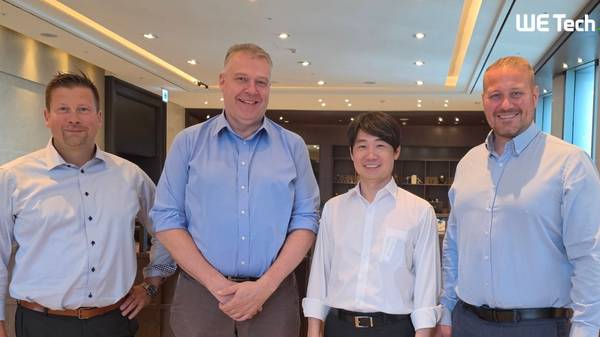
The contract was signed at the offices of the Ciner Group in Turkey on December 9 by
Vassilis Papakalodoukas, CEO of Ciner Shipping Industry & Trading Inc., and
Martin Wernli, Managing Director of Wärtsilä Switzerland and Vice President, Wärtsilä Ship Power, 2-stroke.
According to Wärtsilä, the choice of the X92 engine was based on its particularly high efficiency and environmental performance. The engine features Wärtsilä's electronically controlled common-rail technology, which through its flexible fuel injection and exhaust valve operations, is said to enable a reduction in fuel costs. Other advantages of this technology are said to include stable running speeds down to 12 percent of the nominal speed, smokeless operation, and improved control of exhaust emissions.
"The 9000 TEU container ships that have recently been contracted with HHIC, and which are being powered by Wärtsilä X92 engines, incorporate one of the most fuel efficient and environmentally advanced container ship designs available on the market today. We are proud to be in a position to be operating such ECO-type container ships, which will contribute to the well-being of our society and our charterers," said Vassilis Papakalodoukas.
"The Wärtsilä Generation X series of electronically controlled low-speed, two-stroke engines is absolutely in line with the current and future needs of the marine sector. The Wärtsilä X92 is designed to provide the reliability and lower operating costs that the industry now demands. Container vessels are a vital element within the transportation infrastructure, and environmental issues and fuel economy are likely to be the key drivers in maintaining the role of container transportation. Wärtsilä's competence in these areas has given it a leading position as a systems provider for extended ship power solutions in the large and ultra-large container vessel segment," commented Martin Wernli.
"The common-rail fuel injection technology and tuning philosophy of the Wärtsilä X92 engine makes it possible to align the performance to specifically match the operating profile of the vessels," Wärtsilä added.
Wärtsilä Generation X engines
Wärtsilä launched its Generation X series of engines in May 2011 with two mid-sized engines, the Wärtsilä X62 and Wärtsilä X72. As early as 2009, two engines were introduced that later were renamed the Wärtsilä X35 and the Wärtsilä X40. In 2012, the Generation X series was expanded with the Wärtsilä X82, and in the same year with the Wärtsilä X92 two-stroke diesel engine to serve the market for large and ultra large container ships of 8000 TEU and above.
The Wärtsilä X92 engine has a cylinder bore of 920 mm and provides a power output of 25,860 to 70,200 kW. It is available in 6 to 12 cylinder configurations. The Wärtsilä X92 is fully compliant with IMO Tier II requirements. It can also be equipped with an SCR catalyst to meet IMO Tier III NOx emission levels, and a scrubber to reduce SOx emissions to 0.1 percent - even with high sulphur fuels.
The introduction of the EEDI index also puts an emphasis on CO2 emissions and total vessel efficiency. "The internal engine efficiency of the Wärtsilä X92, and the possibility to apply various Power Take-Off (PTO) arrangements for onboard electricity production, make it easy for shipyards to meet these new requirements," Wärtsilä said.