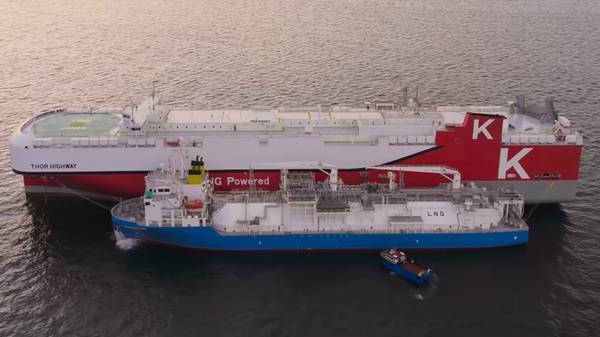
In the marine industry, liquefied natural gas (LNG) as a fuel is still sometimes mentioned as a novel technology, even though platform supply vessels have long been using it. The world’s first LNG-powered supply vessel, the
Viking Energy [pictured], hit the waves in April 2003. The Statoil-chartered vessel has been delivering supplies to oil and gas platforms in the North Sea ever since.
There is no denying that the Viking Energy was well ahead of its time. When Norway’s
Eidesvik Offshore ASA began planning a new platform supply vessel with Wärtsilä Ship Design, there was intense focus on sustainability and minimizing exhaust gas emissions.
Terje Nordtun, Team Leader, System Engineering at Wärtsilä, says that the design process was longer than usual. The design team was heading into uncharted waters with this project.
"Getting the design concept approved by
DNV and the
Norwegian Maritime Directorate took extra time, because the rules for ships powered by LNG were not in place yet. In fact, they were developed during the process." The new ship was built by
Kleven Verft in Norway.
Double your pleasure
In the end, the Viking Energy was fitted with four 6-cylinder Wärtsilä 32DF dual-fuel engines, meaning that the engines can also use diesel oil as a backup fuel. This adds fuel flexibility into the mix. The switch between fuels is conducted automatically, without any loss of power. The safe operation of the vessel is ensured at all times.
When running in gas mode, the Viking Energy’s emissions of nitrogen oxides (NOX) are 85 % lower than in diesel operation. The dramatic reduction is possible because the Wärtsilä engines operate on the lean-burn principle: the mixture of air and gas in the cylinder contains more air than is needed for complete combustion. Lean combustion reduces peak temperatures, so the formation of NOX drops a great deal.
Sulphur oxide (SOX) emissions are completely eliminated because LNG contains no sulphur. And since natural gas contains less carbon per unit of energy than liquid fuels, emissions of CO2 are also lowered. Natural gas has no residuals, and the production of particulates is practically zero.
Gas all the way
Nordtun admits that, since the Viking Energy is a dual-fuel installation, he is constantly being asked how much it actually runs on gas. The answer is: almost all the time.
“Eidesvik tell us that the use of gas is close to 100 percent. Gas mode is the normal operational mode. The engines perform very well on gas during Dynamic Positioning operations and severe weather conditions in the North Sea.”
Diesel mode is only required during LNG refuelling or certain minor preventive maintenance operations.
Another strength of the Viking Energy is how smoothly she runs for a completely new system. In 10 years of operation not a single hour of technical off-hire has been caused by the gas system.
That’s no small feat, since the average running hours for each of the dual-fuel engines onboard is about 40,000 hours at the ten-year mark. The total running time for all four engines, then, is a staggering 160,000 hours without as much as a bump in the road.
Practically perfect
Terje Nordtun confirms that this sort of flawlessness is not something usually seen on new ship types.
“There were a few minor technical issues on the dual-fuel engines during the first couple of years but, as this is a multiengine installation, it did not interfere with the vessel’s operation.”
Her sister vessel, the
Stril Pioner, has also enjoyed a trouble-free decade. Launched a few months after the Viking Energy, the Stril Pioner is owned by
Simon Møkster Rederi.
When the scavenging air channels were inspected onboard the Viking Energy, it was noted how clean the air channel was. When engines run on gas, combustion is very clean with little soot formation.
"Clean combustion has a positive impact on maintenance of the engine cylinder liners/covers. The maintenance interval can be longer than for liquid fuel operation."
LNG catching on
With such a successful technology, it is no wonder that orders for LNG-powered supply vessels have started piling up. However, there was a wait-and-see period after the Viking Energy and the Stril Pioneer. It took five years for the
Viking Queen (2008) to be launched, followed by the
Viking Lady (2009) and the
Skandi Gamma (2011).
The breakthrough year for LNG was 2012, with as many as four dual-fuel supply vessels starting operations: the
Normand Arctic, the
Viking Prince, the
Olympic Energy and the
Viking Princess. All in all, this means that Wärtsilä has amassed an impressive record: nine dual-fuel engine Platform Supply Vessels in nine years.
Waiting in the pipeline are eight more PSVs, five for
Harvey Gulf alone. In November 2012, when
Siem placed an order, the number of LNG-powered PSVs reached 19. Wärtsilä has supplied dual-fuel machinery for 17 of these.
"This means that so far we have delivered our dual-fuel solutions to 89% of LNG-powered PSVs. Wärtsilä really is the market leader," Nordtun says.
Minimising methane slip
Looking back at the first LNG decade for supply vessels, one thing that has greatly improved is managing methane slip. In 2003, when the Viking Energy was launched, methane slip was not yet on the agenda.
Created by gas engines that allow a small fraction of the fuel to go through unburned, methane slip is a grave concern. Unfortunately, the problem of methane slip is present in all Otto-cycle engines, both dual-fuel and spark-ignited. To combat this, Wärtsilä has executed a research and development programme that has shown good results. All the latest dual-fuel engines are now optimized to keep methane slip to an absolute minimum.
Other challenges have also been faced and overcome in the past ten years. Initially LNG vessels suffered from close to non-existent LNG bunkering infrastructure. Nordtun says that the winds of change are blowing now.
“There has been a significant rise in interest in LNG during the last 1-2 years. Infrastructure is picking up.”
Terminals are being built, and the supply of gas can also be organized with trucks and small-scale storage facilities. As the demand for LNG keeps growing, so will the infrastructure.
Get the total package
In addition to bunkering, onboard fuel storage and appropriate gas handling systems are needed. Wärtsilä has responded by creating its own
LNGPac system. This includes insulated LNG storage tanks for vessel, shore-to-ship bunkering connections, gas supply control valves, and an overall control system. A truly integrated solution – which includes the LNG storage system – is now available.
"In PSVs we have no LNGPac in operation yet, but we have sold the system for seven vessels," Nordtun says, adding that the first LNGPac was installed during the Bit Viking’s conversion in 2011.
The client,
Tarbit Shipping of Sweden, wanted to convert a product tanker to LNG propulsion, and to equip the ship with a Wärtsilä LNGPac system for the safe and convenient storage of LNG onboard.
The 25,000 dwt
Bit Viking is operated by Statoil along the Norwegian coastline. The converted vessel qualifies for lower emission taxes under the Norwegian government’s NOX fund scheme.
Previously, the Bit Viking featured twin-screw propulsion, with each screw powered by a 6-cylinder in-line Wärtsilä 46 engine running on heavy fuel oil (HFO). After the make-over, the ship runs on 6-cylinder in-line Wärtsilä 50DF dual-fuel engines that operate on LNG.
LNGPac ensures trouble-free storage of the gas onboard ship, as well as facilitating bunkering operations. The result: one of the safest and most environmentally friendly 25,000-tonne product tankers in the world.
Just warming up
Thanks to LNG fuel, carbon-based greenhouse gas emissions can be cut by at least 15% and nitrogen oxide emissions by 85%. Sulphur and particulate emissions are practically taken out of the equation altogether.
LNG-powered vessels – offshore vessels, LNG carriers or passenger ferries – are becoming a more common sight on the seas, with more than 200 ships already in the LNG armada. Wärtsilä predicts that this is just the tip of the iceberg. During the next ten years, LNG will find its way to a thousand new ships.
Platform supply vessels such as the Viking Energy have played their part in this evolution, and will continue to have a significant role, says Terje Nordtun.
"I see the 10th anniversary as an important milestone. The dual-fuel solution in PSVs has proven to be the right choice for operational flexibility, reliability and reduced exhaust gas emissions."
Source: Wärtsilä Corporation