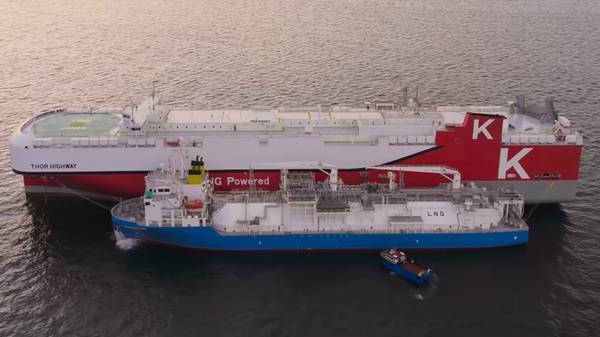
A barge powered by liquefied natural gas (LNG) was bunkered from a truck last week at the Port of
Antwerp. It was the first time that an LNG bunkering operation of this kind had ever been carried out at a Belgian port.
The barge in question, the
Argonon, operated by Dutch firm
Deen Shipping, was refuelled on Wednesday December 5.
Commenting on the landmark bunkering operation, the Port of Antwerp said: "This represents a further significant step towards more environment-friendly shipping in the port of Antwerp. Antwerp Port Authority continues to lend support to those seeking to switch to this more environment-friendly fuel, and so to make the logistics chain yet more sustainable."
"With the introduction of maximum levels for the sulphur content of bunker fuel and stricter standards for emissions by seagoing ships as well as barges, the use of LNG as an alternative to gasoil has been under consideration for some time now. However, such a step demands large efforts not only by ship owners but also by the port, as the necessary facilities have to be provided.
"As part of its sustainability policy, Antwerp Port Authority seeks not only to facilitate but also to encourage the use of LNG as a fuel for ships and barges. Indeed it has undertaken to make LNG available in the port in a safe, efficient manner, in the same way as is already done for conventional fuels. The target date for this is 2015, when the stricter IMO sulphur standards come into force.
Safe bunkering with LNG."
With a view to LNG bunkering, the Port Authority recently carried out a study to determine the safety parameters and procedures for truck-to-ship LNG transfers. It has also drawn up bunker checklists and guidelines for LNG bunkering operations in collaboration with the LNG workgroup of the World Ports Climate Initiative, for which Antwerp is acting as 'lead port'.
These guidelines and procedures form what Antwerp Port Authority refers to as 'the essential conditions' for safe, efficient transfer of LNG within the port area.
The port authority says it is also looking for suitable locations where the necessary facilities can be provided. An investigation was carried out into the possible effects on external safety in the port area and in the vicinity of waterways.
The conclusion of the investigation was that the use of LNG as a fuel would have a minimal impact on the safety of shipping traffic on the Western Scheldt (i.e. the lower Scheldt estuary) and that the use of LNG in the Western Scheldt area is able to offer a 'realistic and useful' alternative to conventional shipping fuel.
Earlier this year, Antwerp port community published its own Sustainability Report for the Antwerp port area, an achievement for which it was presented with the
Best Belgian Sustainability Award on December 4.
In order to read the report please visit: http://www.sustainableportofantwerp.com/en