This is a legacy page. Please click here to view the latest version.
Mon 4 Jun 2018, 14:34 GMT

Wartsila secures Wilhelmsen scrubber maintenance deal


Five-year accord includes annual audits and safety tests to ensure ongoing MARPOL compliance.


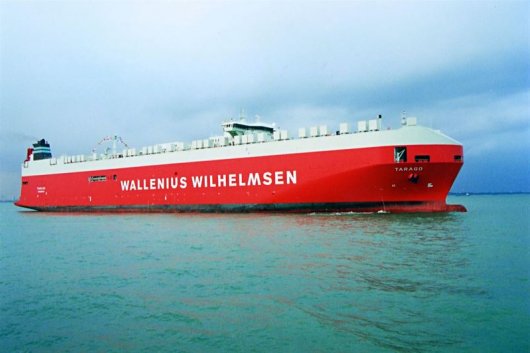
The Wilhelmsen Tarago is one of the three vessels with the 25 MW Wartsila Hybrid Scrubber System using seawater to remove SOx from the exhaust gas.
Image credit: Wartsila
Technology group Wartsila and Norway's Wilhelmsen Ship Management have signed a five-year agreement covering the maintenance of exhaust gas cleaning systems, or scrubbers, installed on three vessels managed by Wilhelmsen Ship Management.

The agreement is designed to ensure that the ships are fully MARPOL compliant and fulfil the International Maritime Organization's (IMO) stricter sulphur limits, due to come into force on January 1, 2020.

All three vessels have a 25MW Wartsila Hybrid Scrubber System installed, which is able to operate in both open and closed loop, using seawater to remove SOx from the exhaust gas. In closed-loop mode, additional reagent is used in combination with sea water.

The services covered under the agreement, signed in December 2017, include annual audits and safety tests to ensure ongoing MARPOL compliance, calibration of the Continuous Emission Monitoring System (CEMS) and water monitoring system as well as operational training courses for the vessels' crew.

"For Wilhelmsen Ship Management, operating sustainably and maintaining MARPOL compliance is absolutely crucial. This agreement with Wartsila ensures that we are doing it in a correct and documented way to fulfil authorities' requirements. Additionally, it allows us to perform long-term cost predictability and channel more focus into critical ship management operations," commented Jon Helge Ulstein, Vessel Manager at Wilhelmsen Ship Management.

"Wartsila's purpose is to enable sustainable societies with smart technologies. We want to build awareness of sustainability and provide solutions that help customers reduce or eliminate emissions. This agreement with Wilhelmsen Ship Management does exactly that by ensuring that the vessels comply with the strict sulphur limits set by IMO's standards. Additionally, the agreement provides Wilhelmsen Ship Management with predictability of the vessel maintenance costs," remarked Glenn Holid, Sales Manager at Wartsila Moss.

Wilhelmsen Ship Management is one of the world's largest third-party ship managers with a portfolio of more than 450 vessels. Wilhelmsen Ship Management manages the ships from five offices worldwide.


VPS: 2025 Marine Fuel Review. 2025 Marine Fuel Review | Steve Bee, VPS  

VPS Group Marketing & Strategic Projects Director analyses fuel quality data from the past year.

New Sea Generation (NSG) logo. New Sea Generation processing applicants for Greece bunker trader role  

Bunker firm offering a performance-based equity stake to experienced traders with active client portfolios.

Port of Barcelona. Spanish ports see fourfold increase in LNG bunkering volumes over two years  

Renewable bioLNG accounted for 12% of marine fuel supplied in 2025, Gasnam data shows.

ICS Deck Procedures Guide cover. ICS releases deck procedures guide covering alternative fuel bunkering  

Publication completes trilogy of operational guides alongside bridge and engine room resources.

Torbjörn Bäck, Echandia. Echandia to supply 3 MWh battery system for Singapore harbour tugboat  

Swedish firm wins contract as part of Singapore's plan to electrify harbour craft by 2030.

Golden Antares and Brave Pioneer methanol bunkering. Singapore completes first methanol bunkering operation following licence awards  

Golden Island delivers 300 tonnes of methanol to dual-fuel vessel in port’s inaugural operation.

MT SPA vessel. Union Maritime takes delivery of world’s first LNG- and wind-powered LR2 tanker  

MT SPA features dual-fuel capability and WindWings technology, with second sister vessel on order.

Petrobras and Transpetro signing ceremony. Petrobras and Transpetro order 41 vessels worth $470m for fleet renewal  

Brazilian state oil companies contract gas carriers, barges and pushboats from domestic shipyards.

European Commission headquarters. EU proposes phase-out of high-risk biofuels from renewable energy targets by 2030  

Draft regulation sets linear reduction trajectory starting in 2024, with contribution reaching zero by end of decade.

Vessel with H2SITE ammonia cracking system. H2SITE launches Norwegian subsidiary to advance ammonia-to-power technology for maritime sector  

Spanish technology firm establishes Bergen hub to accelerate deployment of ammonia cracking systems for shipping.


↑  Back to Top