Mon 24 Sep 2012, 10:08 GMT

Odfjell to reduce Rotterdam workforce by 35%


Terminal operator plans to cut staff numbers in Rotterdam.


Storage tank operator Odfjell is planning to reduce its Rotterdam workforce by 35%, according to Dutch media reports.

It is understood that the management informed members of staff regarding the job cuts on Friday 21 September.

According to the FNV general workers union Bondgenoten, the 300-strong workforce stopped work on the news and held a meeting in the staff canteen. It is claimed that the management had demanded secrecy on the job cuts and are now refusing to discuss redundancy terms.

Odfjell was forced to suspend operations in Rotterdam at the end of July for breaking environmental and safety rules. Government inspectors ordered tanks to be closed down because of the risk of leaks and the lack of proper safety measures.

Last week, Shell terminated its contract with the Norwegian firm for failing to meet its obligations. According to reports, Shell had contacted Odfjell at the beginning of August requesting that the safety concerns should be rectified within a month.

Odfjell Terminals (Rotterdam) BV is one of the largest independent tank storage terminals in Europe. It has been operational since 1957.

The tank farm consists of nearly 300 tanks, ranging in size from 735 to 40 000 cubic metres (cbm). The total capacity of the terminal encompasses more than 1.63 million cbm, of which approximately 33 000 cbm is stainless steel.

All tanks have dedicated tank lines to a pump station from where the tanks can be accessed by dedicated, product dedicated or multipurpose shore lines. Each tank is equipped with automatic gauging equipment.

The terminal has five jetties for deep-sea tankers, with a maximum depth of 39.6 ft alongside. There are seven positions for short-sea tankers, fourteen positions for barge activities and furthermore nineteen platforms for the handling of road tank trucks, iso-tank containers and rail tank cars.

For the handling of high-volume products per rail tank car, OTR has a block train facility (Rail Cargo Center) for both clean petroleum products and bulk liquid chemicals.

Image: Odfjell's storage terminal in Rotterdam


Aurora Botnia vessel. Gasum and Wasaline extend bio-LNG supply agreement to 2027  

Nordic energy company renews fuel supply contract with Finnish-Swedish ferry operator through 2027.

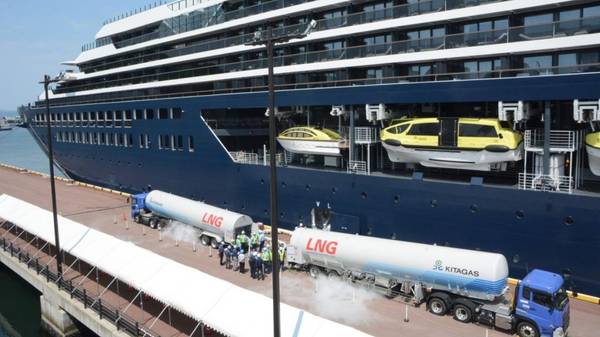
Luminara vessel truck-to-ship bunkering. MOL Techno-Trade completes Japan’s first truck-to-ship LNG bunkering for foreign cruise vessel  

Ritz-Carlton cruise ship Luminara refuelled at Nagasaki Port using truck-to-ship method on 3 April.

NKT Eleonora vessel cable-laying. Methanol-ready cable-laying vessel hull launched in Romania  

Shipbuilder floats hull of dual-fuel vessel designed for offshore renewable energy cable operations.

Dr Prapisala Thepsithar, GCMD. GCMD biofuels lead receives Singapore standardisation award  

Dr Prapisala Thepsithar recognised for contributions to marine biofuel specification development.

Marine Energy Wales (MEW) Conference 2026 graphic. Certas Energy to attend Marine Energy Wales conference in April  

Marine fuel supplier to discuss sector solutions at UK marine renewable energy conference.

Dinamo IV vessel. Sanmar completes sea trials for 14th all-electric tugboat  

Turkish shipyard marks half-century in business with latest battery-powered vessel from ElectRA series.

Gotland Horizon X render. Echandia to supply battery system for Gotlandsbolaget’s hybrid ferry  

Swedish battery supplier wins contract for new high-speed catamaran operating between Visby and Nynäshamn.

Suezmax crude oil tanker render. Guangzhou Shipyard secures Suezmax order, delivers vessels ahead of schedule  

China State Shipbuilding subsidiary reports nine vessel deliveries in the first quarter of 2026.

Clean ammonia project pipeline chart as of March 2026. Renewable ammonia pipeline grows despite Norway project freeze  

GENA Solutions tracks 325 projects totalling 146 MMT of capacity by 2034 despite execution challenges.

Antwerpen and Arlon naming ceremony. Exmar names world’s first ocean-going ammonia dual-fuel gas carriers in South Korea  

Two 46,000-cbm vessels can reduce CO₂ emissions by up to 90% during navigation.